

Amsterdam in 1500 – Caspar Commelin, 1693
€475
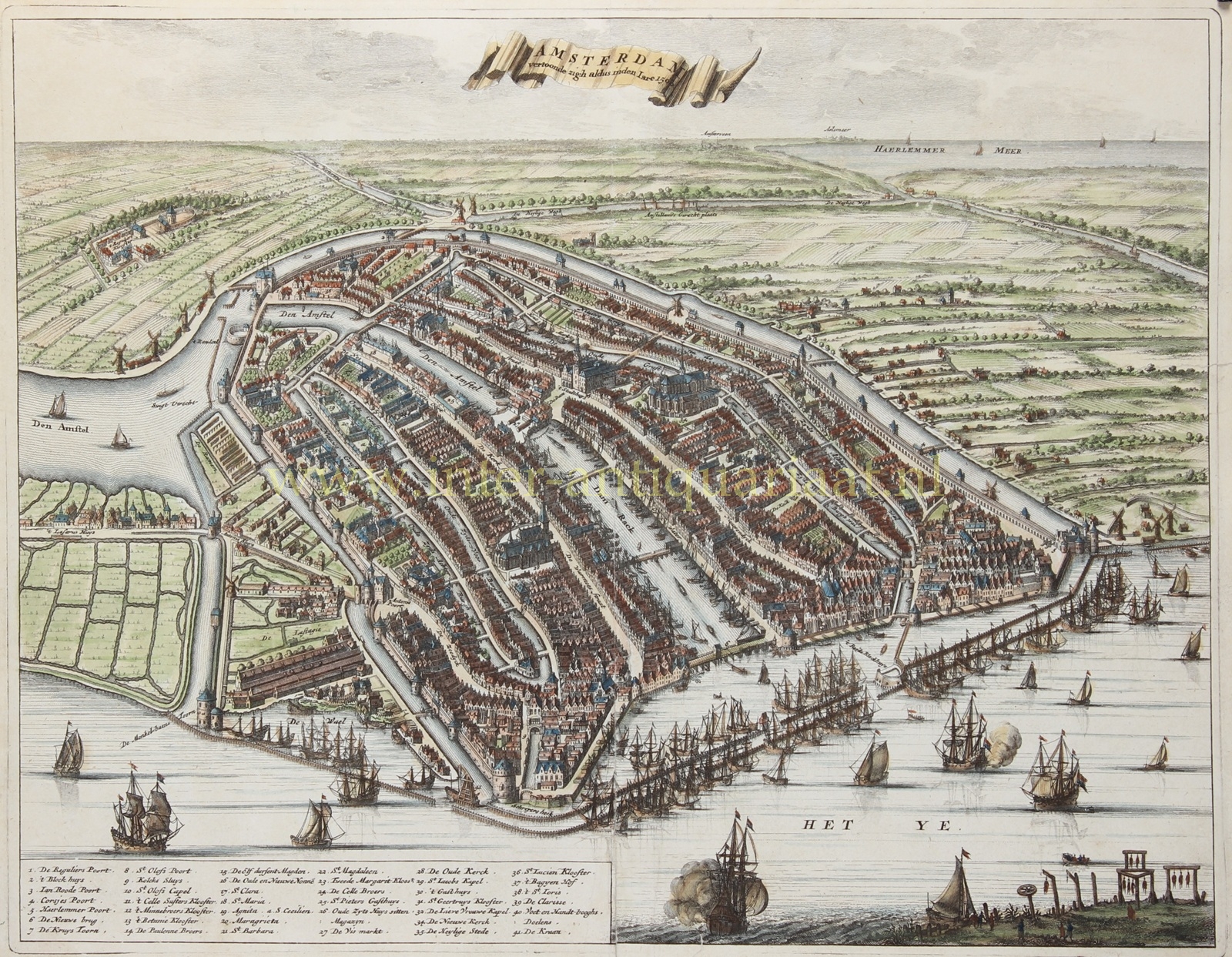


“Amsterdam vertoonde zigh aldus inden Iare 1500.” [Amsterdam appeared in this manner in the year 1500.] Copper engraving published in 1693 by Caspar Commelin as part of his “Beschryvinge van Amsterdam tot in den jare 1691.” Coloured by a later hand. Size: 24.5 × 26.5 cm.
Around the year 1500, Amsterdam was still a compact, walled trading town at the mouth of the Amstel River. Within its walls unfolded a dense network of canals, alleys, and monasteries — bounded on the west by the Singel and on the east by the Kloveniersburgwal and the Gelderse Kade. The Dam, with the town hall and the New Church, formed the heart of the city.
Out on the IJ, seagoing vessels from the Baltic, England, and the German Hanseatic cities lay at anchor — heavy cogs loaded with grain, timber, salt, and fish. On the open water the cargo was transshipped onto lighters and prams – flat bottomed barges – which could pass through the locks into the city and unload along the Damrak.
The Damrak at that time served as Amsterdam’s bustling inner harbour — a lively scene of market barges, river craft, and small trading boats, filled with goods, people, and noise. Here, grain from Danzig was weighed, herring from Enkhuizen traded, and beer from Hamburg stored in warehouses along the quays.
Beyond the city walls stretched the watery landscape of Amstelland, with polders, dikes, and windmills encircling the city like a carefully managed frontier. Around 1500, Amsterdam counted roughly 25,000 inhabitants, predominantly Catholic, and dotted with monasteries both inside and outside its gates.
This view captures the city on the eve of its great expansions of the sixteenth and seventeenth centuries — still medieval in scale and appearance, yet already showing the outlines of the maritime power it would soon become. On the IJ lie the ships that herald the city’s future: Amsterdam stood at the threshold of becoming the gateway to the world’s oceans.
To create this brird’s eye view, Commelin, in his history of the city, drew upon a painting by Cornelis Anthonisz from 1538.
Price: Euro 475,-