

Rotterdam – Lodovico Guicciardini, ca. 1617


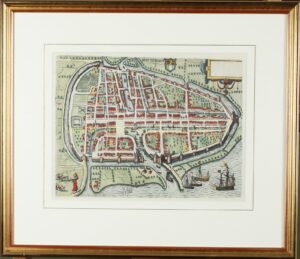
ROTTERDAM AS IT WAS, ALMOST 450 YEARS AGO
Copper engraving, published around 1617 by Lodovico Guicciardini as part of his “Beschryvinghe van alle de Nederlanden, anderssins ghenoemt Neder-Duystlandt” (“Description of all the Low Countries, otherwise called Lower Germany”). Coloured by a later hand. Plate size 24.7 × 33.2 cm (frame: 45 × 52 cm).
This plan shows Rotterdam at the beginning of the seventeenth century, still entirely enclosed by its medieval walls and moats. Within the ramparts unfolds a carefully ordered network of streets and broad canals, such as the Binnenrotte – the river from which the city originated – running from north to south through the centre. Along its banks stand rows of houses and warehouses with stepped gables; in the middle rises the imposing Laurenskerk, already the city’s most prominent landmark.
On the western side the town remains partly rural in character, with gardens, orchards, and the city bastion. The outer canals and bulwarks are clearly visible, with the main gates giving access to the city: the Delft Gate at the top, the Oude Hoofdpoort (Old Main Gate) below, and the East Gate to the right. Outside the walls cows graze in the meadows, while a milkmaid walks toward the city carrying her pail – a charming detail evoking everyday life.
The River Maas forms the lifeline of the city. The ships moored along the quay underscore Rotterdam’s growing importance as a trading and port city: during this period it developed into a key trans-shipment hub between Holland and the sea. The city wall forms a near-triangular circuit around the old core, with carefully rendered bastions, watchtowers, and gates.
This map offers a rare and vivid glimpse of Rotterdam before its great seventeenth-century expansions.
Lodovico Guicciardini (1521–1589) was an Italian merchant who lived in Antwerp. He was the first to give an extensive description of the Dutch Republic.
Although Guicciardini did not possess modern, scholarly historical knowledge, his “Beschryvinghe” lists countless details that must have fascinated contemporary travellers. He wrote with passion about economic and political affairs, painting, and even linguistic distinctions, but he remained silent about the wars then ravaging the Netherlands. The idyllic image he presents of “his” Low Countries, as he explicitly notes, is based on the political situation before 1560.
Price: SOLD