

Orange restoration in Amsterdam – Johan Christoffel Schultz, 1787
€1.350
ORANGE RESTORATION IN AMSTERDAM
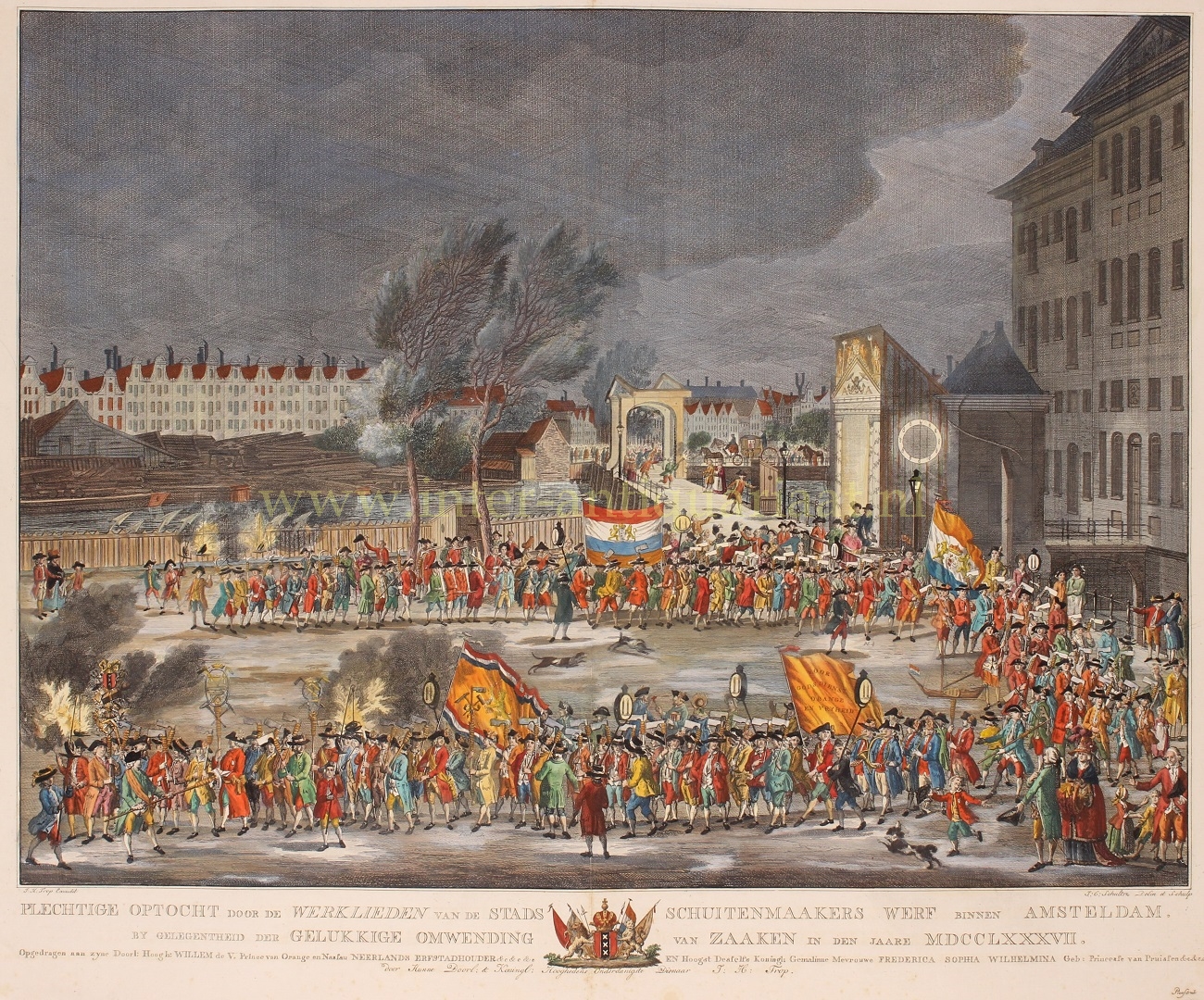
“Plechtige optocht door de werklieden van de stads schuitenmaakers werf binnen binnen Amsteldam by gelegenheid der gelukkige omwending van zaaken in den Jaare MDCCLXXXVII.” Copper engraving made in 1787 by Johan Christoffel Schultz. Coloured by a later hand. Size (including text): 51.5 × 62.7 cm.
At the end of the eighteenth century in The Netehrlands there was a sharp conflict between the Orangists, who wished to maintain the historic position of the House of Orange, and the Patriots. Amsterdam’s shipwrights were strongly Orangist. For meagre pay they often worked weeks of sixty hours or more. The labourers therefore placed their hopes in the Prince of Orange, since they had little to expect from the liberal wealthy shipowners and merchants.
In 1787 the workers rose in revolt against their Patriot employers. The day on which this unrest was violently suppressed became known as “Hatchet Day” (Bijltjesdag), named after the workers’ principal tool.
The authority of Stadtholder William V was weak. In September 1787 he was aided by his brother-in-law, the King of Prussia. With this so-called Orange Restoration, William V’s power as hereditary stadtholder of the Dutch Republic was restored and the Patriot period came to an end. This “reversal of affairs” is what the print celebrates. We see Kattenburgerplein, with the Admiralty’s “’s Lands Zeemagazijn” (today the National Maritime Museum) on the right and, in the background, the Kattenburger Bridge.
Price: Euro 1.350,-