

Amsterdam, Rembrandtplein – Petrus Schenk, ca. 1700
€2.950
REMBRANDTPLEIN AROUND 1700
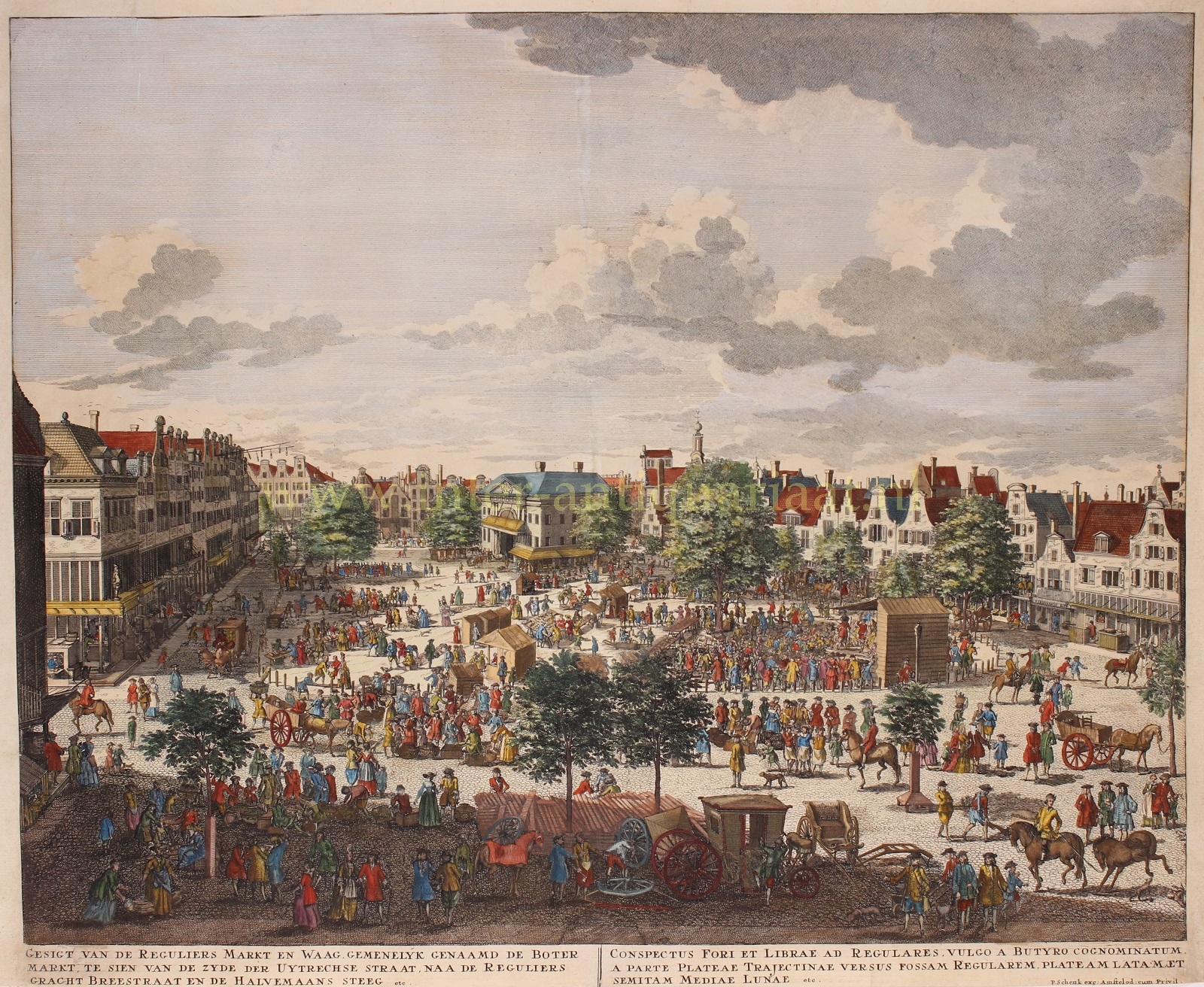
“Gesigt van de Reguliers Markt en Waag, gemenelyk genaamd de Boter markt, te sien van de zyde der Utrechse Straat, naa de Reguliers gracht Breestraat en de Halvemaanssteeg etc”. [“View of the Reguliers Market and Weigh House, commonly called the Butter Market, seen from the side of the Utrechtsestraat towards the Reguliers Canal, Breestraat, and Halvemaanssteeg.] Copper engraving published by Pieter Schenk Sr. around 1700. Coloured by a later hand. Size: 38.5 x 59.5 cm.
In 1655, the Third Reguliers Gate was built near the Reguliersbreestraat in Amsterdam, as part of the city’s fortifications. After the city’s expansion and the construction of the Utrecht Gate at what is now Frederiksplein, the Reguliers Gate became obsolete. In 1668, it was converted into a butter weigh house (Boterwaag), and the surrounding square was renamed Reguliersplein. A year later, in 1669, the Monday dairy market was relocated from Dam Square to this new site, which then came to be known as Botermarkt (“Butter Market”). At the corner where the Utrechtsestraat began, a space was set aside for the poultry market—Kippenhoek—where various birds were sold, though not permitted to be hawked from door to door.
Many traders who made their living on the market settled around the square. The most expensive plots were along the long northern and southern sides, while the shorter sides were more affordable.
After the ox market moved to the Utrechtseplein (now Frederiksplein), a proper carriage square near the Utrecht Gate was lacking. The Botermarkt filled that function, with carriage builders, stables, farriers, saddle makers, and not to forget, inns and taverns situated on or near the square. Every afternoon, a stagecoach departed from Amstelstraat towards Utrecht via the Gooi region.
Besides the weekly butter and cheese market (held three times a week), one of the city’s three annual fairs was also held here in September. These were far more than mere funfairs. Hundreds of stalls and attractions took over the square—and the city—for at least two, but often three weeks. The usual daily and weekly markets continued in between.
A popular fairground song captures the lively bustle:
“The Butter Market swarms,
Oh look how everyone throngs,
And bustles to and fro,
Young and old on the go.
There’s singing, there’s dancing,
While people drink a little something.”
After part of the Reguliersgracht was filled in 1785, the Thorbeckeplein was created. In the mid-19th century, a statue of Rembrandt was placed on the Botermarkt, and the square received its current name: Rembrandtplein.
Price: Euro 2.950,- (incl. frame)