

Steam Sugar Refinery Amsterdam – I.M. de Vries, 1880
€175
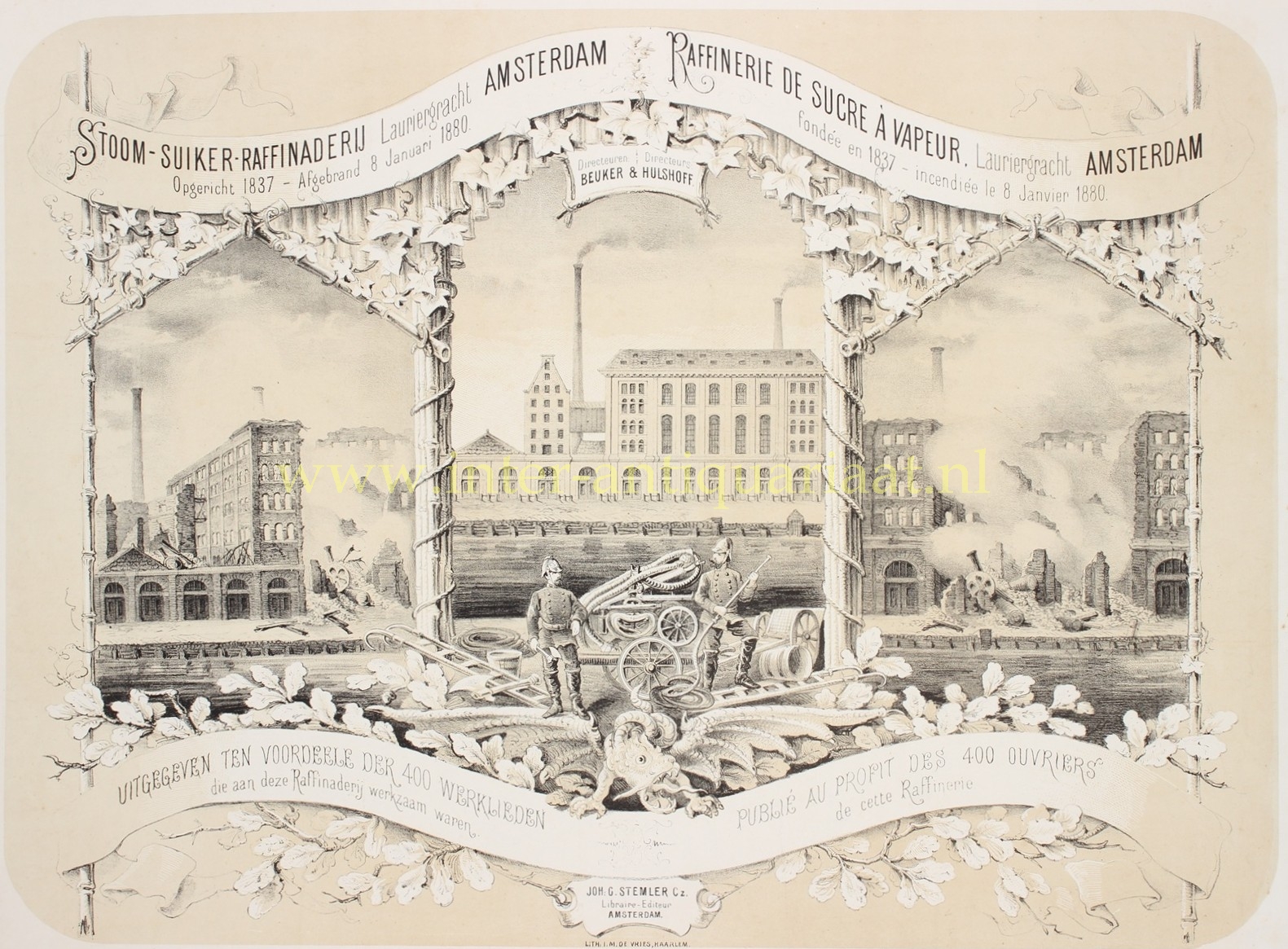
“Stoom-Suikerraffinaderij van Beuker & Hulshoff. Lauriergracht Amsterdam. Opgericht 1837 – afgebrand 8 januari 1880.” [Steam Sugar Refinery of Beuker & Hulshoff. Lauriergracht, Amsterdam. Founded 1837 – destroyed by fire 8 January 1880.] Tinted lithograph made by I.M. de Vries and published by Joh. G. Stemler Cz., “for the benefit of the 400 workers employed at this refinery.” Size: 40 × 55 cm.
Compared to cities such as Manchester, or even the early-industrialized regions of Belgium, Amsterdam did not experience an early, explosive Industrial Revolution. The city remained oriented for a long time toward trade, shipping, and colonial distribution. As a result, industrialization developed here more gradually and on a sector-by-sector basis, often building upon existing commercial networks.
The sugar industry is a prime example. Raw sugar from the colonies—particularly Suriname and Java—was refined in Amsterdam for the European market. Whereas this process had remained largely artisanal during the eighteenth century, the nineteenth century brought increasing mechanization and expansion in scale. The introduction of steam power enabled continuous production and led to larger, capital-intensive enterprises such as the Amsterdam steam sugar refineries.
The refinery on the Lauriergracht, founded in 1837, belongs to this first generation of industrial enterprises within the city. Its location is striking: not on a segregated industrial site, but embedded within the existing urban fabric of the canal belt. This was typical of Amsterdam, where industry long remained intertwined with residential and commercial functions. Only later in the nineteenth century did a clearer spatial separation emerge, for example with the development of the Eastern Docklands and the construction of the North Sea Canal (1876), which gave the city renewed economic momentum.
The presence of approximately 400 workers, as noted on the print, underscores the scale at which such enterprises operated by this time. At the same time, this commemorative print highlights the vulnerability of these industrial structures: fire was a real and recurring hazard, particularly in factories where heat, sugar syrup, and combustible materials were in constant use.
What makes this print particularly noteworthy is that it not only depicts an industrial enterprise, but also marks a moment in the social history of the city. A growing awareness of workers as a collective was a development that ran parallel to industrialization itself. In this sense, the print documents not only a factory and a disaster, but also the transition from a mercantile city to one in which industrial labor and social issues assumed an increasingly central role.
Price: Euro 175,-