

FRAAI GEZICHT OP NAGASAKI MET DEJIMA
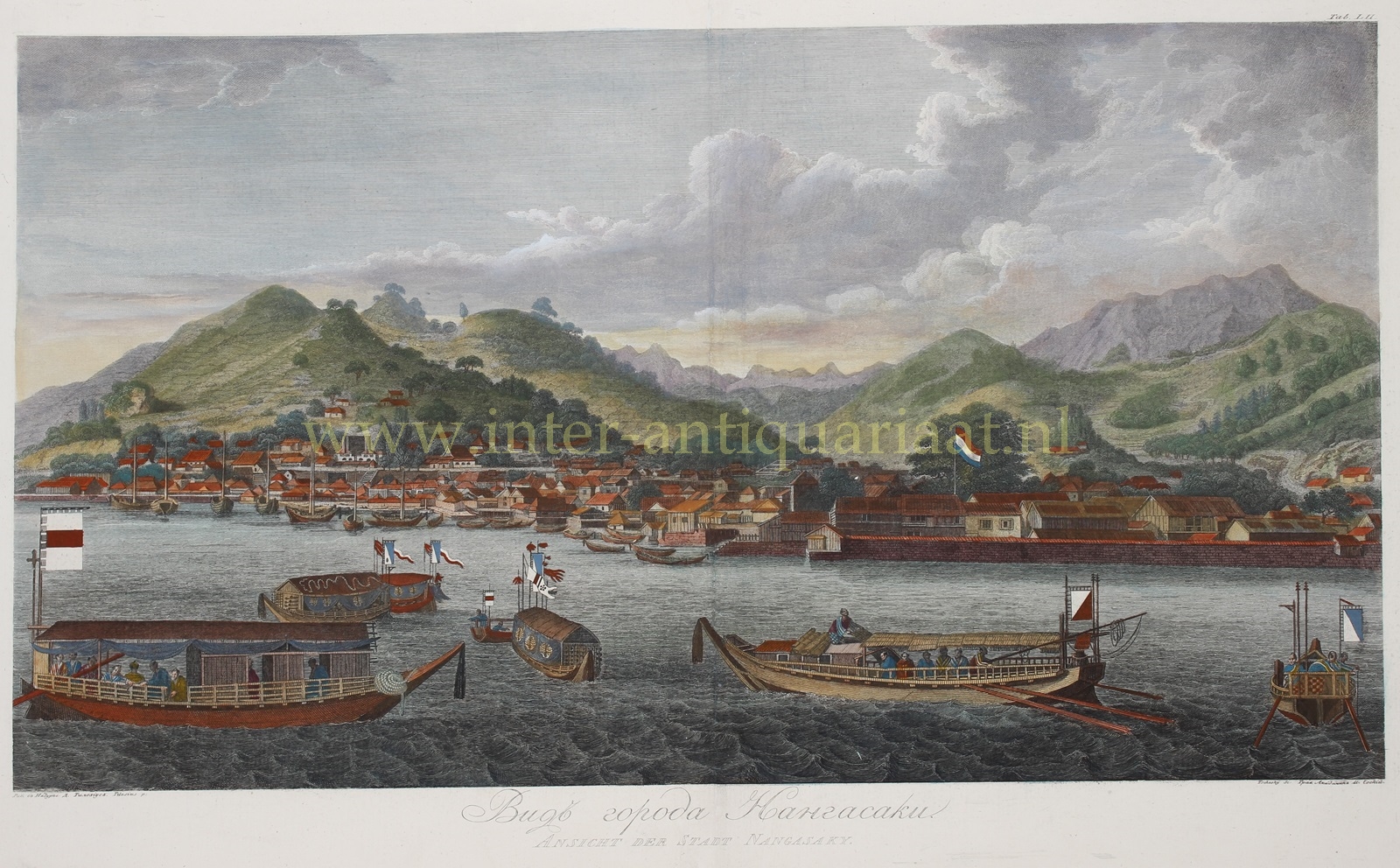
“Видъ города Нангасаки. | Ansicht der Stadt Nangasaky.” Kopergravure naar tekeningen gemaakt in 1804-1805 door Wilhelm Gottlieb Tilesius, verschenen in de atlas horende bij het verslag van de eerste Russische omzeiling van de wereld door de Baltisch Duitse admiraal Adam Johann von Krusenstern (Иван Федорович Крузенштерн). Uitgegeven in 1813. Later met de hand gekleurd. Afm. 35,2 x 63,2 cm.
Na de verdrijving van de Portugezen uit Japan mochten alleen Chinese en Nederlandse schepen naar Japan komen en was Nagasaki de enige haven die ze konden betreden. Dejima, een kunstmatig eiland in de haven van Nagasaki, werd in 1641 de factorij voor de Verenigde Oost-Indische Compagnie (V.O.C.) en vormde bijna twee eeuwen het enige contact van Japan met Europa.
Von Krusenstern had de opdracht van tsaar Alexander I om diplomatieke en economische betrekkingen aan te knopen tussen Rusland en Japan voor o.a. de handel in Russisch bont.
De expeditie van Von Krusenstern arriveerde in oktober 1804 in Nagasaki. Ze brachten talrijke geschenken mee, evenals de overlevenden van een Japanse schipbreuk in 1794 op de Russische Andreanov eilanden, in de hoop daarmee Japan te openen. De Japanners waren niet onder de indruk van de meeste geschenken, met uitzondering van een Engelse automatische klok in de vorm van een olifant en een Russische caleidoscoop. Het geschonken vossenbont, zeer gewaardeerd in Rusland, werd bijzonder slecht ontvangen, aangezien de Japanners het als onrein beschouwden. Het gedrag van de Russische ambassadeur was daarnaast ook niet bevorderlijk voor de onderhandelingen en uiteindelijk slaagden de Russen er niet in de gewenste betrekkingen op te bouwen.
Pas in 1858 werden andere buitenlanders dan Nederlands en Chinezen weer in Japan toegelaten.
We zien hier Nagasaki met het eiland Dejima vanaf een schip in de haven. Met enige afgunst moeten de Russen naar de factorij van de geprivilegieerde Nederlanders hebben gekeken.
Prijs: Euro 1.950,-