

Loenen aan de Vecht – Kornelis Kooten van Bloemswaard, 1726-1737
€7.950
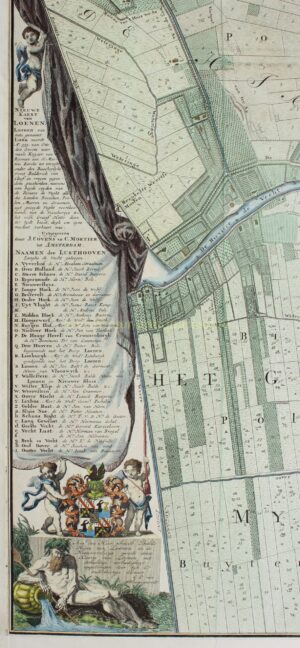
FINEST MAP OF LOENEN AAN DE VECHT
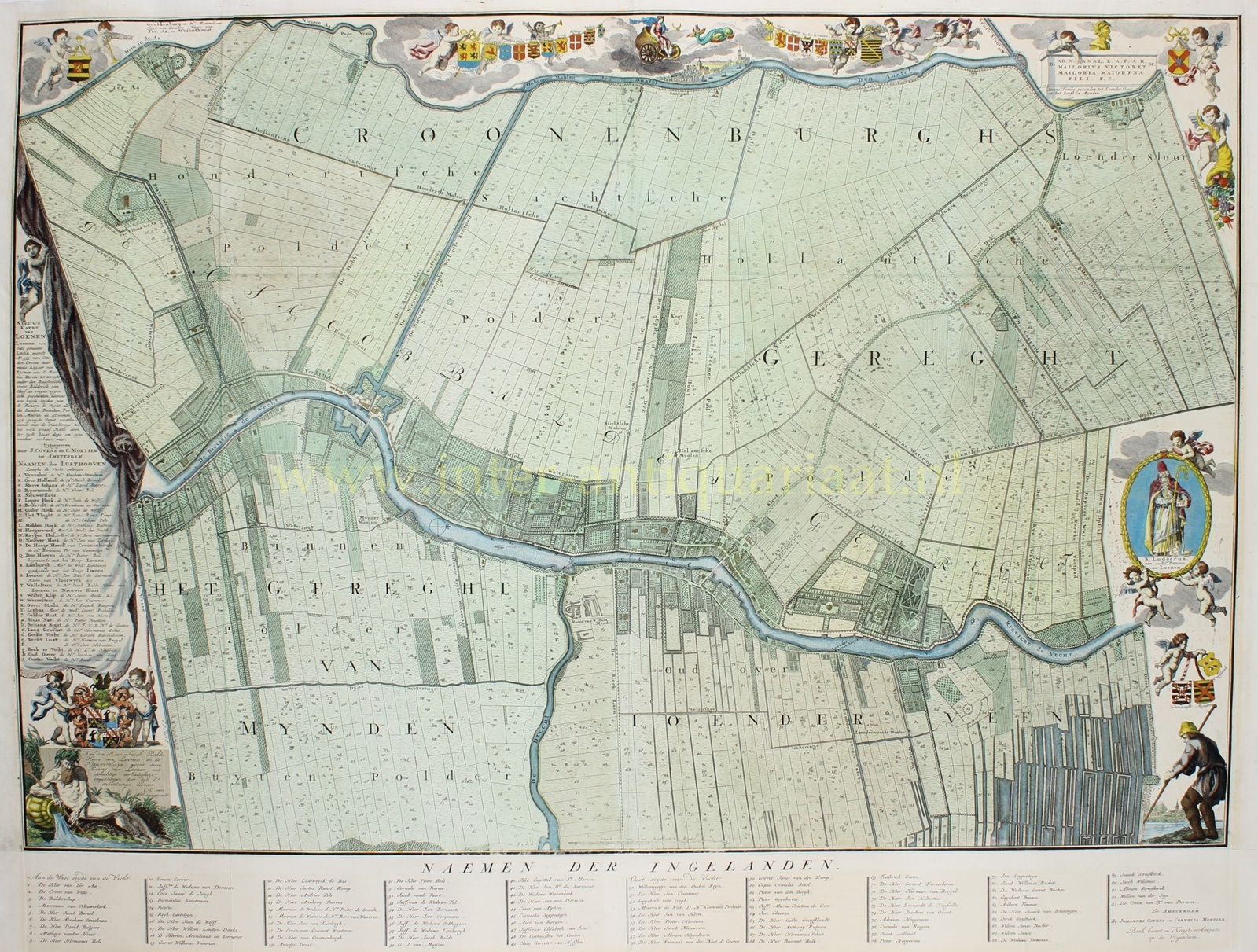
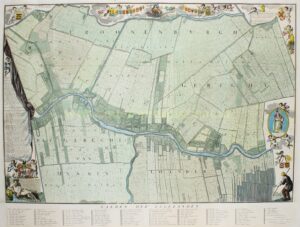
“Nieuwe kaert van Loenen” Copper engraving made by Kornelis Kooten van Bloemswaard, published by Johannes Covens & Cornelis Mortier in Amsterdam between 1726 and 1737. Original hand colouring with later additions. Size (map including name strip): 71 × 92 cm.
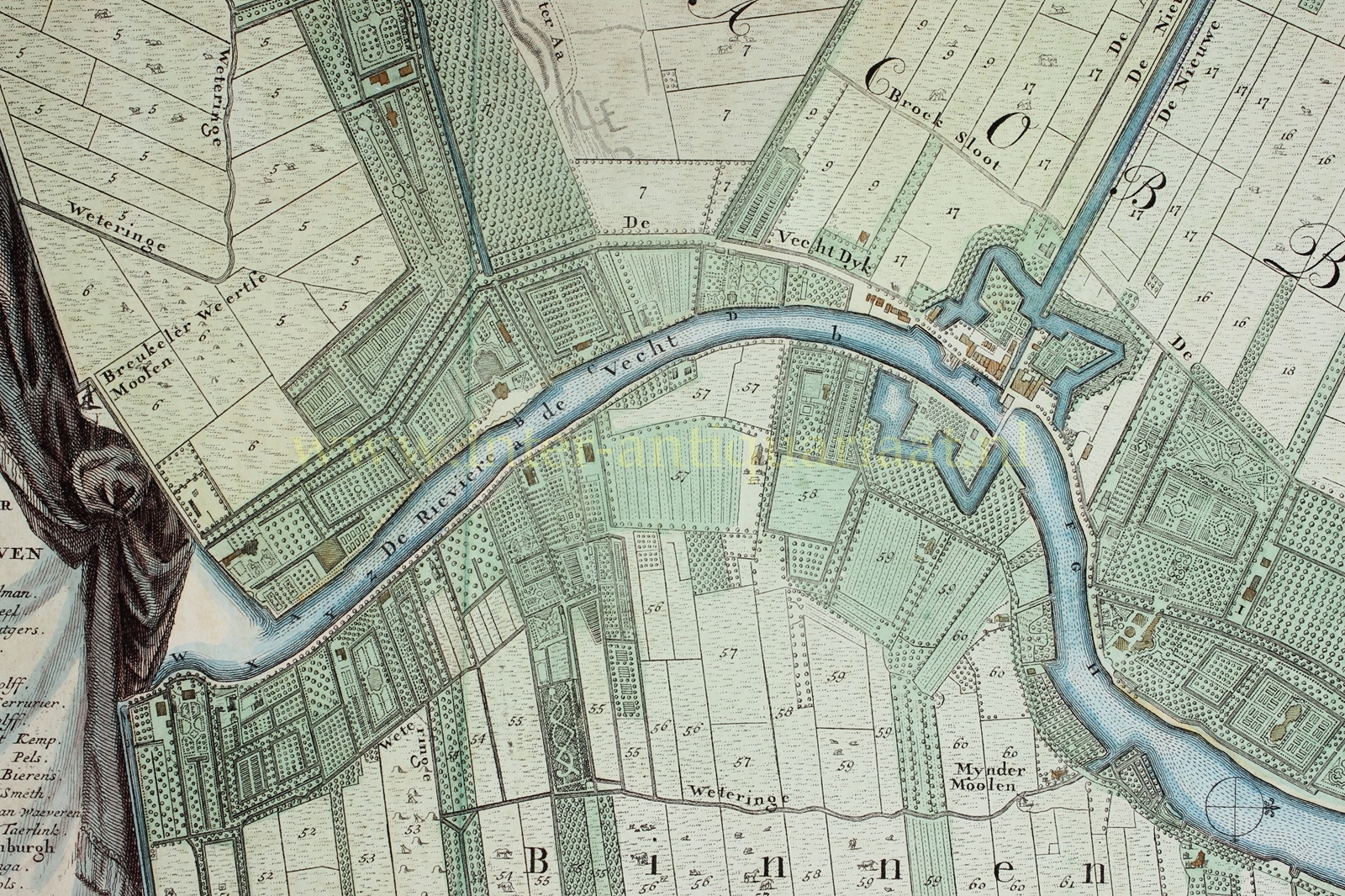
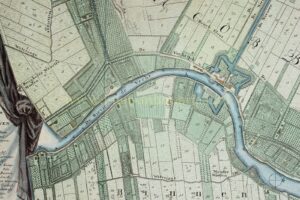
The greatest period of prosperity for the country estates along the river Vecht occurred in the eighteenth century. This superb map clearly depicts the situation of the Vecht estates between Breukelen and Vreeland, with Loenen at its centre. Dedicated to Jacob Balde, Lord of Loenen, the map not only provides an exceptionally accurate representation of the ground plans of the houses and gardens, but also maps with great precision the parcels of land on both sides of the Vecht—westward as far as the river Angstel and eastward to roughly halfway across the present-day Loosdrechtse Plassen.
The numbers within the parcels correspond to the owners’ names (“Naemen der Ingelanden”) listed in the strip at the bottom of the map. It is therefore not only a topographical map, but also a pre-cadastral one, demonstrating that much of the land was owned by urban residents. These owners belonged almost exclusively to the wealthy Amsterdam elite: Jacob Boreel, Lodewijk de Bas, Anthony Bierens, Andries Pels, the whaling merchant Jan van Tarelink, Maria Cristina de Geer, Gillis Graefflandt, Anthony Rutgers, among others—most of them proprietors of country estates along the Vecht. Their landholdings were often situated behind their residences.
Four numbers on the map indicate properties belonging to the Ridderschap (privincial nobility), the Vicarage, the Chapter of St Mary, and the “Carthusians of Cologne.” Of the 93 names listed, 48 are preceded by honorifics such as De Heer, Mevrouwe, Juffrouw de Weduwe, or Juffrouw. The remaining owners, without honorifics, were of lower social standing. Thus, more than half of the landowners in the vicinity of Loenen belonged to the urban aristocracy, and the map also shows that together they owned well over half of the land.
Land use is indicated by cattle and haystacks, hatching (arable land), and small trees (possibly utility woodland) drawn within the parcels. In contrast stand the geometrically laid-out ornamental gardens of the country estates along the Vecht. Buildings not belonging to estate complexes, such as farmhouses, are shown in elevation.
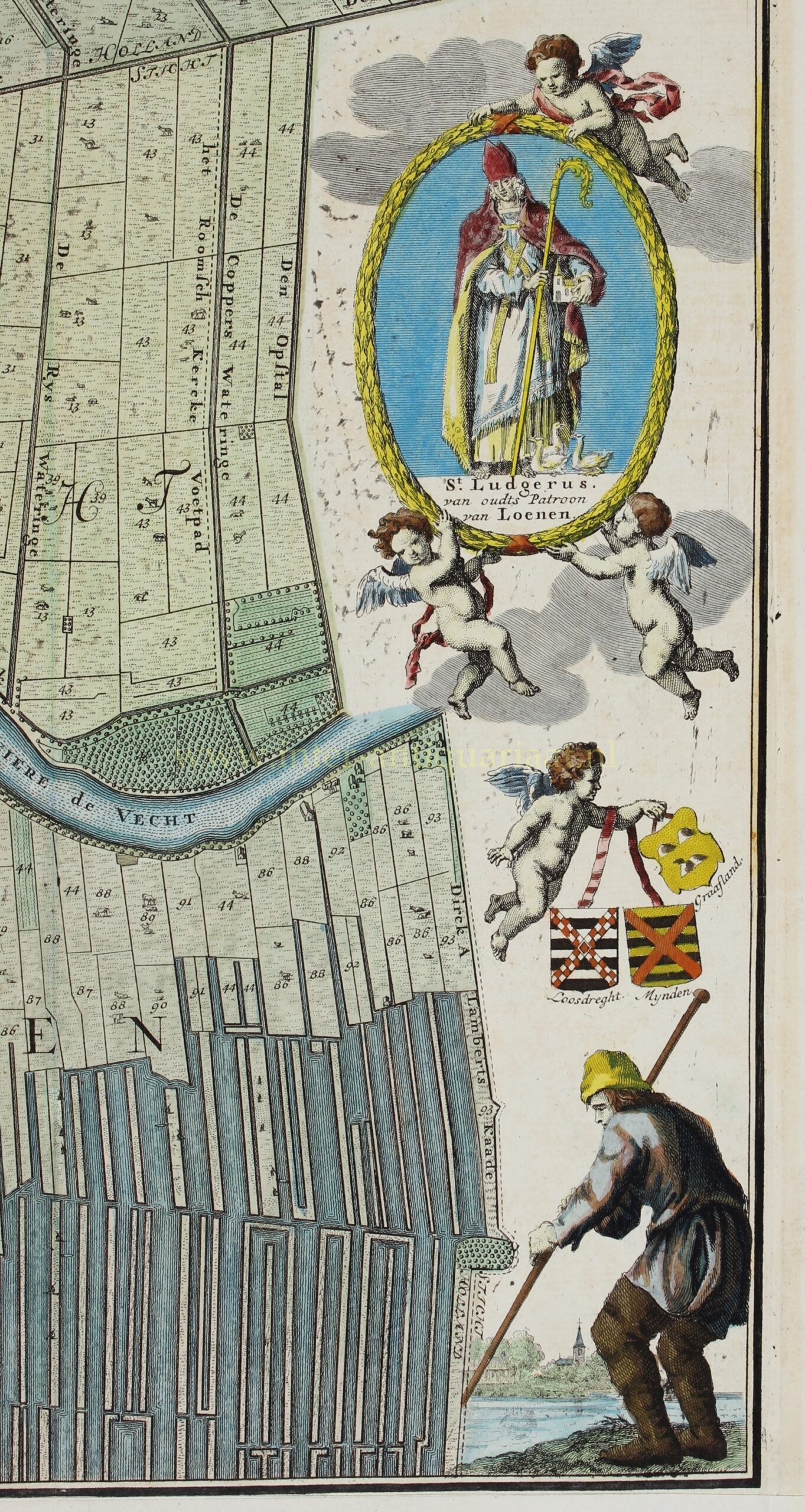
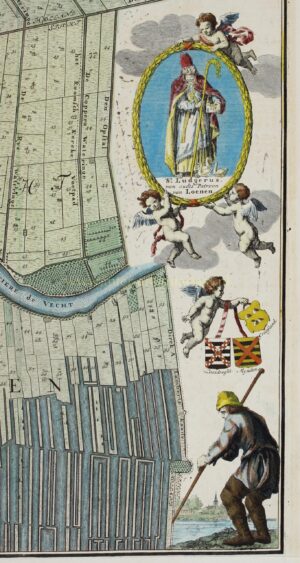
The abundance of detail makes this map endlessly engaging and a rich source of information. At the lower right, the early formation of turf pits and strip fields (trekgaten and legakkers) can be seen near the Lambertskade, resulting from peat extraction. Appropriately, a peat digger wielding his dredging scoop is depicted here.
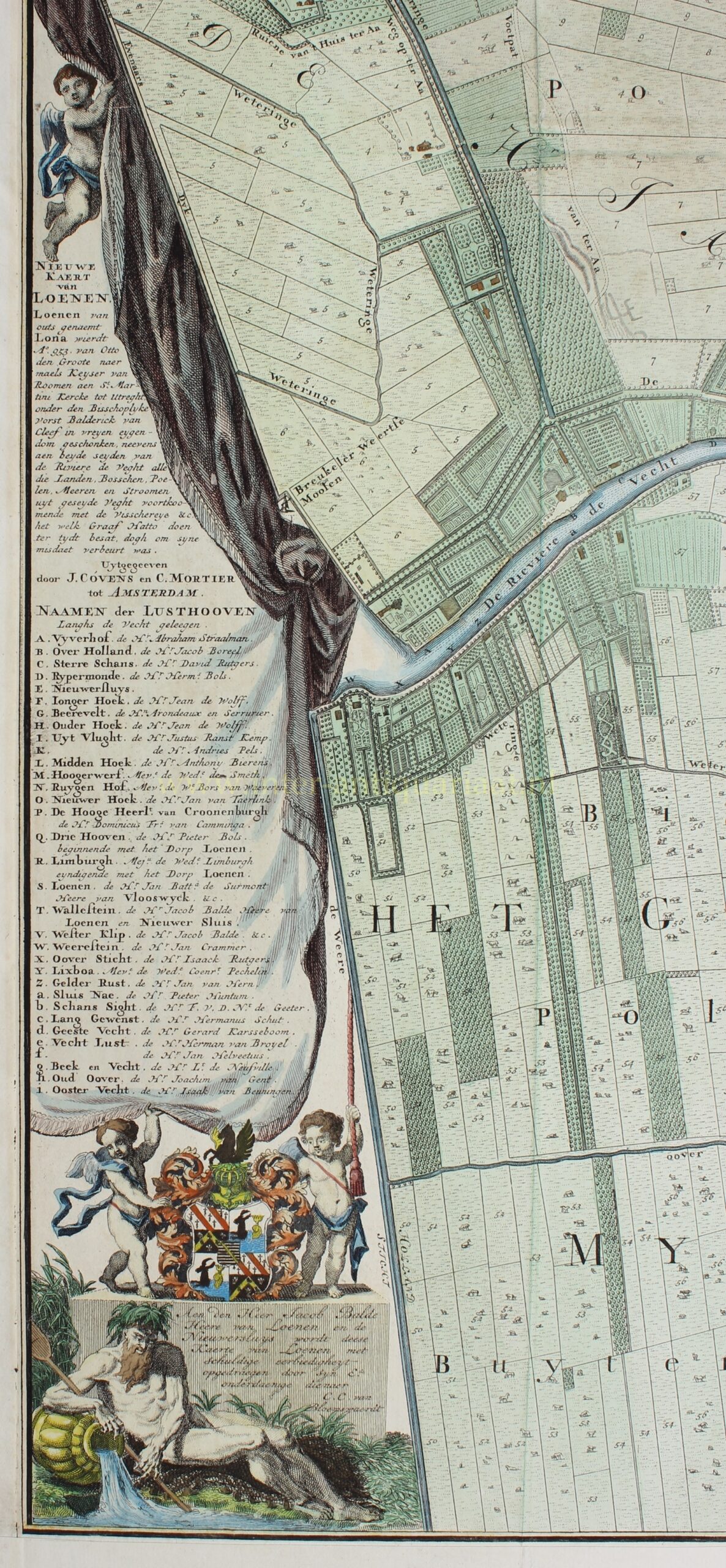
The banker and merchant Jacob Balde, who likely financed much of the map’s production, became Lord of Loenen and Nieuwersluis in 1712 and died in 1730. He resided at the country estate Westerklip and also owned the adjacent estate Wallestein, indicated on the map by the letters v and t. In the list of landowners he appears under number 38.
How this map—of exceptional craftsmanship, both in its surveying and topographical recording and in its final engraving—came into being is unknown. Kornelis Kooten van Bloemswaard, who dedicated the map to Jacob Balde and is therefore regarded as its author, is otherwise virtually unknown as a cartographer. His name appears in several archival documents of the Lordship of Kroonenburg. He served as schepen (alderman) of Loenen, appears to have been an antiquarian, and was acquainted with several members of the Balde family. Until his death in 1749 he was deeply involved with the Loenen archives. This interest in antiquity and local history is clearly reflected in the map’s decorations: at right appears “St Ludgerus, formerly patron saint of Loenen”; above him the (Roman) “Stone Tomb found at Loenersloot and the head at Mijnden”; and at the top the coats of arms of the former lords of Kronenburg and Loenen. The profile between them is probably based on the engraving of Castle Kronenburg and the village of Loenen from 1670 after A. Rademaker (published in 1725).
It is, however, unlikely that Van Bloemswaard produced the map entirely on his own. The designation Nieuwe kaart van Loenen (“New map of Loenen”) may refer to an earlier map that he updated and expanded at the request of Jacob Balde.
The Nieuwe kaart van Loenen is one of the highlights of eighteenth-century commercial cartography of the Vecht region. Although Van Bloemswaard appears to have completed his work around 1726 (this date is shown next to Jacob Balde’s coat of arms at the top of the map), advertisements for the map appear in the Amsterdamsche Courant from 1737 onwards.
Literature:
- Van Lutterveld (1948, p.17, 50, 90, 142 e.v.)
- De Vechtstreek – Oude kaarten en de geschiedenis van het landschap door Marijke Donkersloot-de Vrij (1985, p. 90-92).
Price: Euro 7.950,- (incl. frame)