

Gooi and Eemland – Jan Brouwer, 1875
€750


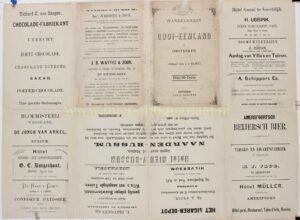
“Wandelkaart door het Gooi-Eemland en Omstreken” [Walking map of the Gooi, Eemland and surrounding areas], colour lithograph made by Emrik & Binger and published by Jan Brouwer in Amsterdam in 1875. Size 42 × 57 cm.
The map presents a region at the moment when an age-old landscape is taking its first steps toward modernisation. The area is still defined by the striking contrast between the high, dry sandy soils of the Gooi and the low, open polders of Eemland, yet new infrastructure and changing forms of land use reveal that this traditional landscape stands on the threshold of major transformations.
In the Gooi, villages such as Laren, Blaricum and Huizen still appear as small, compact settlements set amid an extensive heathland. The heath is intensively used for sheep grazing, sod-cutting and as common pasture, and appears on the map as an almost unbroken expanse between Bussum, Hilversum and Huizen. Hilversum, by this time, has already developed into a regional centre with growing industry and a rapidly increasing population, while Naarden remains visible as a fortified town, entirely enclosed by its characteristic bastions and moats. Huizen, on the edge of the Zuiderzee, retains the structure of a fishing community, with fields on the higher sandy ridges and houses strung along the dike.
East of the glacial ridge, an entirely different landscape unfolds. The Eemland polders — with their long, narrow fields, straight drainage ditches and outlying tidal meadows — form an open and expansive area strongly shaped by water management. The villages of Eemnes-Buiten and Eemnes-Binnen lie on the higher remnants of medieval reclamations, while farther north Bunschoten and Spakenburg appear as fishing settlements clustered against the Zuiderzee dike. Running through the centre of this polder area is the River Eem, the region’s principal waterway, which plays a crucial role in transporting hay and agricultural goods to Amersfoort and Amsterdam.
A significant innovation is the railway line opened in 1874, running from Hilversum via Bussum and Naarden to Baarn, although at the time this map appeared the connection still served primarily local and regional needs. True commuting would not emerge until decades later, as population growth, villa construction and new residential patterns transformed the Gooi during the 20th century.
Prijs: Euro 750,- (incl. frame)