
Poland, Lithuania – Reinier Ottens, c. 1720
€850


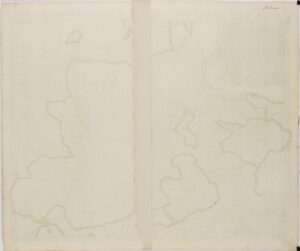
“Tabula Regni Poloniae, Ducatus Lithuaniae &c. ad usum Serenissimi Burgundiae Ducis.” Copper engraving made after a design by Hubert Jaillot and published by Reinier Ottens in Amsterdam around 1720. Contemporary hand colouring, with later additions. Size: 49.5 × 61 cm.
This map depicts the extensive state structure of the Polish–Lithuanian Commonwealth, which in the seventeenth century was one of the largest states in Europe. The territory extended from the Baltic Sea deep into present-day Ukraine and encompassed large parts of modern Poland, Lithuania, Belarus and Ukraine, as well as adjacent regions of Prussia, Russia and Moldavia.
The map is based on a design by the Parisian cartographer Alexis-Hubert Jaillot (1632–1712), who was renowned for his monumental wall maps produced for French court circles. Jaillot built upon the cartographic material of the Sanson family, combining their geographical knowledge in large-scale maps that were both scientifically informative and richly decorative. The map was originally issued in 1696. The title indicates that it was prepared “for His Serene Highness the Duke of Burgundy,” a title held during the reign of Louis XIV by his grandson, for whom several prestigious maps were produced.
The present example was later published in Amsterdam by Reinier Ottens (1698–1750), a member of a well-known Amsterdam family of map publishers and print dealers. The Ottens frequently reused successful French cartographic designs, which they re-engraved or reissued for the international map market. Such editions were often hand coloured to enhance their appeal to collectors and admirers of large decorative maps.
Cartographically the map shows the territories of the Polish Crown and the Grand Duchy of Lithuania, which had formed a political union since the Union of Lublin (1569). The woiwodships, or palatinates, are distinguished by different colours, while major rivers such as the Wisła (Vistula), Dnieper, and Dniester structure the landscape. Important cities — including Kraków, Warsaw, Vilnius, and Lviv — are clearly indicated, as are the frontier regions bordering Prussia, the Ottoman Empire, and Russia.
The map was produced at a time when the Polish–Lithuanian Commonwealth was still an important political power in Eastern Europe. At the same time, however, tensions were already emerging that would intensify during the eighteenth century. Eventually the state came under increasing pressure from its powerful neighbours Russia, Prussia, and Austria, leading to the Partitions of Poland (1772–1795) and the disappearance of the Commonwealth from the political map of Europe.
Price: Euro 850,-