

Battle of Gibraltar – Claes Jansz. Visscher after David Vinckboons, 1607


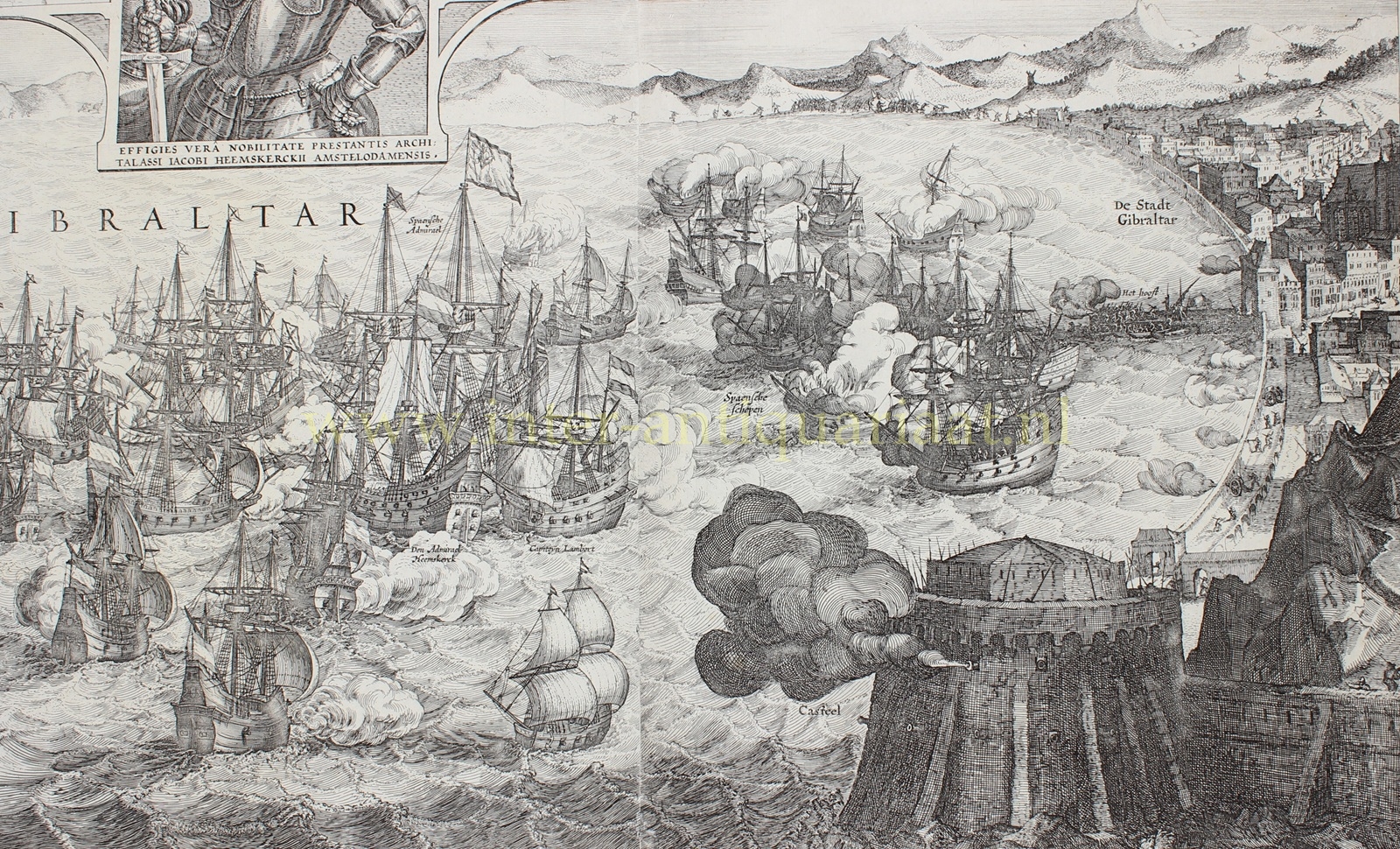




NEWS BROADSIDE OF THE NAVAL BATTLE OF GIBRALTAR (1607)
“Vera vehementis pugnae navalis effigies, quae a classe armata Regis Hispaniae atque illustris Dominorum Ordinum Provinciarum Confoederatarum navibus praesidiariis, sub auspicio nobilis magnanimi archithalassi Iacobi Heemskerckii Amstelodamensis, peracta est sub propugnaculis civitatis Gibraltar, die XXV Aprilis anno MDCVII.” [True representation of the fierce naval battle, fought by the armed fleet of the King of Spain and by the warships of the Illustrious Lords of the United Provinces, under the command of the noble and magnanimous arch-admiral Jacob van Heemskerck of Amsterdam, beneath the fortifications of the city of Gibraltar, on the 25th day of April in the year 1607.] Etching and engraving printed from three copper plates, made by Claes Jansz. Visscher in 1607 after a drawing by David Vinckboons. First state (of two). Size: 43.2 × 84.7 cm.
During the Eighty Years’ War, a Dutch fleet surprised a Spanish fleet lying at anchor in the Bay of Gibraltar. In the four-hour engagement that followed, the entire Spanish fleet was destroyed. The Dutch fleet, consisting of twenty-six smaller warships and four merchant vessels, was commanded by Jacob van Heemskerck.
The Dutch flagship, shown at the centre of the composition, was Aeolus, with Pieter Willemsz. Verhoeff serving as Van Heemskerck’s flag captain. Other Dutch vessels included De Roode Leeuw, commanded by Vice-Admiral Laurens Jacobsz. Alteras (lower left in the image); De Tijger, under Rear-Admiral Lambert Hendricksz; De Zeehond, De Griffioen, De Gouden Leeuw, De Zwarte Beer, De Witte Beer, De Friesche Pinas, De Morgenster, and De Olifantstromp, commanded by Captain Harpert Maertenz Tromp and his nine-year-old son, the future renowned admiral Maarten Harpertszoon Tromp.
The Spanish fleet, consisting of twenty-one ships, including ten of the largest galleons, was commanded by Don Juan d’Álvarez d’Ávila. The Spanish flagship San Augustín was commanded by Don Juan’s son. Other vessels included Nuestra Señora de la Vega and Madre de Dios.
The Dutch fleet sailed on 25 March 1607 under the command of Admiral Jacob van Heemskerck. Its objective was the destruction of the Spanish fleet, thereby facilitating peace negotiations. Upon reaching the Iberian Peninsula, Van Heemskerck learned that a major Spanish fleet was located in the Gulf of Cádiz.
The Spaniards were taken by surprise by the appearance of the Dutch fleet. They were unable to put to sea but did manage to man their ships with some 4,000 soldiers. The vessels were drawn as far back into the bay as possible and arranged in a neat line. Observing the small Dutch ships, Don Juan Álvarez compared them to his own “floating castles” and asked a captured sea captain from Rotterdam whether the Dutch would truly dare to attack. The Rotterdam captain replied that he had no doubt they would.
Van Heemskerck left several ships at the entrance to the bay to prevent the enemy’s escape. The attacking vessels were ordered to concentrate on the Spanish flagship. The Dutch fleet sailed into the bay, ignoring the coastal batteries.
During the initial approach to the Spanish flagship, Van Heemskerck was killed when a cannonball tore off his leg. To preserve the morale of the crew, his death was kept secret until after the battle.
Several galleons caught fire, and one Spanish ship exploded when its powder magazine was hit. The Dutch captured the Spanish flagship but did not take it as a prize; instead, they allowed it to run aground in the bay.
During the destruction of the Spanish ships, the Dutch deployed rowing boats and killed hundreds of Spanish soldiers and sailors attempting to reach the shore.
The Dutch losses amounted to 100 men, including Admiral Van Heemskerck, with 60 others wounded. The Spaniards lost their entire fleet of twenty-one ships and 4,000 men, including Admiral Álvarez.
Partly as a result of the destruction of this Spanish fleet, peace negotiations began in 1608, culminating in the Twelve Years’ Truce of 1609.
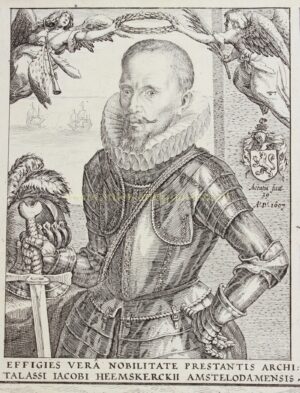
At the top of the print are five small scenes showing the ships in the bay, a “true likeness of the distinguished commander-in-chief at sea Jacob van Heemskerck of Amsterdam,” his funeral procession, and his tomb in the Oude Kerk in Amsterdam. At lower left is an inset map of the Strait of Gibraltar.
Literature:
- Frederik Muller – “De Nederlandsche geschiedenis in platen : beredeneerde beschrijving van Nederlandsche historieplaten, zinneprenten en historische kaarten” (1863-1882), no. 1241.
- Hollstein’s Dutch & Flemish Etchings, Engravings and Woodcuts ca. 1450 – 1700, no. 19-1(2)
Price: SOLD