

Beheading Johan van Oldenbarnevelt (1619) – Reinier Vinkeles, 1777
€175
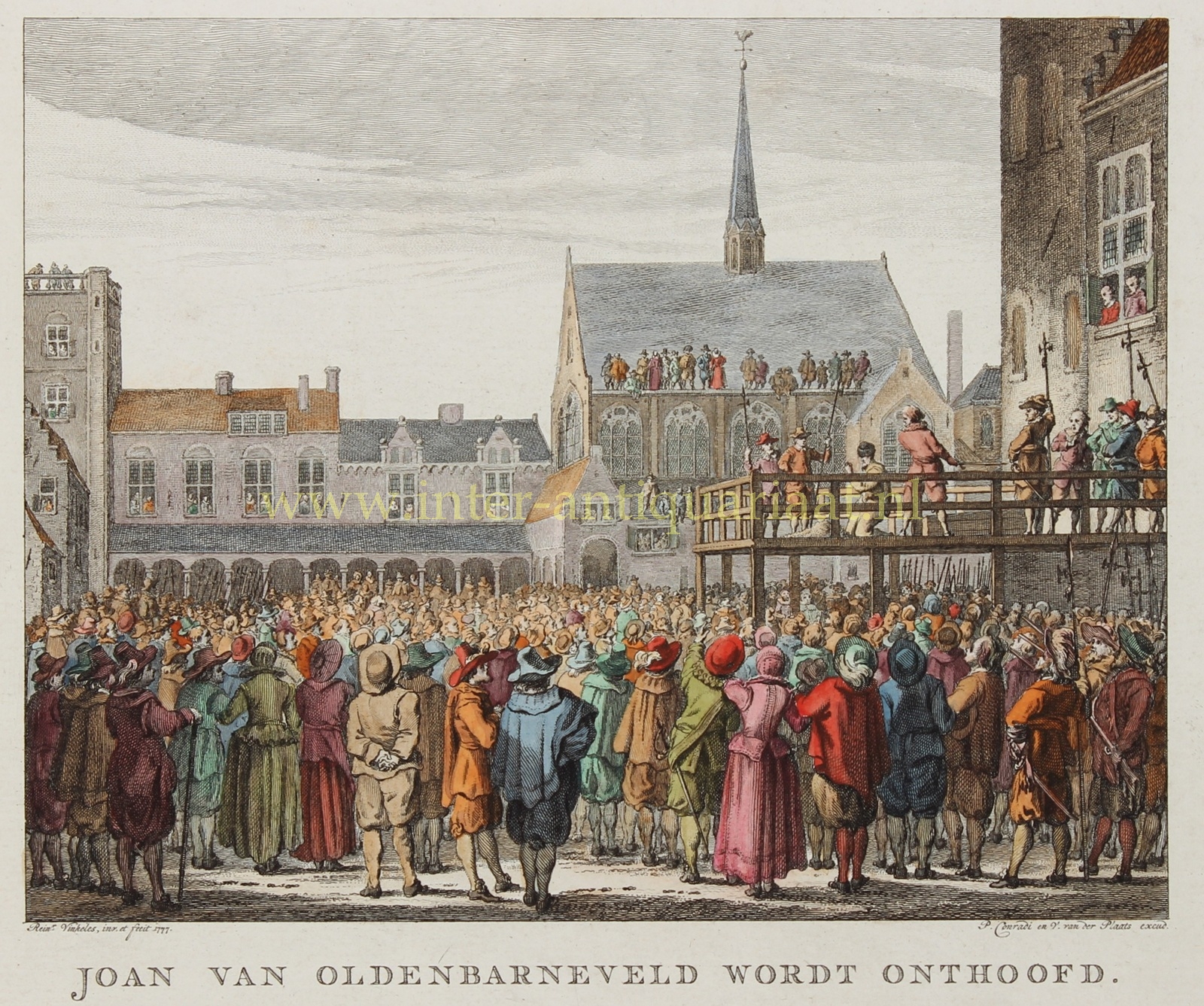
“Joan van Oldenbarneveld wordt onthoofd“ [Johan van Oldenbarnevelt is beheaded.] Etching made in 1777 by Reinier Vinkeles for Jan Wagenaar’s “Beknopte historie van ’t vaderland” [Concise history of the fatherland], published by Petrus Conradi and Volkert van der Plaats in 1786. Coloured by a later hand. Size (plate mark) 22.4 × 27.8 cm.
The print depicts the execution of Johan van Oldenbarnevelt on 13 May 1619 at the Binnenhof in The Hague. The former Land’s Advocate of Holland kneels blindfolded on the scaffold while the executioner prepares to carry out the beheading. Soldiers armed with pikes stand around the platform to maintain order, while a large crowd has gathered in the square to witness the spectacle. In the background the Hofkapel can be seen, its roof crowded with spectators trying to gain a better view of the execution.
The execution of Van Oldenbarnevelt marked the dramatic end of a political conflict that had divided the Dutch Republic for years. Since the late sixteenth century he had been one of the most influential statesmen of the young Republic and played a key role in organising resistance against Spain and in negotiating the Twelve Years’ Truce (1609). His powerful position, however, brought him into conflict with Stadtholder Maurice of Orange, as religious and political tensions became intertwined.
The conflict largely revolved around the struggle between the Remonstrants and Counter-Remonstrants within the Reformed Church, but it also had a clear political dimension: Van Oldenbarnevelt defended the autonomy of the provinces, while Maurice sought stronger central authority. In 1618 Maurice had his political rival arrested. After a lengthy trial before a specially appointed court, Van Oldenbarnevelt was sentenced to death on charges of alleged treason.
The image is not a contemporary depiction of the event of 1619, but an eighteenth-century historical reconstruction. Reinier Vinkeles based his composition on earlier representations of the Binnenhof and on written sources in order to dramatise the moment of the execution. Emphasis is placed on the theatrical character of the scene: the high scaffold and the densely packed crowd reinforce the sense of a public act of state.
As an illustration in Jan Wagenaar’s national history, the print was intended not only to depict a historical moment but also to present the reader with a morally and politically charged episode from the past of the Republic. The execution of Van Oldenbarnevelt long remained in Dutch historiography a symbol of the tensions between state power, religion, and political liberty in the early Dutch Republic.
Price: Euro 175,-