

Amsterdam, Dam Square, fire fighting – Jan van der Heijden, c. 1680
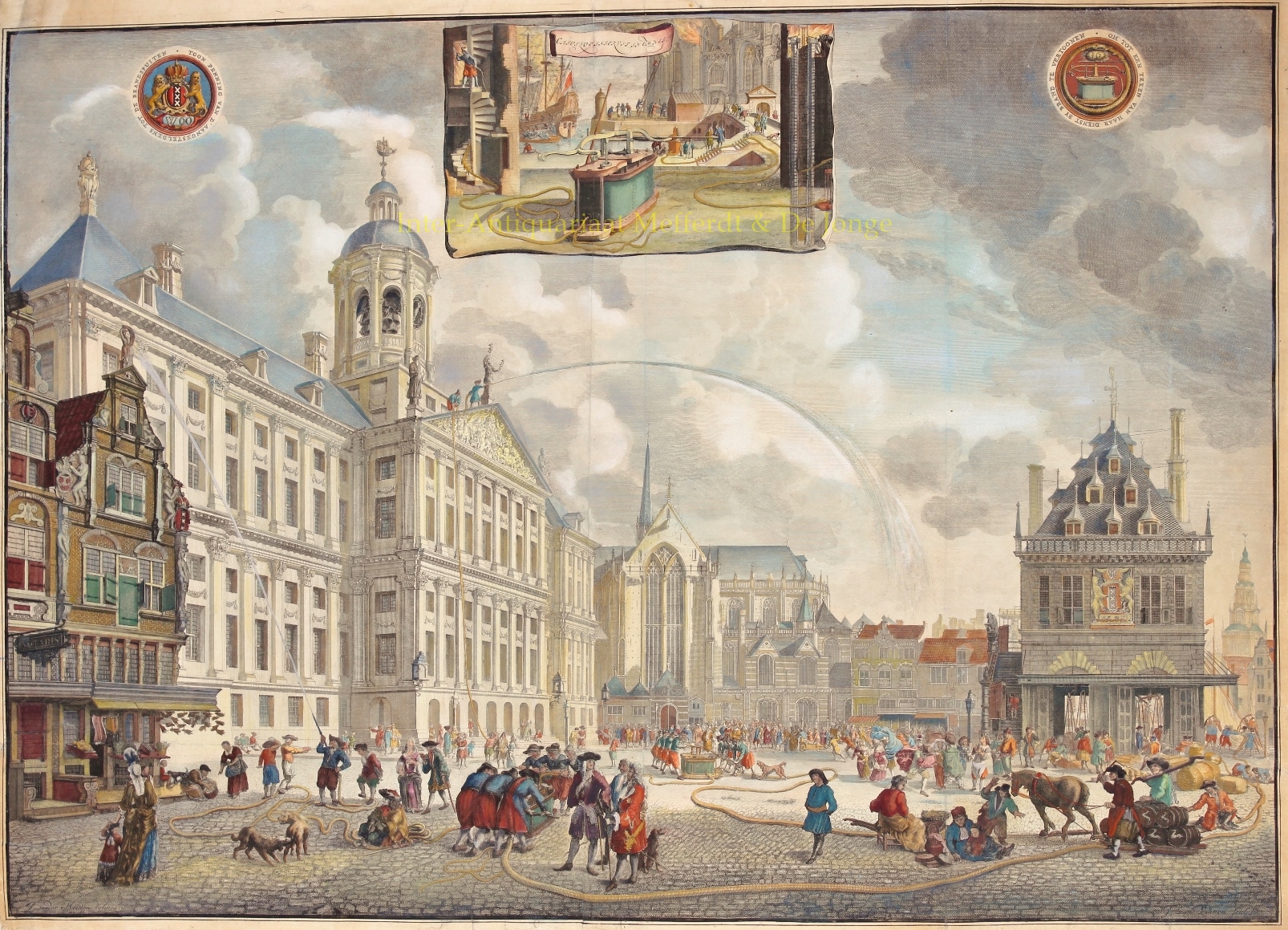
DEMONSTRATION OF THE FIRE HOSE ON THE DAM SQUARE IN AMSTERDAM
Etching made around 1680 by Jan van Vianen (c. 1660 – after 1726), after a design by Jan van der Heijden (1637–1712). Coloured by a later hand. Size: 47.5 × 56.5 cm.
For centuries, fighting fires meant long chains of people passing buckets of water. A new era began after the Amsterdam Town Hall burned down on 7 July 1652, prompting the city to purchase 58 hand fire pumps. Among the eyewitnesses was the fifteen-year-old Jan Goriszoon van der Heijden. His presence at the fire would later prove decisive.
Van der Heijden first made his mark in 1668 when he proposed to the city council the introduction of public street lighting throughout Amsterdam: “to provide the entire city with lights on dark nights, to prevent the drowning of many who fall into the water … to detect burglaries and deter mischief, and also to have light at hand everywhere in case of fire.” Soon 2,500 lanterns of his design were installed, lit and extinguished daily by a corps of lamplighters.
Even more significant was his improvement of the fire pump in 1672. To the tub with nozzle then in use, he added a suction pump and leather hoses. This allowed water to be drawn directly from the canals—filtered through a woven basket—while the hoses enabled targeted firefighting.
Shortly after, the suction pump and fire engine were combined into a single device. Because the double pump stroke created a “dead” moment halfway through, Van der Heijden added a pressure vessel that maintained a steady water jet. For this invention he received a patent in 1677.
The city’s burgomasters were impressed, and each of Amsterdam’s sixty districts was equipped with one of the new engines, operated by guild members and local volunteers. Each crew had a set number of officials, and one or two compulsory training sessions were held annually under the supervision of the general fire chief—the first of whom was Jan van der Heijden himself. Initially carried to fires, the engines were later mounted on wheels.
Besides inventor, Van der Heijden was also a gifted painter and draughtsman. As a painter he became renowned for his remarkably accurate cityscapes; as a draughtsman he applied his talent to instruction sheets and promotional prints for his fire engines. The present print is a fine example. His works can be admired in the Rijksmuseum, the Louvre, and other major museums.
Price: SOLD