

Dejima – Arnold Montanus/Jacob van Meurs, 1669
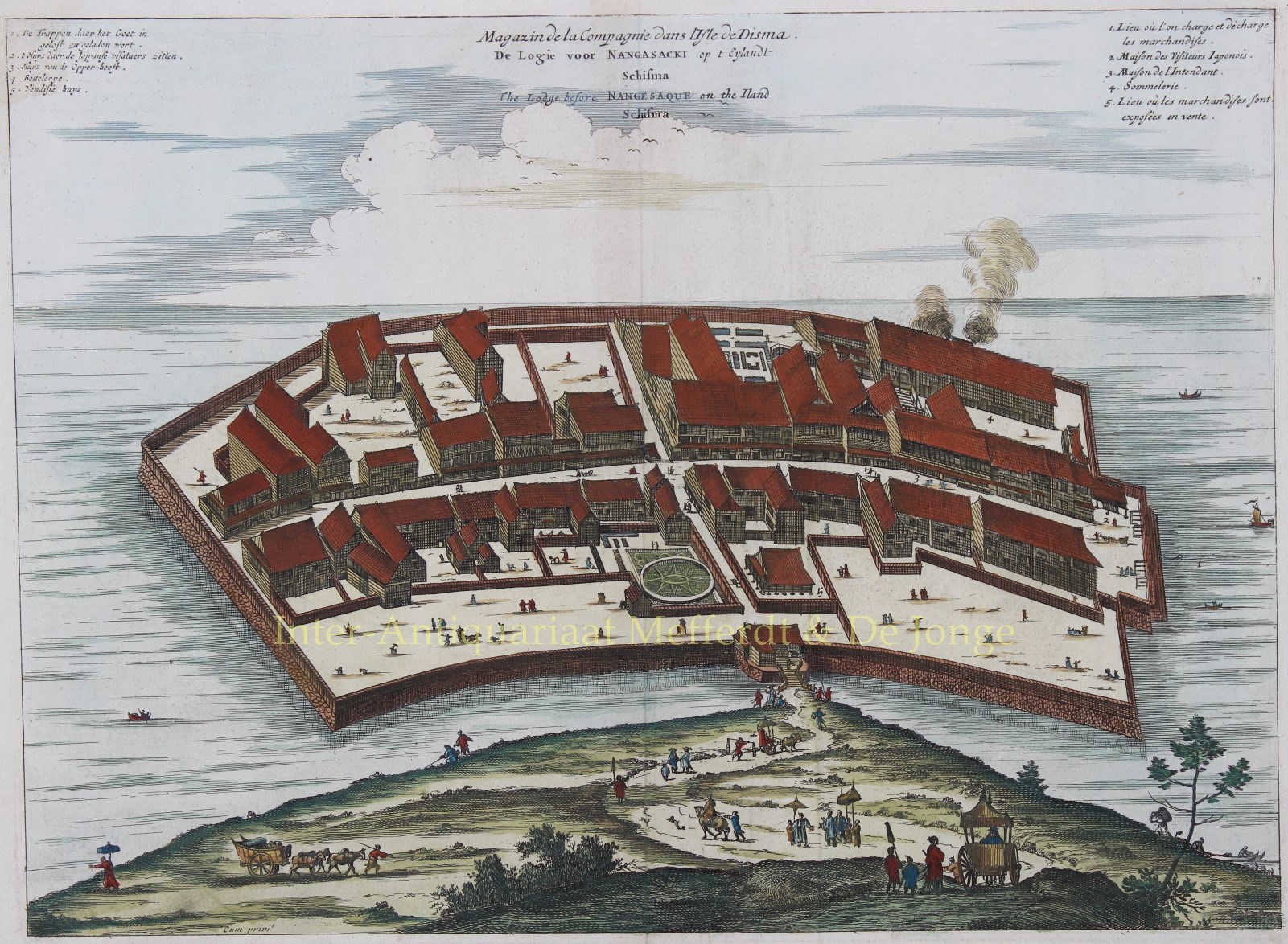
THE DUTCH FACTORY AT DESHIMA
”Magazin de la Compagnie de l’isle de Disma / De logie voor Nangasacki op ‘t Eylandt Schisma / The Lodge before Nangasaque on the Iland Schisma. ” Copper engraving of the island of Deshima from “Gedenkwaerdige gesantschappen der Oost-Indische Maatschappij in ’t Vereenigde Nederland aan de kaisaren van Japan…” [Memorable Embassies of the Dutch East India Company to the Emperors of Japan] by Arnold Montanus, published by Jacob van Meurs in 1669. Coloured by a later hand. Size: 25.5 × 35 cm.
After the expulsion of the Portuguese from Japan, only Chinese and Dutch ships were permitted to trade with the country, and Nagasaki was the only port they were allowed to enter. Deshima (築島) became the trading post of the Dutch East India Company (VOC) in 1641 and remained Japan’s sole point of contact with Europe until the late 1850s.
Life on Deshima was monotonous. The Dutch lived on the fan-shaped island, measuring approximately 70 by 210 metres, under strict restrictions. Apart from the annual journey to the shogun in Edo (present-day Tokyo), they were not allowed to leave the island. During the trading season from August to November, the staff usually consisted of a Chief Factor, a second merchant, several junior merchants, and a number of assistants, including the doctor.
In this earliest print of Deshima, the upper left and right corners contain legends in Dutch and French identifying various features, including the steps used for loading and unloading, the house for Japanese visitors, the residence of the Opperhoofd [Chief Factor], the loading and unloading quay, the bottlery, and the auction house.
Price: SOLD