
The Hague, Binnenhof – Stortenbeker and Heijligers, 1879
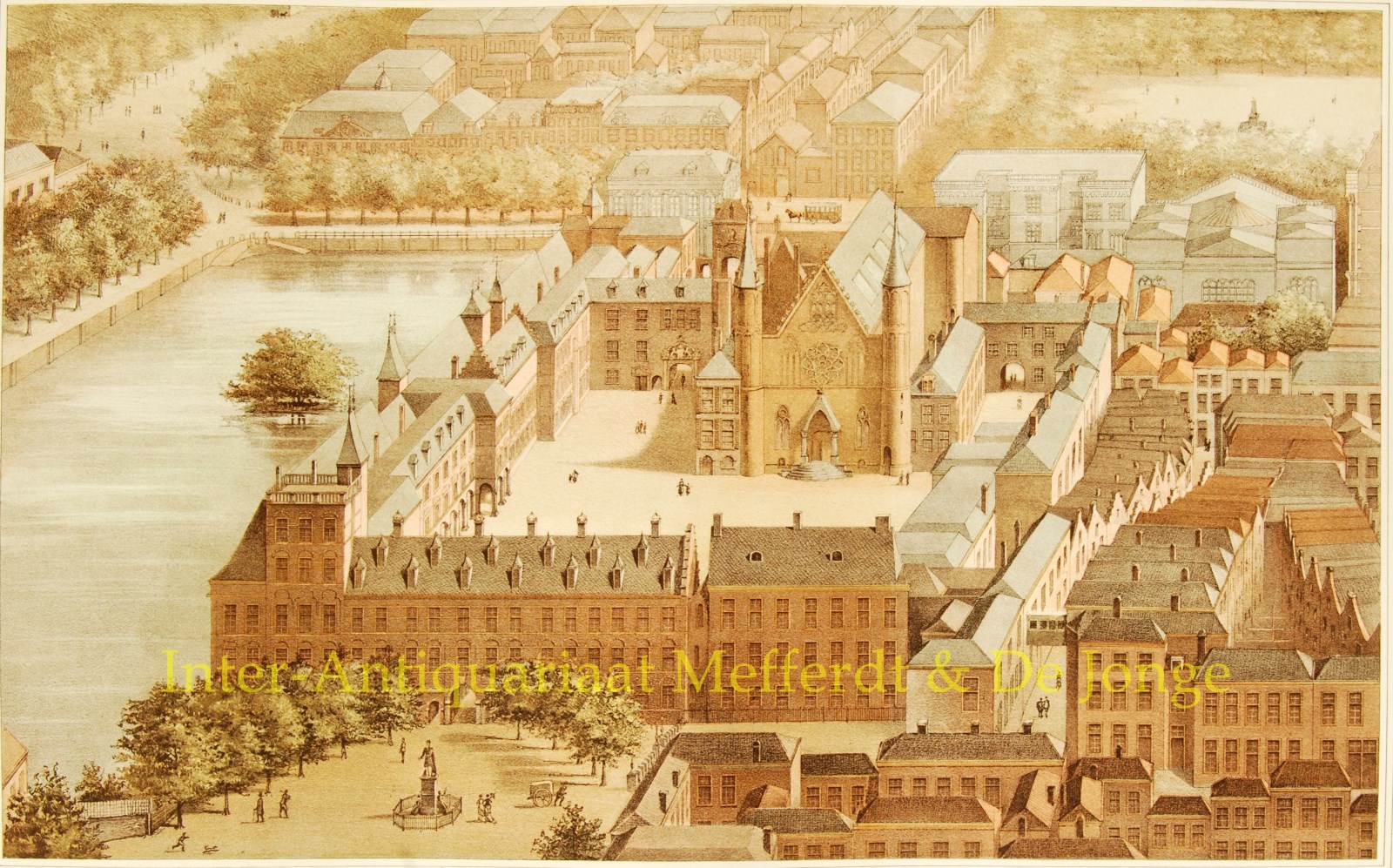
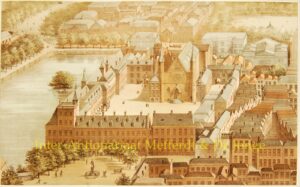
“Gezicht a vol d’oiseau op het Binnenhof.” [Bird’s-eye View of the Binnenhof.] Colour lithograph printed by S. Lankhout & Co. in The Hague after a design by Stortenbeker and Heijligers. The print comes from the series “Prenten van het Binnenhof” [Prints of the Binnenhof], compiled and published by H.C. Susan in 1879. Size (image): 33 × 53.5 cm.
After 1875, the population of The Hague began to grow rapidly, as it did in other Dutch cities. The agricultural depression and the rise of industrialisation drove large numbers of people from the countryside to the cities in search of a better livelihood. In The Hague, employment could be found not only in government service, but also in the metalworks on the southern side of the city, in numerous printing houses and, above all, in the building trade. At the same time, The Hague remained an attractive place of residence for bankers, men of independent means and retired colonial civil servants from the Dutch East Indies, drawn by its spacious surroundings and greenery, its luxury shops and its social life. By 1880, The Hague had a population of more than 114,000. Streets in the outer districts were being built up at an ever-increasing pace, while the city centre was also becoming more crowded, particularly around the Spui.
Since 1864, a horse-drawn tram had run between The Hague and Scheveningen (visible in the print) following roughly the route of today’s tram line 1. It was the first horse-drawn tramway in the Netherlands. During its early years, operating the service within the city was not yet profitable and the concession changed hands several times. The Haagsche Tramweg-Maatschappij (HTM) took over the horse tram in 1887.
In 1879, the Court Chapel [Hofkapel] on the Binnenhof was sold to the Dutch State and subsequently dismantled. The same year also saw Abraham Kuyper establish the Netherlands’ first political party, the Anti-Revolutionary Party (ARP).
Price: SOLD