

Rotterdam – Friedrich Bernhard Werner, Johann Friederich Probst, ca. 1760
€2.850
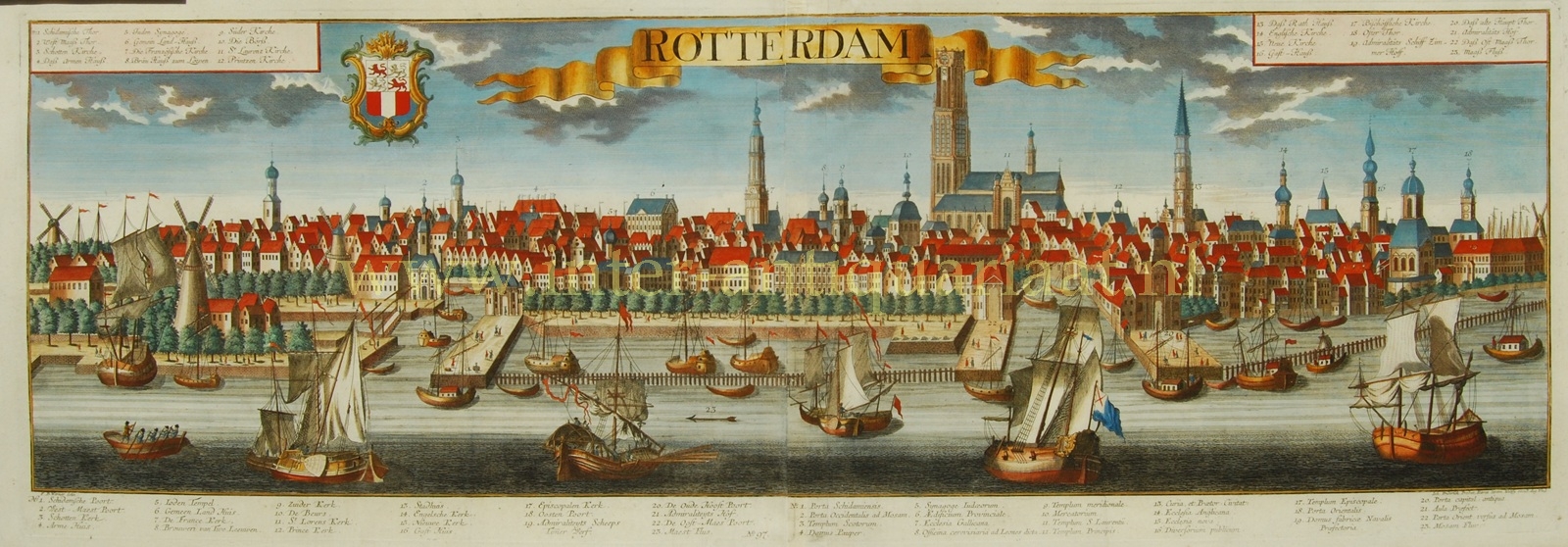
ROTTERDAM ON THE MAAS, C. 1760
“ROTTERDAM”, large copper engraving after a design by Friedrich Bernhard Werner, published in Augsburg by Johann Friedrich Probst around 1760. Coloured by a later hand. Size (print): 35 × 102 cm.
Seen from the south bank of the Maas, Rotterdam stretches across the horizon in a broad city panorama, with a bustling river full of shipping in the foreground. Behind the quays rise the towers of the city, dominated at the centre by the imposing Grote or Sint-Laurenskerk. Above the city unfurls a large ribbon bearing the name Rotterdam, flanked by the city’s coat of arms.
The numbers within the image refer to 23 buildings and locations identified in the German, Dutch and Latin legends. In addition to the Laurenskerk, these include the town hall, the exchange, the Schiedamse Poort, the Oosterpoort, the Oude Hoofdpoort, the Admiralty and its shipyard, several churches and the Jewish synagogue. The print thus presents Rotterdam not merely as a city, but emphatically as a port and trading centre on the Maas.
The panorama belongs to the large series of European city views for which the Silesian draughtsman Friedrich Bernhard Werner (1690–1776) supplied the designs. Before devoting himself to drawing cities, Werner led a remarkably adventurous life, working at various times as a soldier, a ‘Wunderdoktor’ or quack doctor, a translator of operas and a surveyor. From 1729 onwards he produced almost one hundred large city views for the Augsburg publishers associated with the heirs of Jeremias Wolff. His designs were subsequently transferred to copper by various engravers.
The business had developed from the celebrated print publishing house of Jeremias Wolff (1663–1724), one of the leading Augsburg art publishers of his day. After his death, the business was continued by his son-in-law Johann Balthasar Probst and subsequently by Probst’s sons. Johann Friedrich Probst (1721–1781), who took over part of the business in 1750, continued to publish Werner’s large city views for many years.
In the eighteenth century Augsburg was an important international centre for print production, sometimes described as “die Bilderfabrik Europas” (‘Europe’s picture factory’). City views intended for a European market were given a recognisable Augsburg visual character. That is evident here as well. The panorama is based on the topography of Rotterdam, but some of its buildings have acquired a distinctly South German appearance; several Rotterdam church towers, for example, were crowned with the onion-shaped domes so familiar in Augsburg architecture.
Price: Euro 2.850,-