

Scheveningen – Abraham Jacobsz. Hulk after Adriaan van de Velde, 1803
€450
THE BEACH AT SCHEVENINGEN
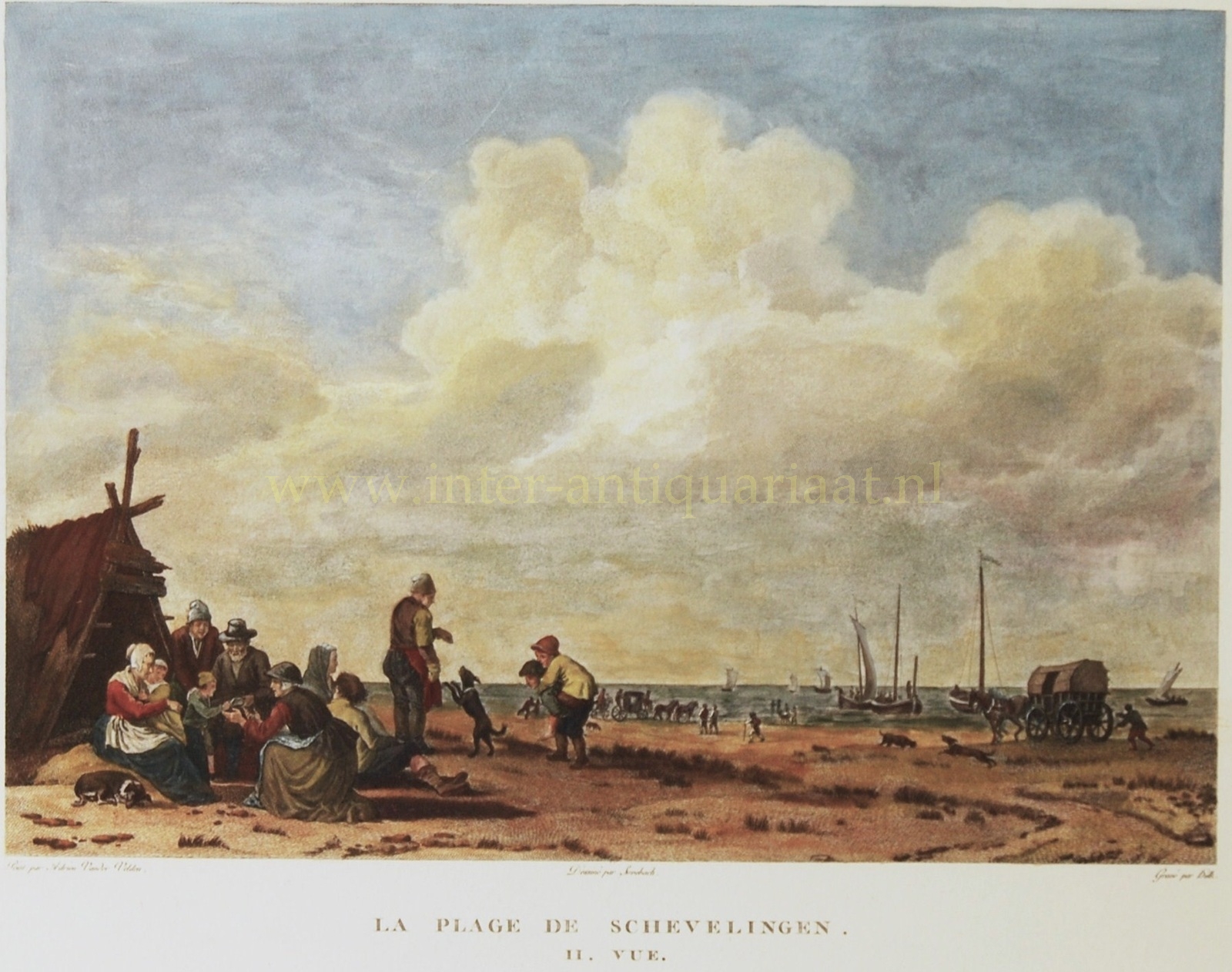
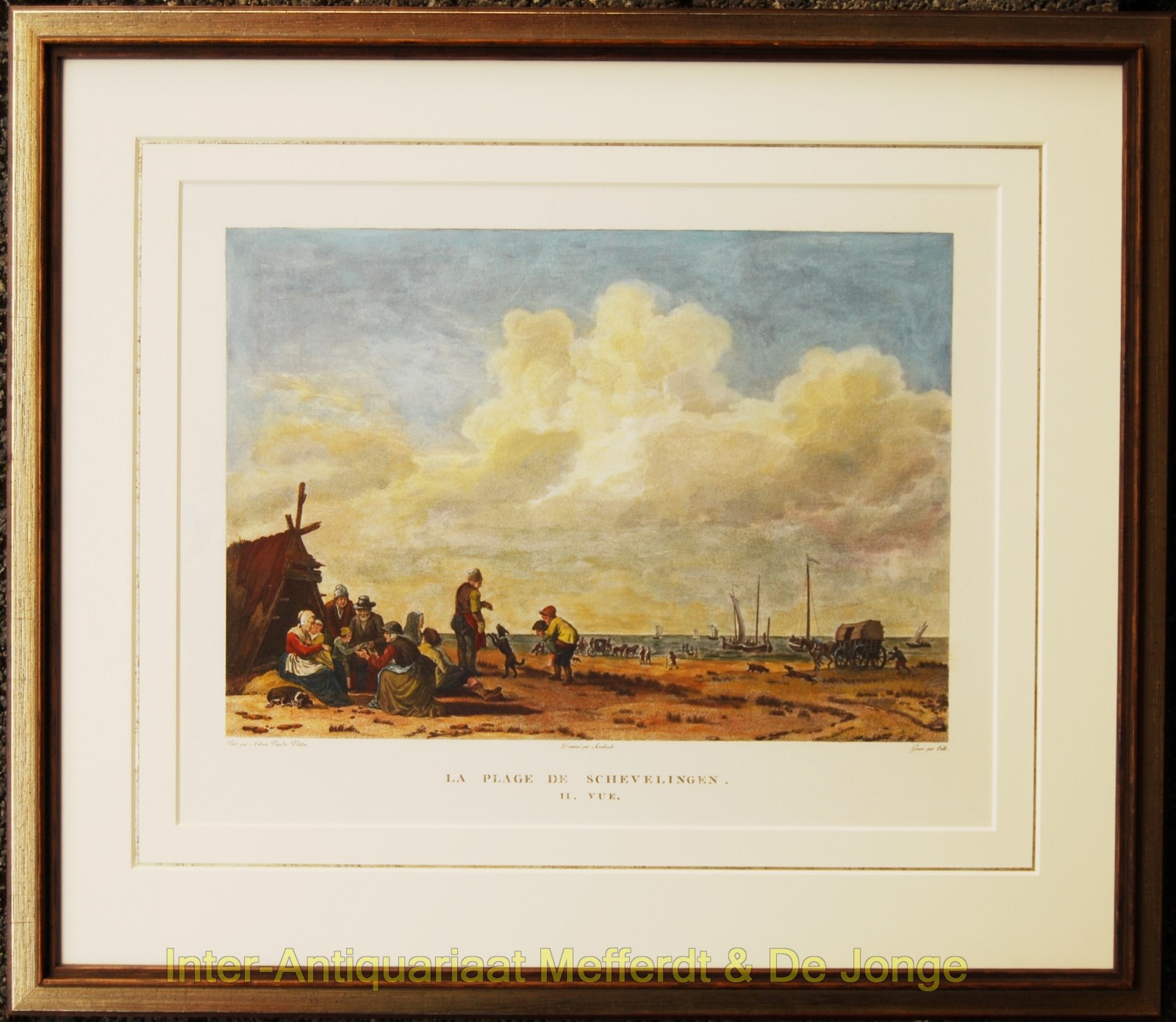
“La Plage de Schevelingen. II. Vue”, copper engraving made in 1803 by Abraham Jacobsz. Hulk after a drawing by Jacques François Swebach-Desfontaines, which in turn was based on the painting Beach Scene by Adriaen van de Velde (1636–1672). The print was published in Paris as part of the monumental print series Le Musée français. Later hand-coloured. Size (image) approx. 23.5 × 29 cm; (frame) 47 × 53.5 cm.
Van de Velde painted several views of the beach at Scheveningen, combining scenes of everyday life by the sea with a remarkable sense of light, space and atmosphere. Here too, he placed the horizon exceptionally low. As a result, almost two-thirds of the composition is occupied by an impressive expanse of clouds, while life on the beach unfolds in a narrow strip below. The original painting, dated 1663 or 1665, is now in the Mauritshuis in The Hague.
On the left, a fishing family has gathered beside a simple shelter on the beach. A grandfather has a child beside him and is teaching it to read, while other members of the family sit around them and the children play. A little farther away, a fisherman plays with a dog. In the background, fishing vessels lie offshore, while carts and horses move across the broad beach. To the right is a covered wagon, while closer to the water an elegant carriage drawn by four horses passes by. Van de Velde thus brings together two worlds: the everyday life of the Scheveningen fishermen and the beach as a place of recreation for affluent visitors from The Hague. A contemporary description records that the fishing family is waiting for the incoming tide, so that the boats left high and dry at low tide can be refloated.
The history of the painting adds another interesting dimension to the engraving. From 1768, the work belonged to Stadholder William V and hung in his collection in The Hague. In 1795 it was seized by the French and taken to Paris, where it was exhibited in what later became the Musée Napoléon. It was during this period in Paris that Swebach-Desfontaines made his drawing after the painting and Hulk’s engraving was published in Le Musée français. Following the fall of Napoleon, the painting returned to the Netherlands in 1815; since 1822 it has formed part of the collection of the Mauritshuis.
Price: Euro 450,- (incl. frame)