

Rotterdam, departure of the civic guard – Quirijn Ver Huell, 1830
€4.950
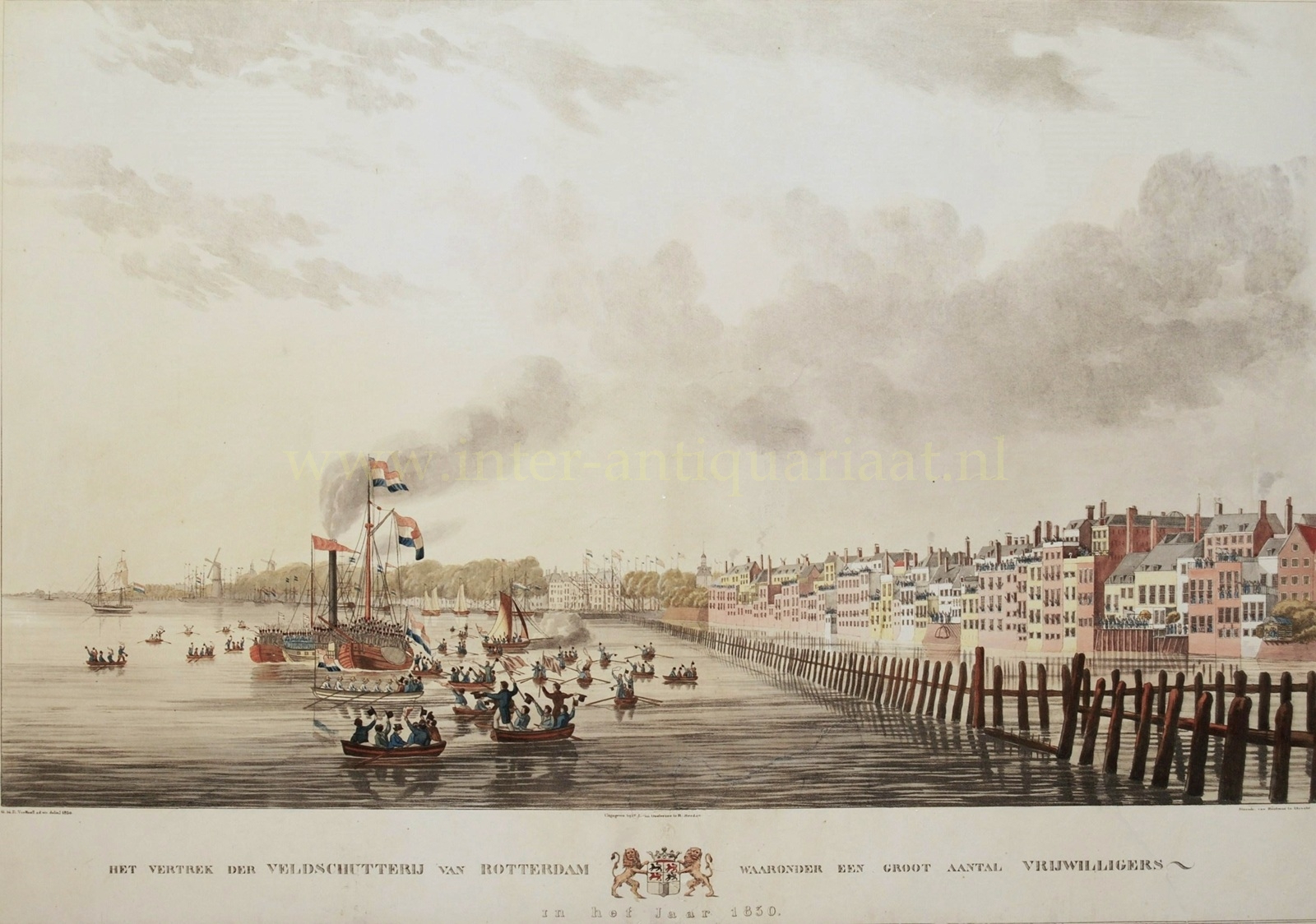
ROTTERDAM BIDS FAREWELL TO ITS CIVIC GUARD, 1830
“Het vertrek der Veldschutterij van Rotterdam, waaronder een groot aantal vrijwilligers, in het jaar 1830” [The Departure of the Rotterdam Civic Guard, Including a Large Number of Volunteers, in 1830], lithograph printed in Utrecht by Johannes Paulus Houtman after a drawing by Quirijn Maurits Rudolph Ver Huell, published in Rotterdam by W.J. van Oosterzee in 1830. With original hand colouring. Size: approx. 58 × 84 cm.
This large antique view of Rotterdam depicts the departure of the city’s civic guard on 20 October 1830, when its members were mobilised to help suppress the Belgian Revolution. The event is captured in an impressive panoramic view of the Nieuwe Maas, with the Boompjes in the background. Two sailing vessels and a steamboat carry the departing guardsmen, including a large number of volunteers. The river is alive with festive activity as dozens of rowing boats accompany the departing ships. On the right, the stately merchants’ houses on the backside of the Haringvliet provide the backdrop to this exuberant farewell.
The Belgian Revolution had broken out in August 1830, leading to Belgium’s declaration of independence on 4 October. King William I of the Netherlands refused to accept the secession and mobilised the civic guards of the Northern Netherlands to reinforce his army. Rotterdam also contributed troops, who departed amid scenes of great public enthusiasm. The print reflects the patriotic fervour among Rotterdam’s supporters of the Dutch monarchy. Ultimately, attempts to reverse the secession failed, although the Netherlands did not formally recognise Belgian independence until 1839.
The Rotterdam civic guard was originally a municipal militia responsible for defending the city and maintaining public order. Under the Militia Act of 1827, men aged approximately 25 to 34 were liable for service. Active members were required to undertake regular military exercises and could be called upon to reinforce the army in times of war. This is precisely what happened during the Belgian Revolution.
The artist, Quirijn Maurits Rudolph Ver Huell (1787–1860), was a naval officer, draughtsman and writer. He spent much of his career in the Dutch navy and was appointed director of the Rotterdam Naval Dockyard in 1843. He also published illustrated travel accounts and biographies. In 1845, he was involved in founding the Royal Netherlands Yacht Club, whose collections later formed the basis of the Maritime Museum Rotterdam. The club’s former headquarters on the Willemskade now houses the Wereldmuseum. Much of Ver Huell’s surviving work is preserved in Museum Arnhem, the Gelders Archief and the Maritime Museum Rotterdam.
Large, early lithographs published as separate prints are particularly rare. Only a few impressions of this magnificent view of Rotterdam are known to have survived.
Price: Euro 4.950,- (incl. frame)