

Badminton – Johann Heinrich Keller, 1743
€7.500

BATTLEDORE AND SHUTTLECOCK – AN 18TH-CENTURY FORERUNNER OF BADMINTON, 1743
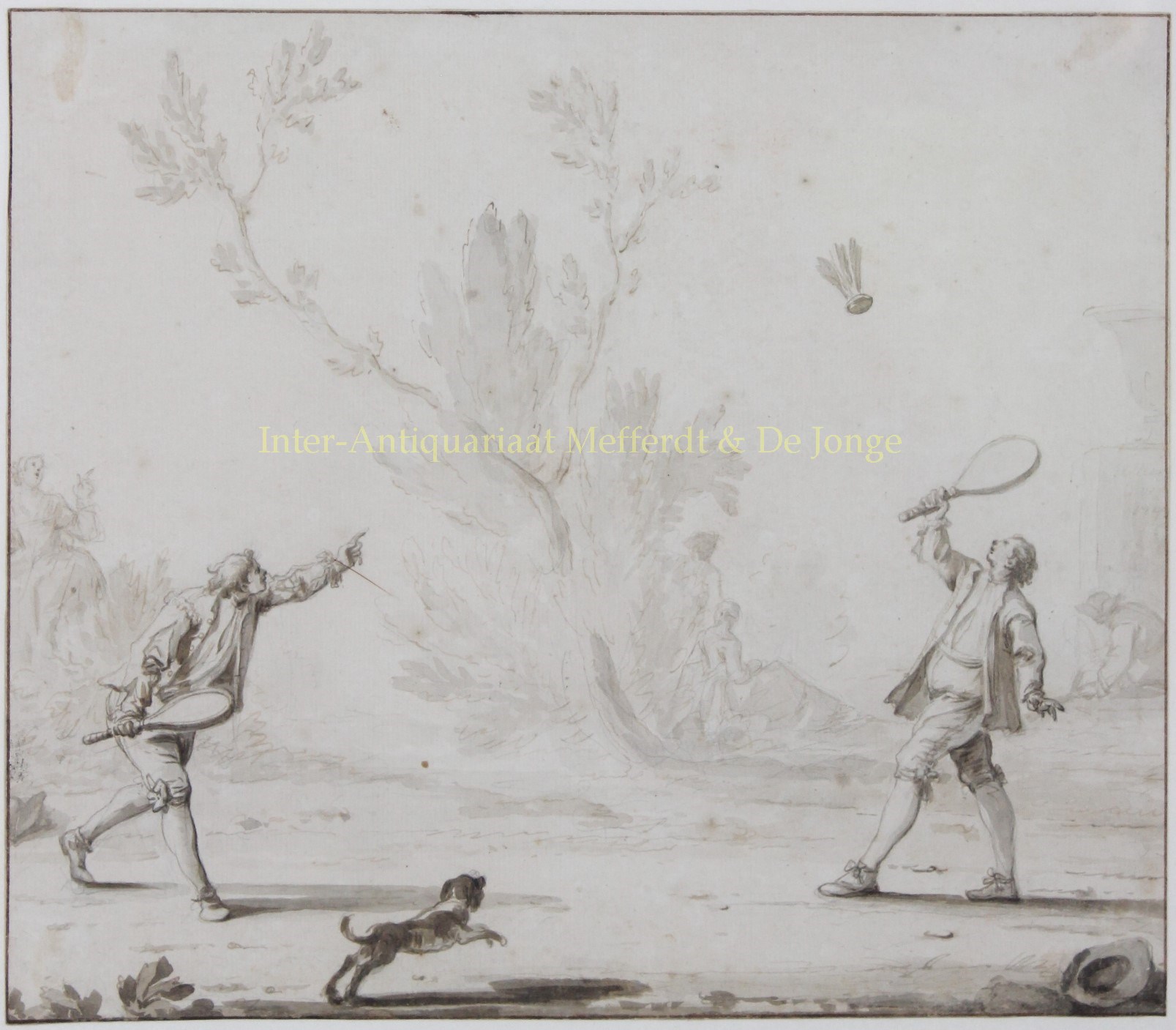
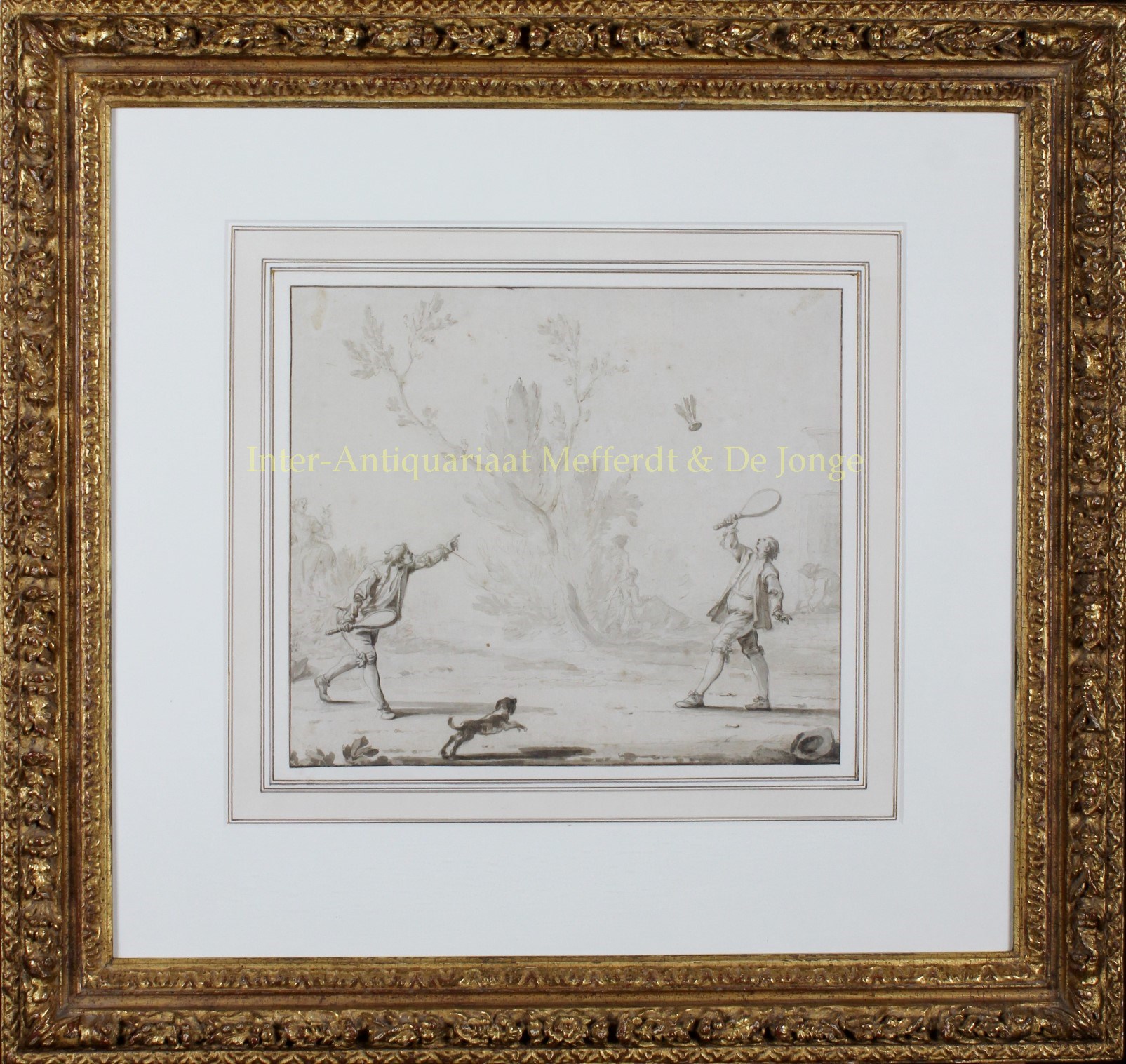
The Shuttlecock Game, pen and brush drawing with ink wash by Johan Hendrik Keller, signed and dated 1743 on the pedestal beneath the vase on the right. Size: 24 × 27 cm.
Two elegantly dressed gentlemen amuse themselves in a park with a game of shuttlecock, an early forerunner of modern badminton. Keller has carefully depicted both players, capturing their sweeping movements and elegant eighteenth-century attire. By contrast, the surrounding trees, several spectators and the landscape are only lightly sketched. This contrast between the meticulously rendered figures and the loosely drawn background gives the composition a lively character. The players’ animated poses, the shuttlecock flying through the air and the little dog running across the foreground all contribute to the strong sense of movement.
The shuttlecock game, known in France as jeu de volant and in England as battledore and shuttlecock, was a game of skill in which players used small rackets to hit a feathered shuttlecock back and forth. Unlike modern badminton, the object was generally not to defeat one’s opponent, but rather to work together to keep the shuttlecock in the air for as long as possible. No net was required, and the game could be played both indoors and outdoors. During the eighteenth century, it was a popular form of social recreation and physical exercise.
The game has a long history. Games involving feathers and rackets had been played for centuries in various parts of Asia and Europe. Shuttlecock was also a familiar pastime in eighteenth-century France.
Modern badminton emerged in the nineteenth century from related games. At Badminton House, the English country estate of the Dukes of Beaufort in Gloucestershire, the traditional shuttlecock game was already being played in 1830. By the 1860s, a variation had developed in which players stood opposite each other, separated by a cord stretched between them. By 1863, this version of the game was explicitly referred to as badminton. The sport subsequently developed further, notably among British military personnel in India, before the Badminton Association of England was established in 1893.
Johann Heinrich Keller (1692–1765) was a Swiss-born painter and draughtsman. Following his artistic training and travels through Germany and France, he settled permanently in The Hague in 1726. There, he became a sought-after decorative painter, specialising in paintings for the interiors of prestigious residences. His work included painted wall hangings, ceiling paintings and overdoor panels featuring mythological, pastoral and other decorative subjects. His patrons also included members of the court of the Dutch stadtholder. His work reflects the influence of French painting from the first half of the eighteenth century.
Price: Euro 7.500,- (incl. frame)