

Haarlem, Spaarne – Leon Schenk after Abraham Rademaker, ca. 1730
€3.950
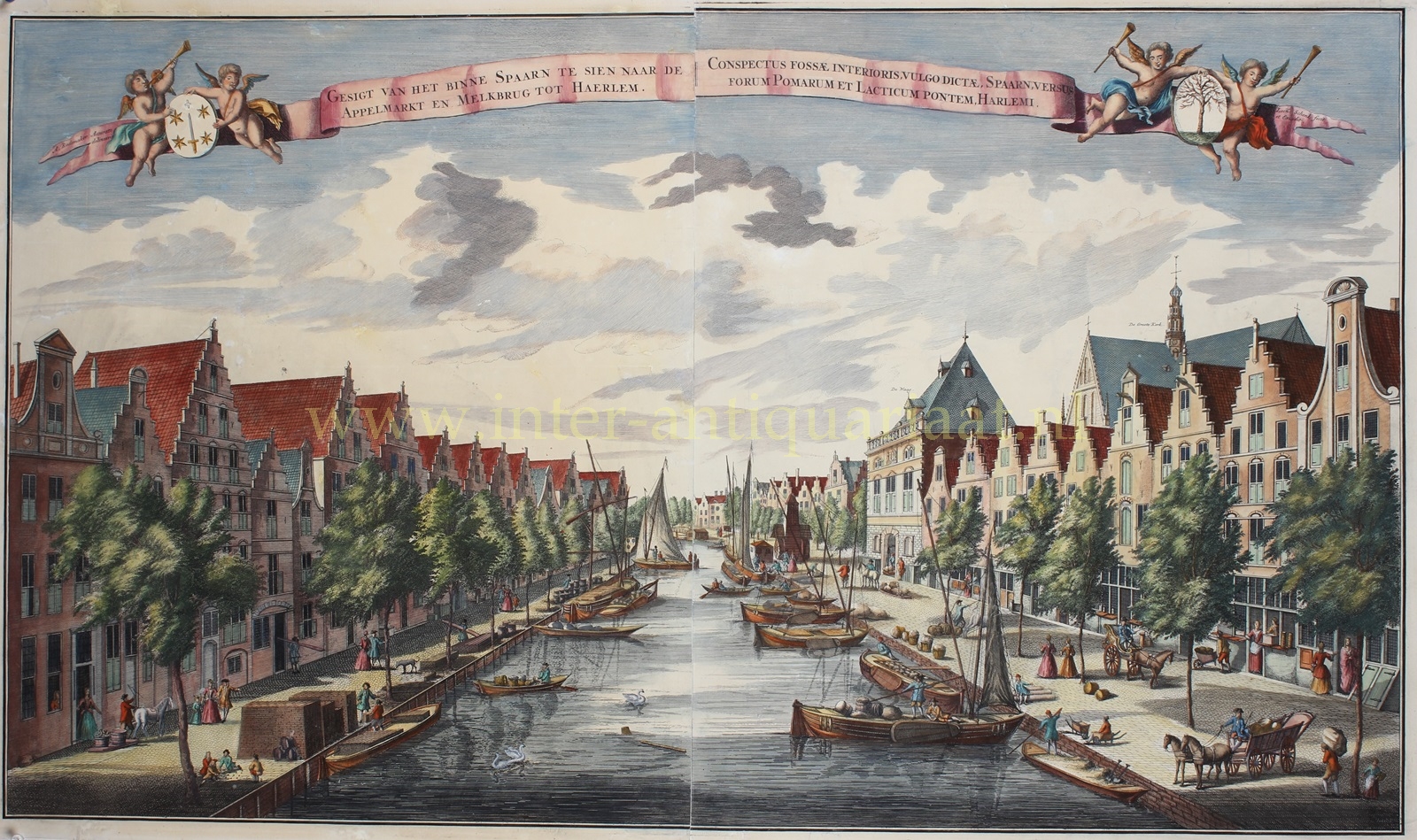
“Gesigt van het Binne Spaarn te sien naar de Appelmarkt en Melkbrug tot Haerlem” [View of the Binnen Spaarne looking towards the Appelmarkt and Melkbrug in Haarlem]. Copper engraving on two joined sheets after a design by Abraham Rademaker, published around 1730 by Leon Schenk. Coloured by a later hand. Size: 55 × 95 cm.
Much of the activity that made Haarlem prosperous was made possible by its location on the River Spaarne. Before the advent of the railways, waterways connected Haarlem with the wider world. In 1631, Haarlem was linked to Amsterdam by a towing canal. The network of towing canals and horse-drawn barges provided Holland with a remarkably efficient transport system for its time during the seventeenth century.
In 1732, Haarlem had a population of 45,000, making it the third-largest city in the Dutch Republic, after Amsterdam and Leiden. (During the eighteenth century, Haarlem’s textile industry – like that of Leiden – went into serious decline, and by 1800 the population had fallen to approximately 20,000.)
We see the Spaarne from the Gravestenenbrug, looking towards the city centre. The house of Pieter Teyler had not yet been built. The Weigh House, on the corner of Damstraat, stands on the waterfront to the right. Ships could moor here to unload their merchandise using a crane powered by a treadwheel. Inside the arched openings of the weigh house itself was a beam balance on which incoming goods were weighed. The city levied a weighing fee, effectively a tax on goods weighed there and thus a source of municipal revenue. (The Weigh House continued to perform its original function until 1915.)
Behind the Weigh House, the Grote Kerk rises above the city.
Literatur : Catalogus Harlemia illustrata, no. 396 (“very rare”)
Price: Euro 3.950,- (incl frame)