

Ask me no more – Lawrence Alma-Tadema, 1906
€2.950
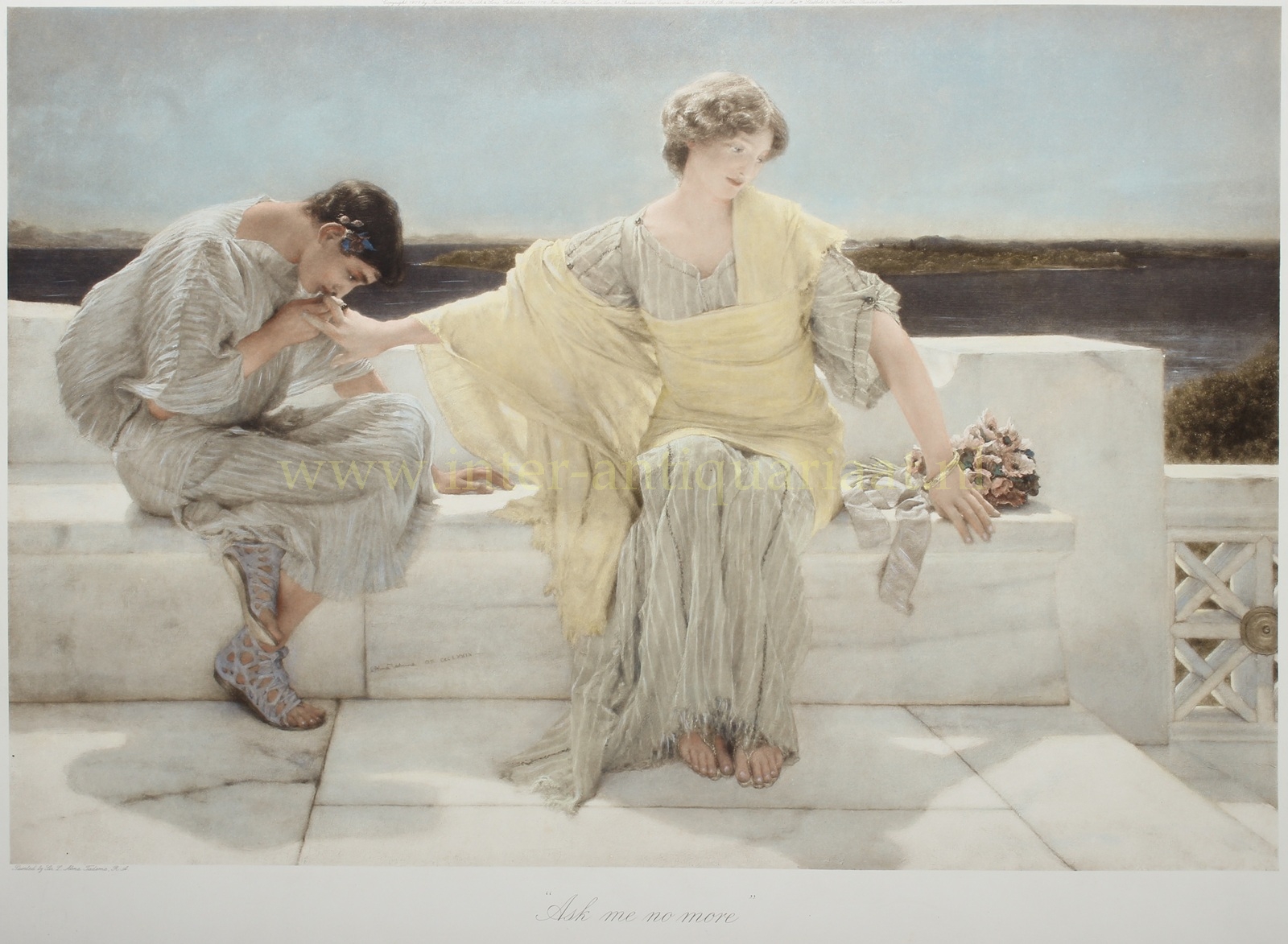
“Ask me no more”, photogravure published in 1906 by Arthur Tooth & Sons after the painting of the same title from 1906 (Opus CCCLXXIX) by Sir Lawrence Alma-Tadema. With orignal hand-colouring. Size approx. 45 × 66.5 cm.
On a sunlit marble terrace overlooking the deep-blue Mediterranean, a young Roman suitor bends over the hand of his beloved. As he kisses her hand, she turns her face away. Her pose is restrained, but not rejecting. Their touching hands provide the only physical contact between them and form the emotional focus of the scene. Beside the young woman lies a bouquet of anemones, a gift from her admirer.
With her pale complexion and English hairstyle, the young woman looks at least as much like a beauty from Alma-Tadema’s own time as an inhabitant of ancient Rome. The classical world here serves merely as the setting for an essentially timeless game of love.
The title is taken from The Princess by Alfred, Lord Tennyson, published in 1847. The final stanza of the song Ask me no more, included in the poem, reads:
“Ask me no more; thy fate and mine are sealed
I strove against the stream and all in vain
Let the great river take me to the main
No more, dear love, for at a touch I yield”
The words give meaning to the precise moment Alma-Tadema chose to depict. The woman has resisted her love, but at his touch her resistance gives way. Visually, Alma-Tadema holds that moment in suspension a little longer: somewhere between courtship and surrender, while Tennyson’s verse already reveals the outcome.
Lovers meeting on a marble terrace overlooking the Mediterranean were among Alma-Tadema’s favourite themes. He repeatedly chose not passion itself, but the moment immediately preceding it, when gestures and glances still leave room for doubt and anticipation. Ask me no more was among the last works in which he employed this motif. Remarkably, Alma-Tadema painted this emphatically youthful love scene in 1906, at the age of seventy. He later wrote that above all he had sought to evoke an impression of youth and happiness in the painting.
The painting had been commissioned by Arthur Tooth & Sons in March 1906 and was exhibited that same year at the Royal Academy. Tooth immediately also published this photogravure after it. The print was therefore not a later reproduction of an already famous painting, but formed part from the outset of the dissemination of one of Alma-Tadema’s last major love scenes.
Price: Euro 2.950,- (incl. frame)