

William of Orange – J.H. Isings, 1938/1939
€650
WILLIAM OF ORANGE AS MILITARY COMMANDER, 1568
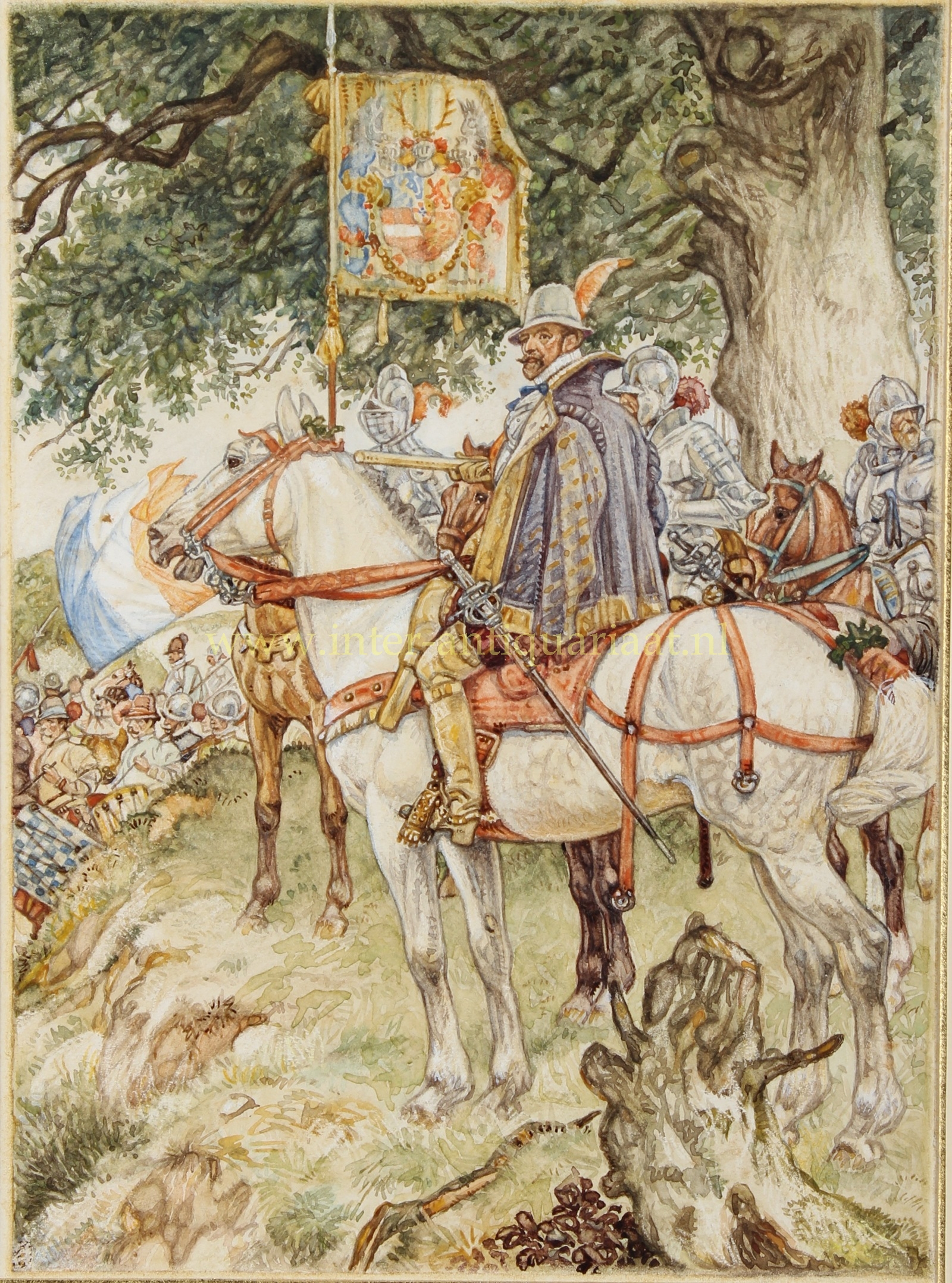
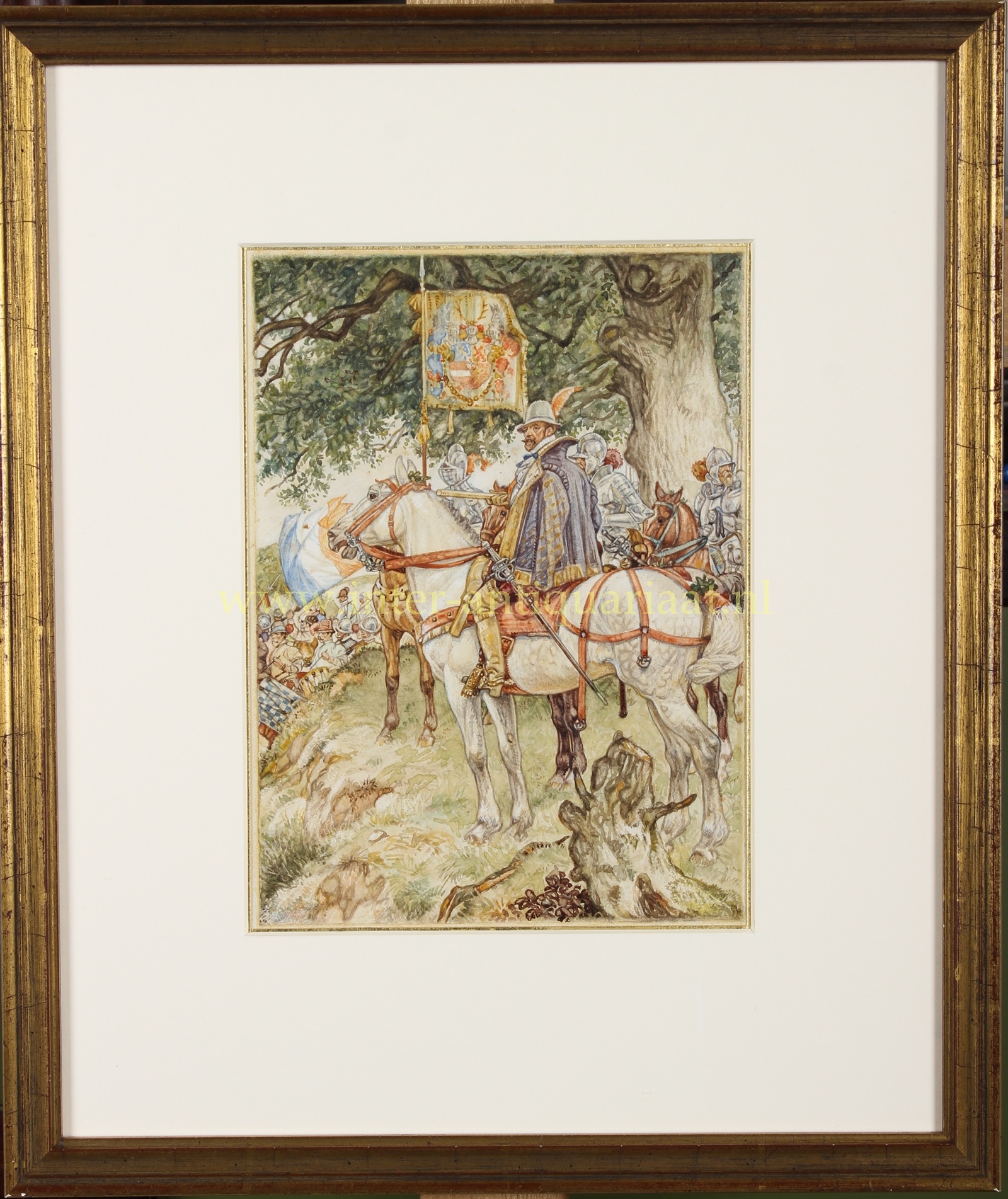
“Als een Prins opgezeten, met mijner heires kracht” [Mounted like a Prince, with the might of my army], original watercolour by Johan Herman Isings, ca. 1938/1939, created as the design for the colour frontispiece to Pieter Louwerse’s “Geïllustreerde vaderlandse geschiedenis voor jong en oud Nederland” [Illustrated History of the Netherlands for Young and Old], completely revised and continued by J.J. Moerman and published by Van Holkema & Warendorf in Amsterdam in 1939. Size (watercolour): 21.7 × 15.8 cm (frame: 38.5 × 32.5 cm).
The composition was inspired by the eleventh stanza of the Wilhelmus, the Dutch national anthem. Beneath the reproduced image in the book appeared the lines:
“Mounted like a Prince,
with the might of my army,
I awaited battle
with the presumptuous tyrant.”
The stanza refers to William of Orange’s military campaign of 1568, in the first year of what would later become known as the Eighty Years’ War. After his brother Louis of Nassau had won an early victory over the royal forces at Heiligerlee in May, William himself raised a large army with which to invade the Netherlands from German territory. In October 1568, he and his troops succeeded in crossing the River Meuse north of Maastricht. He hoped to force the Duke of Alba into a decisive battle, but Alba avoided a direct confrontation. It is precisely this episode that is recalled in the following lines of the Wilhelmus: “He who lay entrenched near Maastricht, feared my might; my horsemen were seen galloping most courageously across the field.”
Isings did not depict these words literally as a single identifiable moment during the campaign. Instead, he transformed them into a powerful historical image of William of Orange as a military commander: seated on a white horse, surrounded by his cavalrymen, with the princely standard beside him. The meticulous rendering of armour, weapons, clothing, saddles and horse tack is characteristic of Isings. For his historical scenes he conducted extensive research, striving to render even the smallest details of material culture as convincingly as possible.
The book for which the watercolour was created already had a long history by that time. Pieter Louwerse (1840–1908) originally published his Geïllustreerde vaderlandsche geschiedenis voor jong en oud Nederland in 1886–1888. Decades later, the work was completely revised and continued by Job Jan Moerman. For this new edition, Johan Herman Isings (1884–1977) was commissioned to produce a new series of illustrations. The present watercolour was reproduced as the prominent colour frontispiece, while the remaining illustrations were printed in a single colour.
Isings ranks among the best-known Dutch illustrators of national history. He became particularly famous for his historical school plates, which from 1911 onwards shaped the way generations of Dutch schoolchildren imagined the past. In his book illustrations too, he combined historical accuracy with a strong sense of mise-en-scène. Rather than choosing the most dramatic moment of action, he generally preferred the instant in which a historical event seems to unfold before the viewer. Here, too, William occupies the calm and controlled centre of the composition while the army around him is in motion.
The fact that this particular image was placed at the very front of the book is significant. William of Orange appears here not merely as a historical figure, but as the personification of the traditional narrative of the birth of the Netherlands. The red, white and blue among his troops and the lines from the Wilhelmus directly connected the sixteenth-century Revolt with Dutch national identity. The composition continued to be used in later editions of Louwerse’s history of the Netherlands.
The present watercolour is the original design from which this well-known book illustration was reproduced. Whereas the printed plate brought Isings’ composition to generations of readers, the original sheet preserves the work as he actually applied it to paper, with the delicate brushwork, transparent washes of colour and minute detailing that were inevitably partly lost in reproduction.
Price: Euro 650,- (incl. frame)