

Amsterdam, Nieuwezijds Voorburgwal – Jan de Beijer, ca. 1759
€14.500
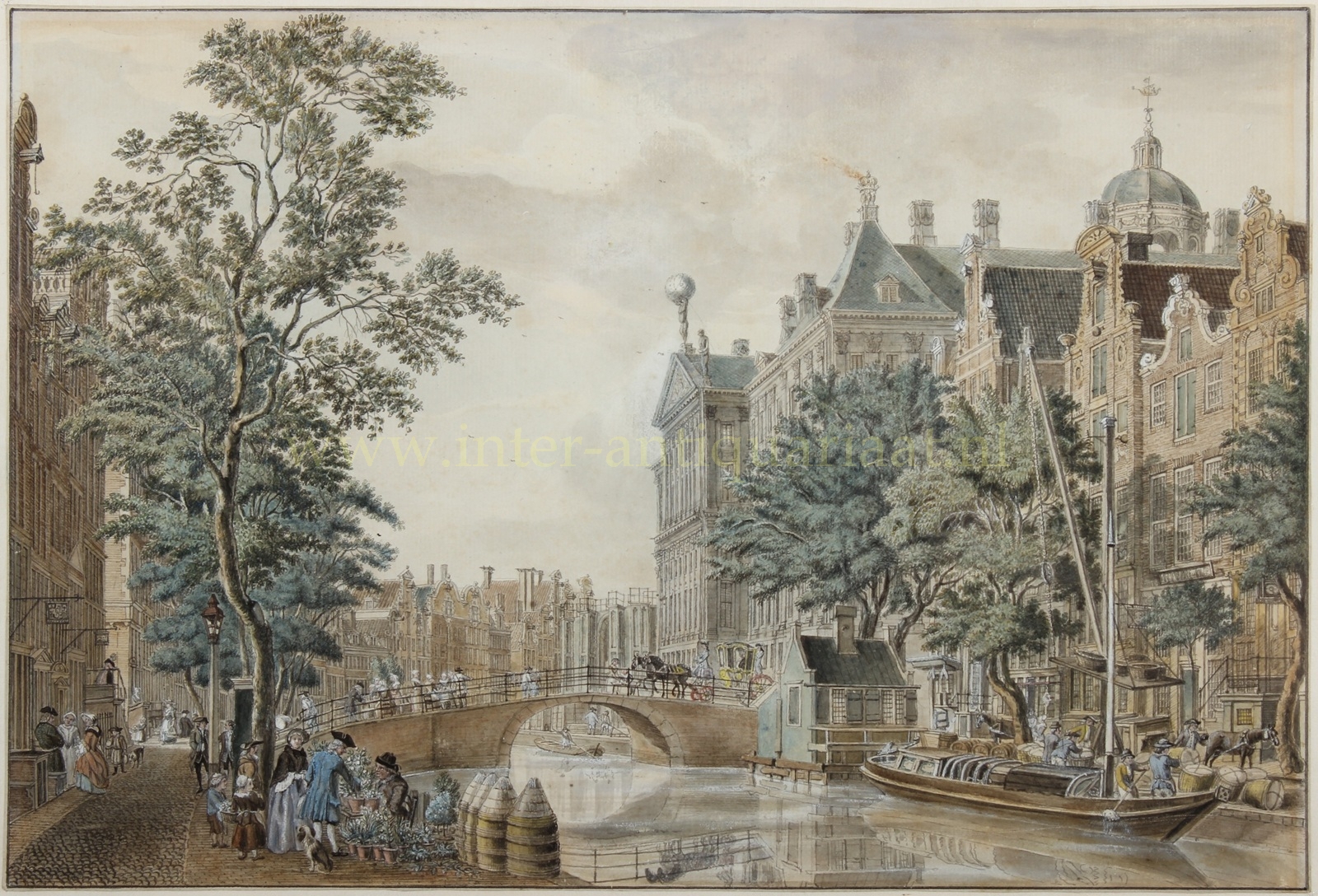
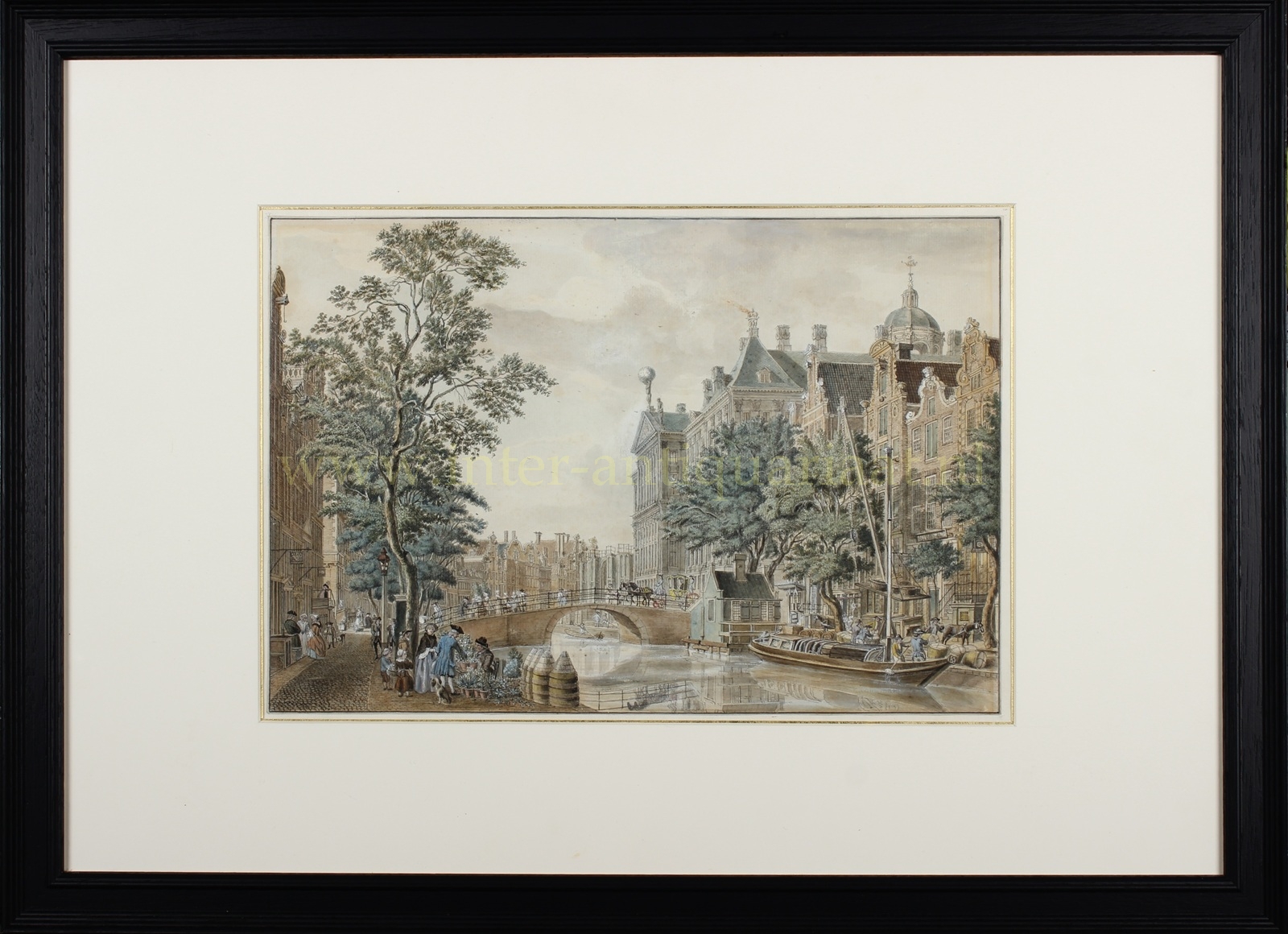


THE NIEUWEZIJDS VOORBURGWAL WITH THE FLOWER MARKET AND TOWN HALL, AMSTERDAM, CA. 1759
View of the Nieuwezijds Voorburgwal in Amsterdam. Pen and ink, watercolour and gouache drawing by Jan de Beijer, ca. 1759. Size: 25.5 × 37.7 cm.
De Beijer looks northwards from the southern part of the Nieuwezijds Voorburgwal towards Dam Square. The canal, which has since been filled in, forms the central axis of the composition. On the left, beneath the trees, the flower market is being held. A vendor has arranged his potted plants along the quay, where customers inspect the goods on display. Flowers, plants and trees were generally brought to the market by boat and sold directly from the quayside.
On the opposite bank, to the right, were the Pijpenmarkt and the landing place of the Gouda packet service, the Goudse Veer. A packet boat moored alongside the quay is being unloaded, while a horse waits on the quayside to carry the goods onward. Operating according to a fixed timetable, the Goudse Veer connected Amsterdam with Gouda and formed part of the extensive network of scheduled inland services linking Amsterdam with towns elsewhere in the Dutch Republic.
In the centre of the composition, a stone arched bridge spans the canal. Pedestrians and a horse-drawn carriage cross the bridge, which connected the Stilsteeg on the left with the Gasthuisstraat on the right. In 1875, the two narrow streets were widened and joined together to form the present-day Paleisstraat.
Beyond the bridge rises the monumental rear façade of the Town Hall on Dam Square, designed by Jacob van Campen and completed in the seventeenth century. High above the façade, Atlas carries the globe on his shoulders, while behind him rises the cupola, surmounted by a weather vane in the form of a cog ship, an old symbol of Amsterdam. Further in the distance, the unfinished tower of the Nieuwe Kerk is also visible. It was not until 1808 that the former Town Hall became the Royal Palace of Amsterdam.
The drawing is more than a detailed city view. De Beijer combines the architecture of central Amsterdam with everyday life along the canal. Pedestrians, market vendors, boatmen and other figures populate the quays and bridge, while barrels, merchandise and moored vessels evoke the commercial activity taking place here. The tall trees lend the busy urban scene a strikingly green and leafy character.
Jan de Beijer (1703–1780) was one of the leading topographical draughtsmen of the eighteenth-century Netherlands. In his Amsterdam city views, he combined great accuracy in the depiction of buildings and streets with lively, sometimes almost painterly staffage. As a result, his drawings are not only important topographical documents, but also exceptionally engaging records of eighteenth-century urban life.
The area changed dramatically during the nineteenth century. The flower market moved to the Singel in 1862, and in 1884 the Nieuwezijds Voorburgwal was filled in. De Beijer’s drawing thus preserves one of Amsterdam’s best-known city views in a form that has since disappeared.
Price: Euro 14.500,- (incl. frame)