

Atlas title page – Abraham Ortelius / Christophe Plantin, ca. 1592-1612
€175
GEOGRAPHY IS THE EYE OF HISTORY – ORTELIUS’ PARERGON, 1592–1601
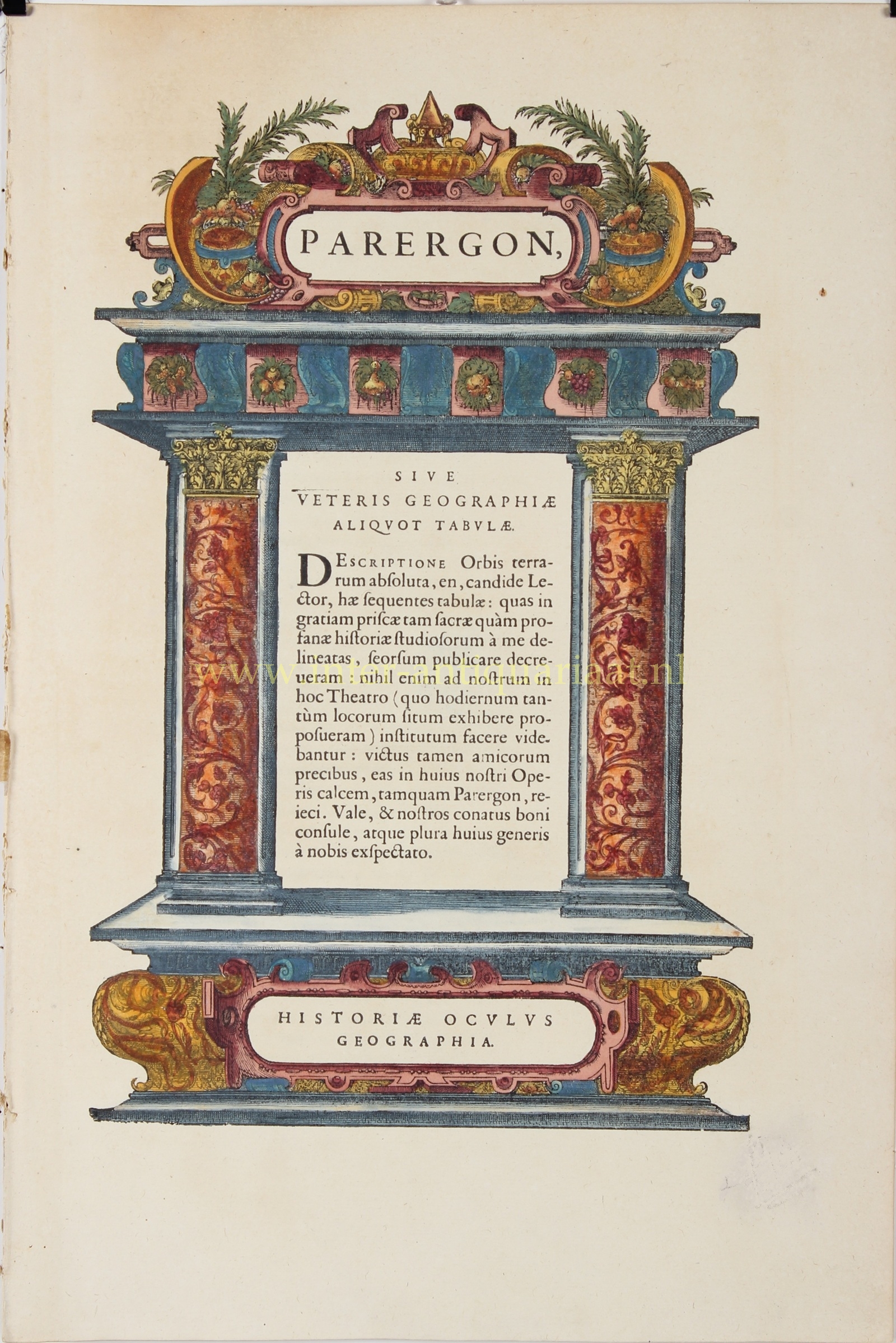
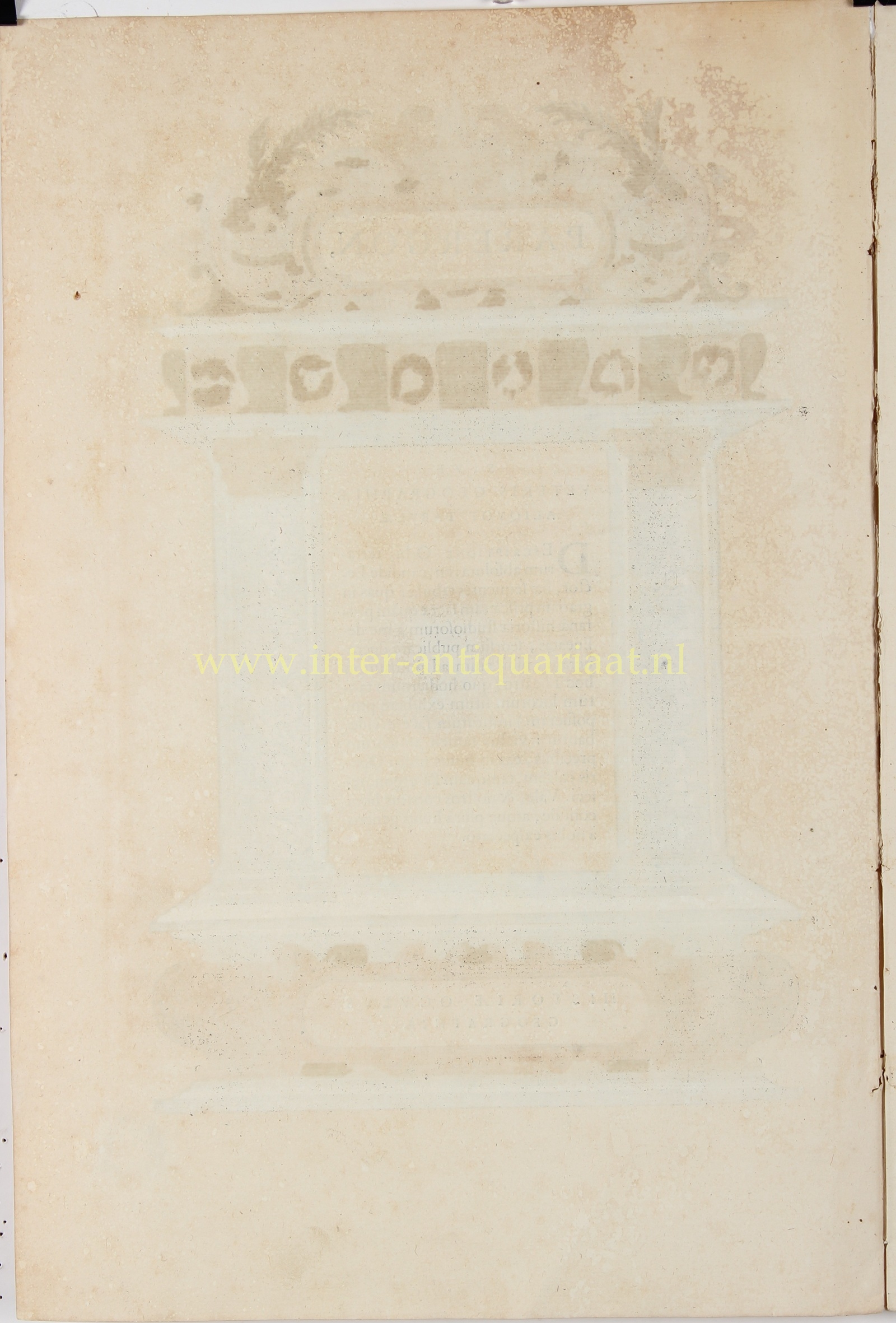
“Parergon, sive Veteris Geographiae aliquot tabulae” [Supplement, or several maps of ancient geography], title page for the Parergon of Abraham Ortelius, printed in Antwerp by Christophe Plantin, ca. 1592–1612. Woodcut with letterpress, with original hand colouring. Approx. 45 × 29.9 cm (sheet).
The title page takes the form of an elaborately decorated Renaissance architectural structure. Two columns with red-marble shafts support a broad entablature adorned with fruit, foliage and ornament. Between the columns appears Ortelius’ address to the reader; below, within an oval, is his famous motto: “Historiae Ocvlvs Geographia” [Geography is the eye of history.]
The motto neatly encapsulates the purpose of the Parergon. Whereas in his celebrated Theatrum Orbis Terrarum Ortelius mapped the world of his own day, in the Parergon he sought to make the world of the past visible. Geography, in his view, offered a means of understanding history: events from Classical and Biblical antiquity acquired greater meaning when one could see where they had taken place.
In the text on the title page, Ortelius himself explains why he added these maps. He had made them for students and enthusiasts of ancient history, both sacred and secular, and had originally intended to publish them separately. They did not, after all, entirely fit the original purpose of the Theatrum, which was to show the contemporary location of countries and places. At the urging of friends, however, he ultimately added the historical maps to his atlas as a parergon: literally a ‘supplementary work’ or appendix.
The first three maps of the Parergon appeared as early as 1579 as additions to the Theatrum. In the years that followed, Ortelius steadily expanded the series with reconstructions of, among other subjects, the Roman Empire, ancient Greece, Egypt, the Holy Land, and the journeys of figures from the Bible and Classical mythology. Unlike many of the maps in the Theatrum, for which Ortelius drew upon the work of other cartographers, he carried out extensive historical and geographical research himself for the Parergon. The collection is therefore generally regarded as the first historical atlas.
The architectural frame surrounding the text was not, incidentally, designed especially for Ortelius. The Antwerp printer Christophe Plantin had previously used the same woodblock for the opening of Genesis in his monumental Biblia Regia, or Plantin Polyglot, printed between 1569 and 1572. For the first separate title page of the Parergon, the block was reused and combined with Ortelius’ own title and text. The Parergon first received this separate title page in the edition of 1592.
Price: Euro 175,-