

Satire on women’s emancipation – A. Sala, ca. 1892
€750





WOMEN UNDER ARMS – A SATIRE ON WOMEN’S EMANCIPATION, CA. 1892
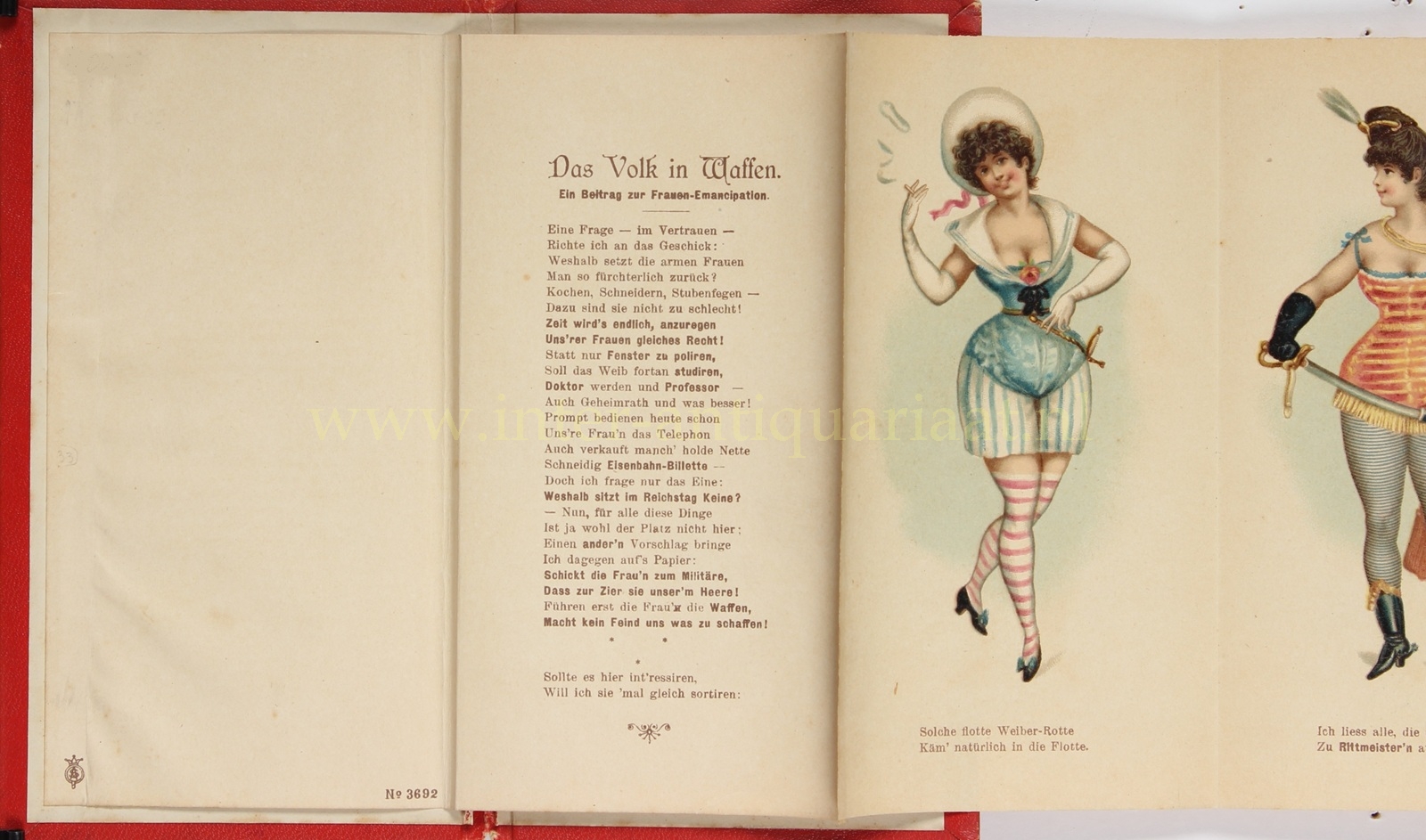
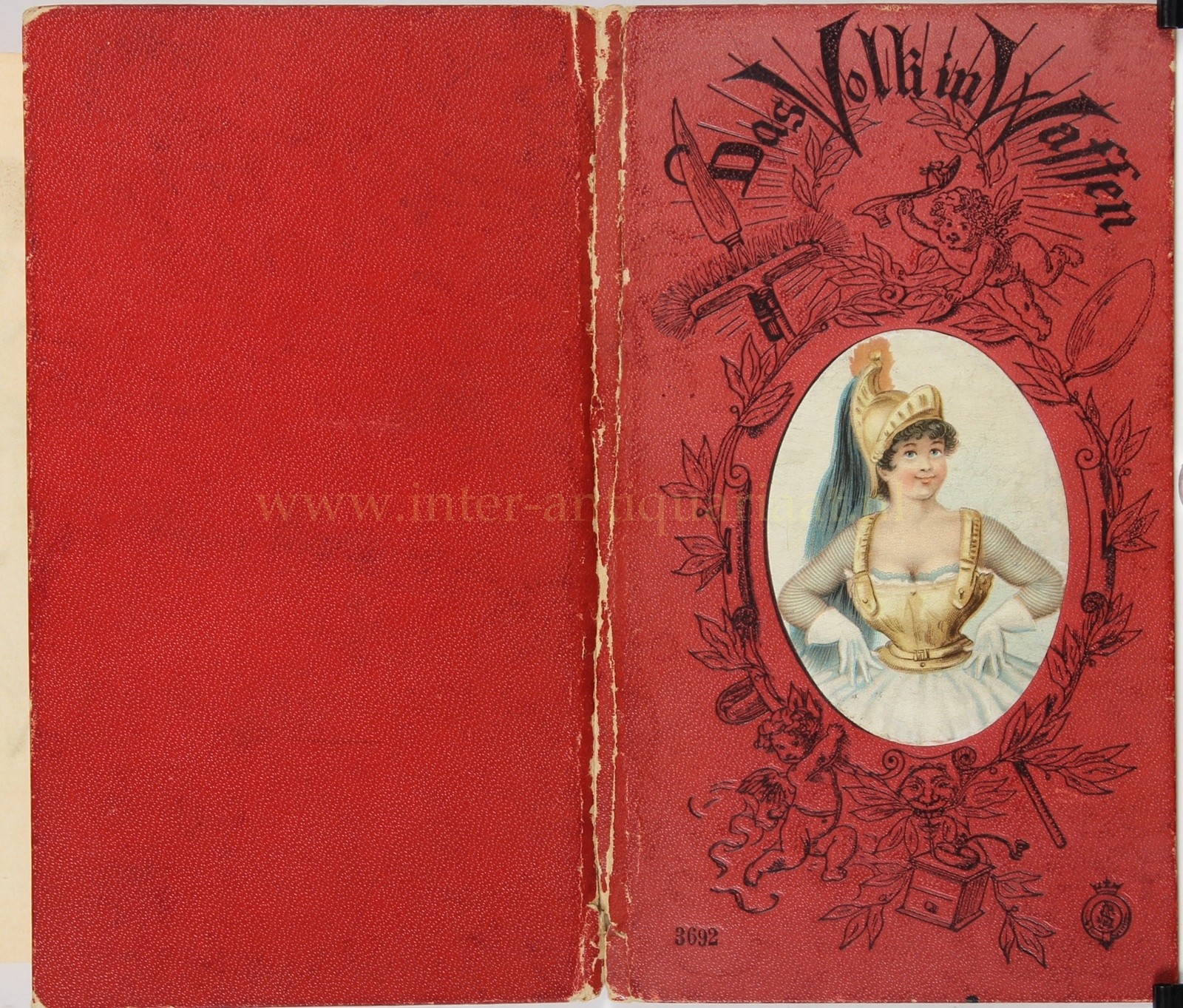
“Das Volk in Waffen. Ein Beitrag zur Frauen-Emancipation” (The People in Arms. A Contribution to Women’s Emancipation), humorous German leporello published by A. Sala in Berlin, ca. 1892. Chromolithograph, with ten depictions of women as soldiers, each accompanied by a mocking rhyme. Unfolded dimensions ca. 14.8 × 95 cm.
What would happen if women not only claimed the same professions and political rights as men, but were also required to serve in the army? It is from this premise that this colourful satire on women’s emancipation unfolds.
On the title page, an anonymous poet observes that women are now studying, becoming doctors and professors, operating telephones and selling railway tickets. Yet one important sphere still remains closed to them:
“Doch ich frage nur das Eine:
Weshalb sitzt im Reichstag Keine?”
(Yet there is one thing I ask:
Why is there not a single woman in the Reichstag/parliament?)
The solution he then proposes is as simple as it is absurd: send women into the army.
“Schickt die Frau’n zum Militäre,
Dass zur Zier sie unser’m Heere!
Führen erst die Frau’n die Waffen,
Macht kein Feind uns was zu schaffen!”
(Send the women into the military,
So that they may adorn our army!
Once the women bear the weapons,
No enemy will give us any trouble!)
There follows a colourful parade of ten female soldiers. Dressed in tight-fitting fantasy uniforms, corsets, bloomers, striped stockings and high heels, they combine the outward trappings of military life with the female stereotypes of their day. Sabres, rifles and military helmets alternate with domestic and other comic attributes. Even traditional roles such as the cook, the cleaner and the dreaded mother-in-law are transformed into branches of the armed forces.
Each figure is assigned her own regiment and an accompanying verse. Thus an attractive young woman is destined for the navy:
“Solche flotte Weiber-Rotte
Käm’ natürlich in die Flotte.”
(Such a dashing female crew
Would naturally belong in the fleet.)
The wordplay continues throughout the series. Military jargon is combined with jokes about appearance, temperament, domestic life, marriage and the supposed characteristics of women. The result is at once a military caricature, a fashionable revue and a mildly risqué pictorial satire.
The subtitle “Ein Beitrag zur Frauen-Emancipation” is emphatically ironic. In the German Empire, the position of women in education, professional life and the public sphere was becoming an increasingly prominent subject of social debate during these years. Political equality, however, was still far removed: women did not have the right to vote and could not sit in the Reichstag. The line “Weshalb sitzt im Reichstag Keine?” therefore referred to a very immediate political reality.
The satire transforms the growing social emancipation of women into a comic vision of the future. Women may enter one of the most explicitly masculine domains of all — the army — but are immediately represented according to familiar clichés: coquettish, domestic, seductive, quarrelsome or maternal. It is precisely this contradiction that makes the series today such a vivid document of contemporary attitudes towards changing gender roles at the end of the nineteenth century.
The crowned “AS” monogram on the inside of the cover is the trademark of A. Sala, an important Berlin lithographic art printer, publisher and manufacturer of luxury paper goods. The firm used this trademark from the 1880s onwards and specialised in, among other things, humorous printed matter, luxury paper products and games.
Price: Euro 750,-
RESERVED