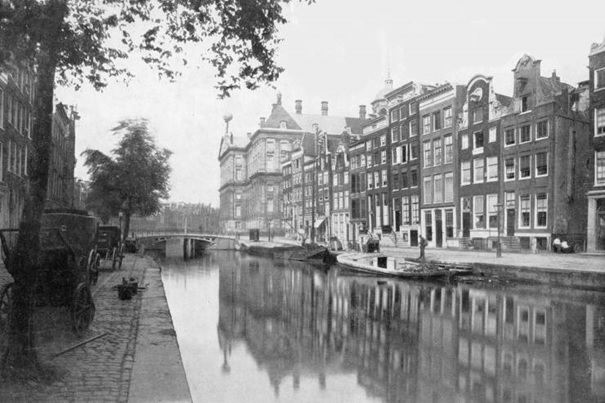

Amsterdam, Nieuwezijds Voorburgwal – Andries and Hendrik de Leth, c. 1725-1731
€4.950
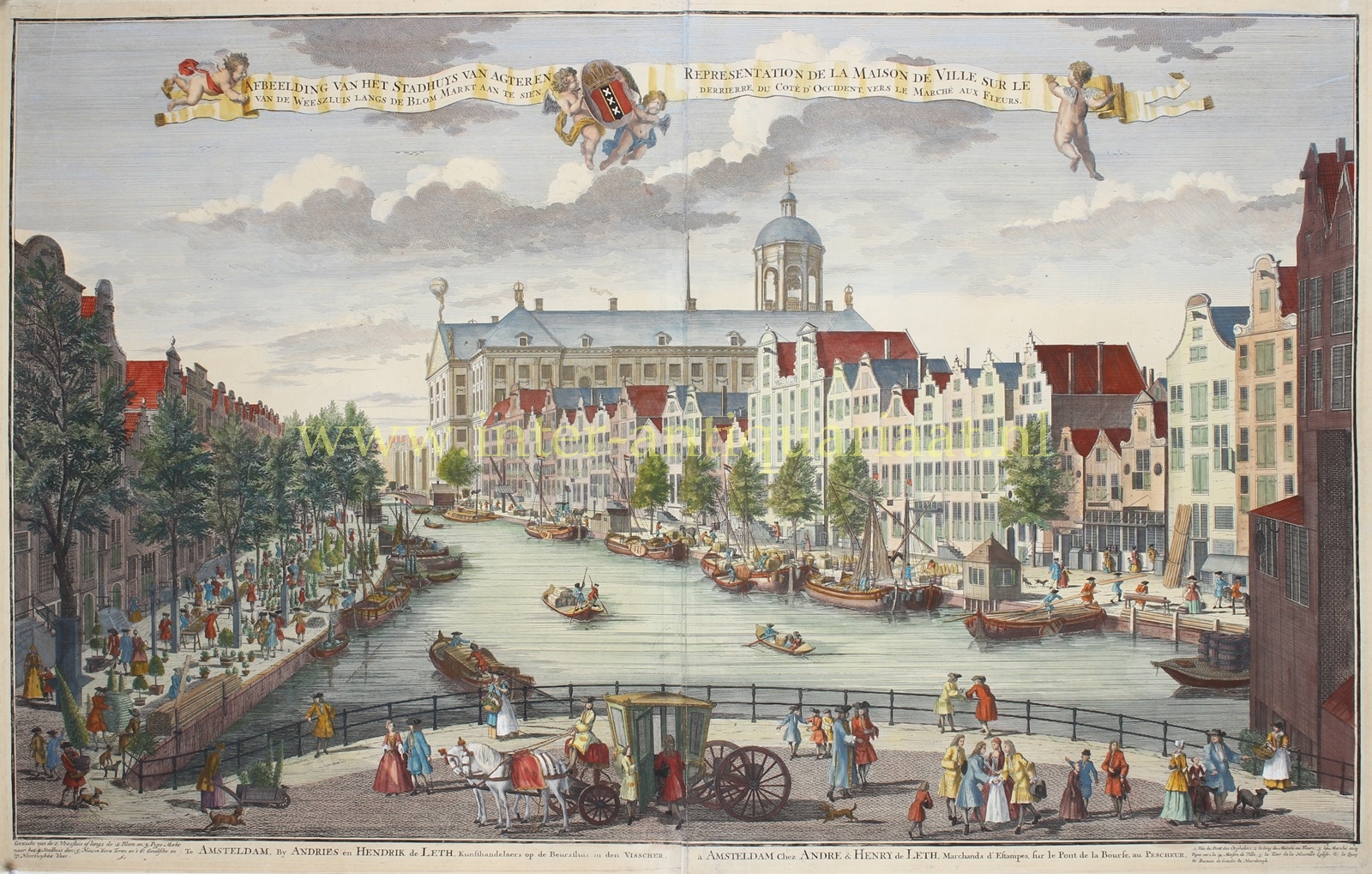
NIEUWEZIJDS VOORBURGWAL WITH FLOWER MARKET AND TOWN HALL IN AMSTERDAM, 1725–1731
“Afbeelding van het Stadhuys van Agteren van de Weeszluis langs de Blom Markt aan te sien / Representation de la Maison de Ville sur le Derriere, du Coté d’Occident, vers le Marché aux Fleurs.” Etching and engraving, printed from two copper plates, made by Hendrik de Leth and published in Amsterdam by Andries and Hendrik de Leth, 1725–1731. Coloured by a later hand. Plate mark: 58.4 × 92 cm.
From the Weessluis, named after the nearby Burgerweeshuis (Civic Orphanage), we look northwards along the Nieuwezijds Voorburgwal. In the distance, the monumental western rear façade of Amsterdam’s Town Hall dominates the view (since 1808 the Royal Palace). The quays, canal and bridge in the foreground teem with merchants, pedestrians, boatmen, small boats, cargo vessels, horses and carriages. The print therefore presents not only a monumental city view, but also an exceptionally lively picture of everyday traffic and commerce in early eighteenth-century Amsterdam.
Along the water on the left is the flower market, which in the eighteenth century was Amsterdam’s principal market for flowers, plants and trees. Merchants from the surrounding region brought their goods into the city by boat and offered them for sale along the quay. As early as the seventeenth century, florists and growers from places including Haarlem and Noordwijk came to sell their wares at this market. In 1862, the flower market moved to the Singel, between the Munt and Koningsplein.
On the opposite side was the Pijpenmarkt, or Pipe Market, where earthenware tobacco pipes (mainly from Gouda) were brought ashore, unloaded and traded. This was also the landing place for the ferry service to Gouda. Opposite the Pijpenmarkt, near the Weessluis, was the Boommarkt, where the ferry services to Lisse and Noordwijk called. This part of the Nieuwezijds Voorburgwal was therefore not only an important market district but also a busy hub for passenger and goods transport.
Behind the Town Hall rises the base of the never-completed tower of the Nieuwe Kerk. Plans to provide the church with a monumental tower had been abandoned during the seventeenth century; in 1783, most of the remaining tower structure was demolished.
The Nieuwezijds Voorburgwal was filled in in 1884. The Weessluis, which crossed the canal between Sint Luciënsteeg and Rosmarijnsteeg, disappeared at the same time.
Prijs: Euro 4.950,-