

Art Nouveau furniture poster – Adolf Senglaub, ca. 1900
€1.650
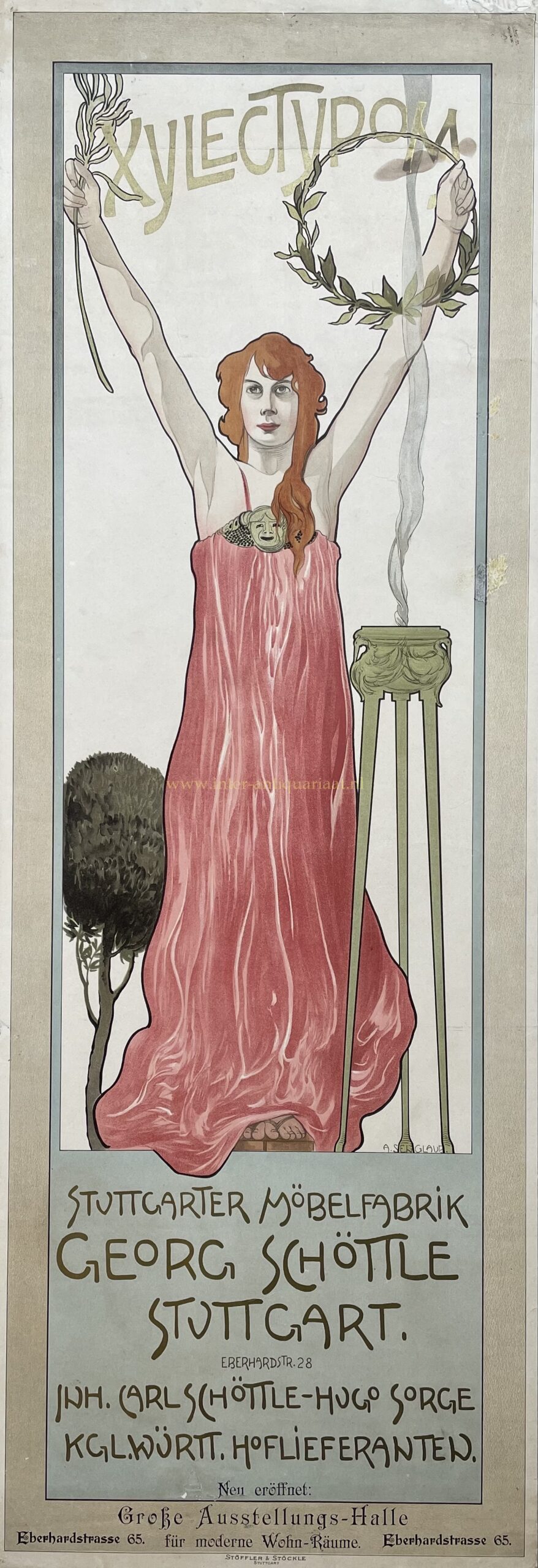
ART NOUVEAU POSTER FOR MODERN FURNITURE – STUTTGART, C. 1900
“Xylectypom – Stuttgarter Möbelfabrik Georg Schöttle”, colour lithograph after a design by Adolf Senglaub, published in Stuttgart, c. 1900. Signed “A. Senglaub” in the lower right of the image. Size: 96.5 × 33.5 cm.
This Art Nouveau poster depicts a young woman with long, reddish-brown hair, dressed in a flowing pink gown. With both arms raised, she holds a palm branch and a laurel wreath, classical symbols of victory and glory. Her pose and attributes are reminiscent of Victoria, the Roman goddess of victory. Beside her stands a tall, slender pedestal supporting a smoking incense burner.
The poster was designed for the Stuttgarter Möbelfabrik Georg Schöttle, a renowned furniture manufacturer and official supplier to the royal court of Württemberg. The company, then managed by Carl Schöttle and Hugo Sorge, specialised in modern furniture and interior furnishings, incorporating innovative techniques in the decorative arts.
Across the top, the word Xylectypom appears in large letters, referring to an innovative wood-decorating technique developed in the late nineteenth century. In this process, sandblasting was used to partially remove the softer wood between the annual growth rings, bringing the natural grain into raised relief. The technique made it possible to embellish furniture, doors and wall panelling with distinctive, organic ornamentation. Around 1900, the Schöttle company was among the leading manufacturers employing this technique.
At the bottom, the poster announces the opening of a large new exhibition hall at Eberhardstraße 65 in Stuttgart, where visitors could admire fully furnished modern interiors. Contemporary advertisements indicate that the exhibition opened around Christmas 1900.
The designer, Adolf Senglaub (1873–after 1945), studied at the Stuttgart Academy of Fine Arts and worked as a painter, draughtsman and poster artist. His graphic work around the turn of the century displays the characteristic visual language of German Jugendstil, with its preference for stylised figures, flowing lines and elegant lettering.
With its tall, narrow format, stately female figure and refined colour palette, this poster is a fine example of early German poster art. It also reflects the close collaboration between artists, designers and furniture manufacturers around 1900, when the Jugendstil movement sought to establish a new unity between art, craftsmanship and modern interior design.
Price: Euro 1.650,-