

Amsterdam – Heirs Jansz. van Waesberge, 1694
€2.750

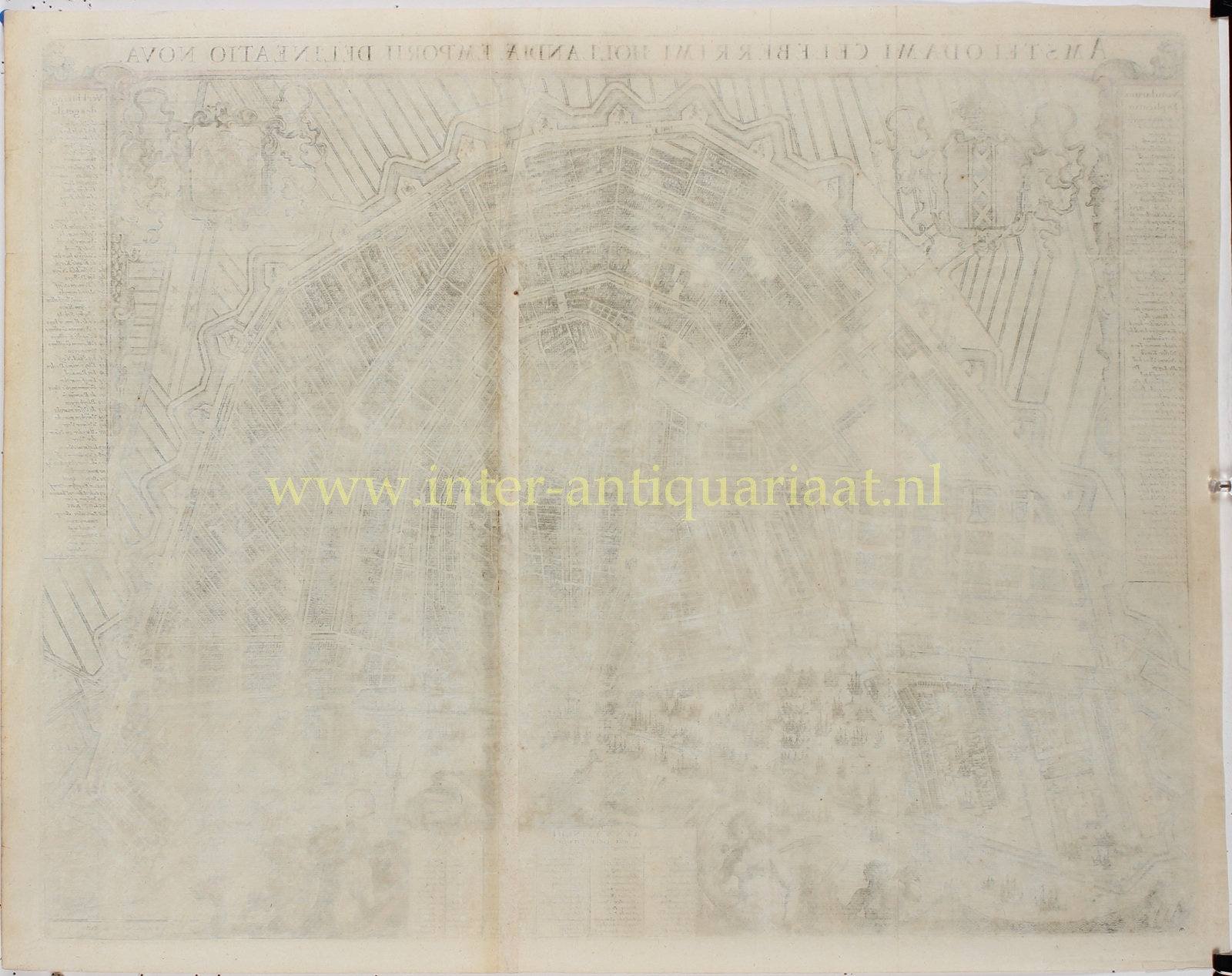


THE FAMOUS AMSTERDAM, COMMERCIAL CITY OF HOLLAND
“Amstelodami Celeberrimi Hollandiae Emporii Delineatio Nova”, copper engraving of the city of Amsterdam, produced around 1694 by the Heirs of Johannes Janssonius van Waesberge. Coloured by a later hand. Size: 41 × 43 cm.
The model for this map was an earlier city plan by Johannes Janssonius from 1657. The title, the legend panels, and the city’s coat of arms and seal on both maps are strikingly similar. Whereas Janssonius shows the Third Expansion (derde uitleg), this map also depicts the Fourth Expansion (Vierde Uitleg), the never-realised grid for the Plantage district designed by the city architect Daniël Stalpaert in 1662.
The map contains four lists of references. On the left, under the heading “Notularum Explicatio”, the numbering runs from “1 Het Willige Rasphuis” (where convicted criminals were forced to rasp wood for the paint industry) to “63 De Engelsche Kerck” (in the Begijnhof). On the right, under the title “Verklaringe des getals”, it continues from “64 De Oßen Sluys” (the point where the Spui flowed into the Rokin) to “121 Admiraliteits hock”. At the bottom centre, in four shorter columns, is a third list: “Aenwijsinghe met cijfer getalen. Waer de niewe Royinge der Stadt met de oude verenight” (referring to the Fourth Expansion). To the right of this is another list with the “Naemen der Bolwercken” (names of the bastions), from “1 Zee Burch” (which guarded the IJ and was demolished in 1877) to “26 Leeuwenburg” (the north-westernmost bastion of the city, later known as Het Blauwhoofd).
The central legend at the bottom is surrounded by Neptune, god of the sea, who is offered cornucopias by various sea creatures. It was through the water, after all, that Amsterdam had acquired its wealth.
Price: Euro 2.750,-