

Nagasaki with Dejima – Baikōdō, c. 1860
€2.750
NAGASAKI AND DEJIMA AT THE END OF THE DUTCH TRADE MONOPOLY
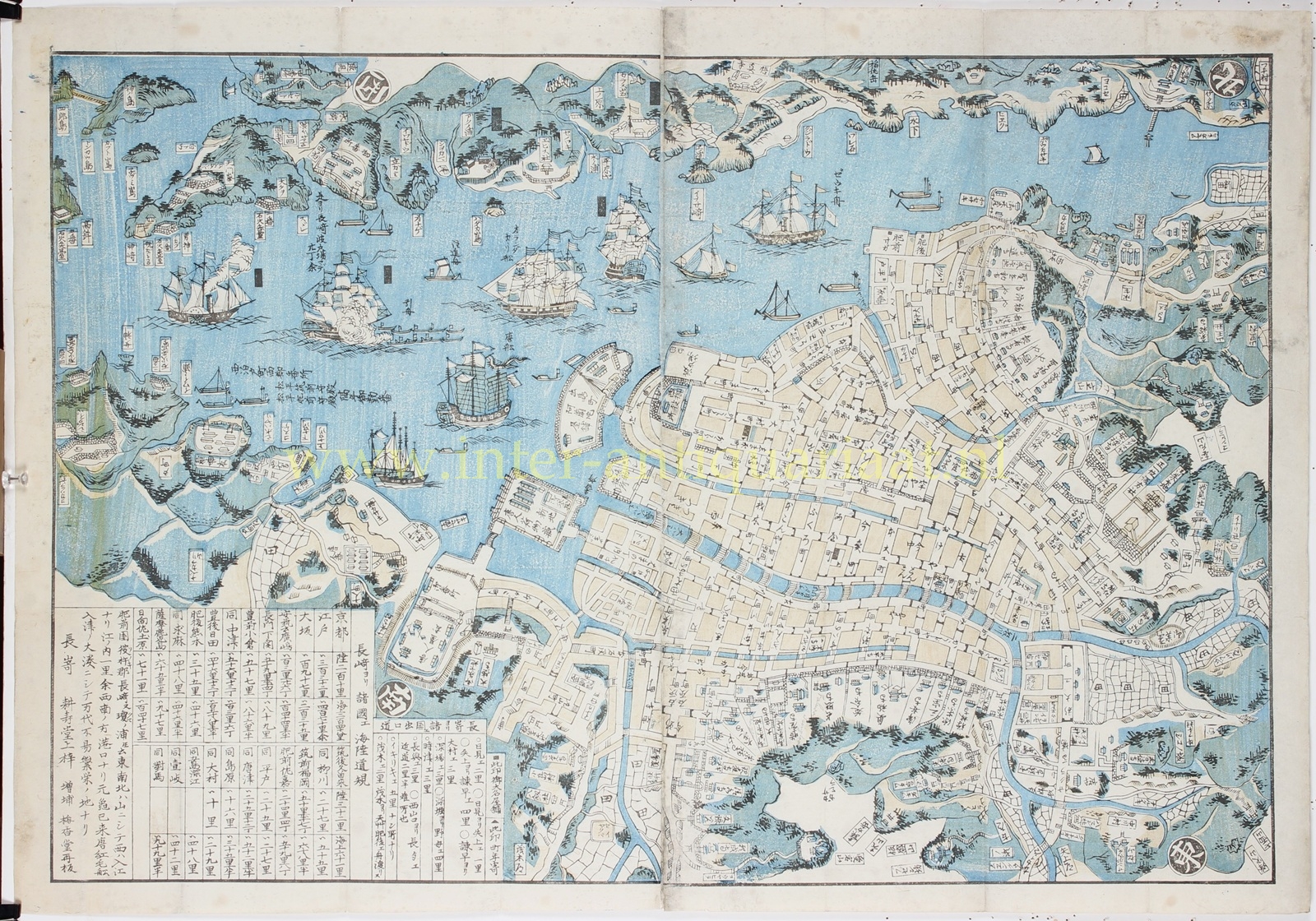
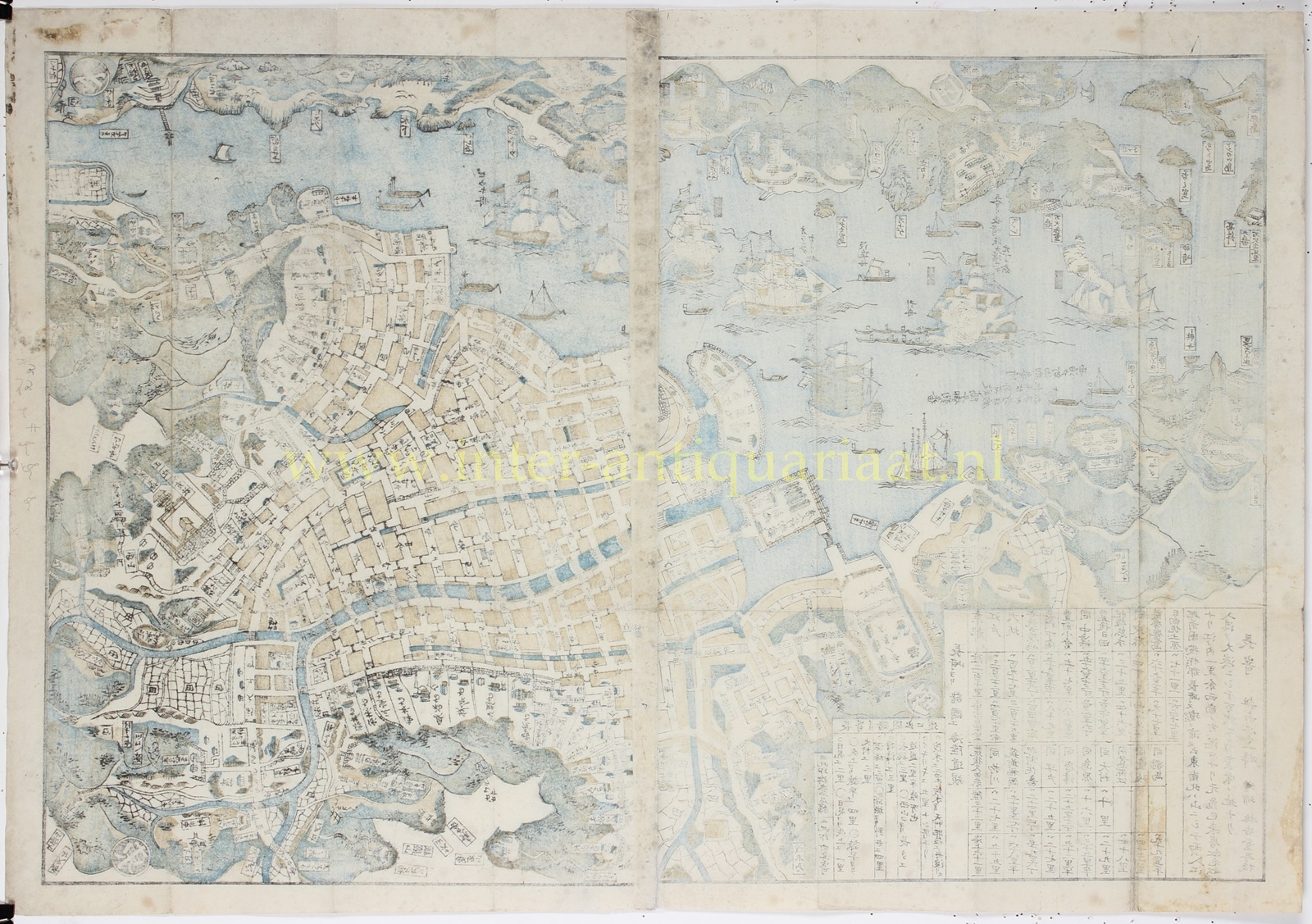
“Shinsen Hizen Nagasaki zu” (新鐫 肥前長崎圖), woodblock print with original colours, first published by Kōjudō (耕寿堂) in Nagasaki, here in a revised edition by Baikōdō (梅香堂), c. 1860. Size (paper): 46.4 × 68.3 cm.
The map shows Nagasaki obliquely from the southwest, with north towards the upper right. Prominent in the composition is the vast harbour. Because of this unusual orientation, the ships appear to sail horizontally into the map. At the centre lies Dejima, the characteristic fan-shaped island on which the Dutch maintained their trading post for more than two centuries. At lower left, tables give the distances from Nagasaki to other places, both by land and by sea.
From 1641, the Dutch East India Company (VOC) maintained a factory on Dejima. After the Portuguese had been expelled from Japan, the Dutch formed the only European trading community permitted to remain in the country. Their presence was strictly regulated: trade was conducted through Japanese officials, the residents could leave Dejima only under certain conditions, and the island was connected to the city by a single bridge. For more than two centuries, Nagasaki thus served as the principal channel through which European goods, books and scientific knowledge reached Japan.
Just as this map was being published, that old system was collapsing. In 1853, the American Commodore Matthew Perry appeared off Uraga with his ‘Black Ships’, while in the same year the Russian envoy Yevfimiy Putyatin arrived at Nagasaki with his fleet. Foreign pressure on the Tokugawa shogunate increased rapidly. From 1854 and 1855 onwards, Japan concluded treaties with the United States, Great Britain, Russia and the Netherlands. The centuries-old Dutch privilege had thereby come to an end. On the map, modern Western steamships appear among the traditional sailing vessels; these were no longer exclusively Dutch.
The Netherlands nevertheless continued to play a role during these transitional years. In 1855, King William III presented the steamship Soembing to the shogunate. The vessel was used by the Nagasaki Naval Training Center, founded that same year, where Dutch naval officers provided instruction. In 1857, a second Dutch training mission arrived, accompanied by the naval physician Johan Pompe van Meerdervoort, who organised Western medical education in Nagasaki and ultimately laid the foundations for Japan’s first modern Western-style hospital, opened in 1861.
The treaties of 1858 made the opening of Japan definitive. In 1859, Nagasaki was opened to international trade and the old Dutch factory on Dejima was abolished and converted into a Dutch consulate.
The map records virtually the last moment at which Dejima still lay in the harbour as a separate, fan-shaped island. In 1861, the first land reclamation began along its edges; in the following years, increasing areas of water around Dejima were filled in. Following the opening of Nagasaki, a new foreign settlement developed south of Dejima, where merchants and diplomats from various Western countries established themselves. Dejima was incorporated into this settlement in 1866. Eventually, the island’s distinctive shape disappeared entirely from the cityscape.
Price: Euro 2.750,-