

Antwerp – Braun & Hogenberg, 1572
€975


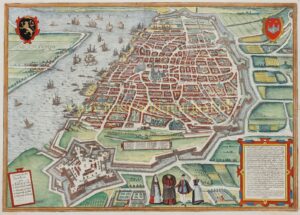

“Antverpia”, copper engraving made for the first volume of the “Civitates Urbis Terrarum,” published in 1572 (or later) by Georg Braun and Frans Hogenberg. Coloured by a later hand. Latin text on the verso. Size: 34 × 47.5 cm.
We see the city on the Scheldt in bird’s-eye view. Particularly striking in the foreground is the star-shaped citadel on the southern side of Antwerp, built by the Duke of Alba, together with the city moat and the harbour serving this prosperous commercial centre. The city centre is clearly recognisable, with the Cathedral of Our Lady (1), the town hall (24) behind it overlooking the Grote Markt (13), and the cattle market (16). The northern tower of the Gothic cathedral forms the city’s principal landmark.
The earliest historical references to Antwerp point to the existence of a settlement with a central function in the mid-seventh century. In 1008 it received its own city seal, and in 1315 it became a Hanseatic city. Merchant guilds settled here, and between 1347 and 1496 Antwerp’s population grew from 5,000 to 50,000; by around 1560 it had reached approximately 100,000 inhabitants.
In the sixteenth century Antwerp was also an important centre of the arts and the home of Christoffel Plantin, the most important printer and publisher north of the Alps. The prosperous metropolis attracted many artists, including Jan Brueghel the Elder, Peter Paul Rubens, and Anthony van Dyck.
Antwerp, however, also became entangled in the Wars of Religion, and in 1585 the city was captured by Alexander Farnese, Duke of Parma. Numerous Protestant merchants and craftsmen were subsequently driven out, leading to a sharp decline in the city’s importance. This bird’s-eye view shows Antwerp in the period shortly before these events.
In the cartouche at lower right, the city is described as follows:
Antwerp is a fine and renowned trading city in Brabant, much visited by Germans, French, Spaniards, English, Italians, and others. In this city stand magnificent and imposing public and private buildings, among them in particular the Church of Our Lady with its lofty stone tower, and the splendid and beautiful town hall. The venerable Hanse, the English, and the Portuguese also possess public buildings in which the merchants have their lodgings. In the church of Saint Michael there stands a magnificent monument and tomb for Isabella’s husband, Charles [the Bold], Duke of Burgundy. On 5 November 1567 the vast city wall was built with imposing fortifications and bastions, and surrounded by a great moat. Within it, comfortable houses inhabited by the garrison encircle a large square. In the centre stands a statue of the famous Duke of Alba, made of gilded metal and lavishly cast by order of the King of Spain. It was erected in memory of Fernando Álvarez de Toledo, Duke of Alba, by Philip II, commander-in-chief of the Spanish Netherlands, as the king’s most loyal servant; for after suppressing the revolt and crushing the rebels, he upheld the faith, the law, and the peace of the province.
Price: Euro 975,-