

Nagasaki, Dejima – Guillaume Dheulland + Jacques-Nicolas Bellin, 1764
€295


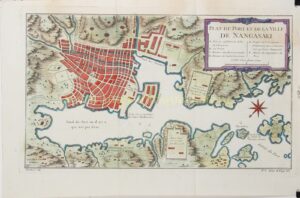
THE BAY OF NAGASAKI WITH VOC TRADING POST DEJIMA
“Plan du port et de la ville de Nangasaki“. Copperplate engraving made by Guillaume Dheulland and published by Jacques-Nicolas Bellin in 1763 after a map from Engelbert Kaempfer‘s “De Beschryving van Japan” of 1729. Coloured by a later hand. Size: approx. 19 x 33.5 cm.
Following the expulsion of the Portuguese from Japan, only Chinese and Dutch ships were permitted to sail to Japan, and Nagasaki was the only port they were allowed to enter. Dejima became the trading post of the Dutch East India Company (VOC) in 1641 and remained Japan’s sole point of contact with Europe until the late 1850s.
Life on Dejima was monotonous. The Dutch lived there under strict restrictions. Except for an annual visit to the shogun in Edo (present-day Tokyo), they were not permitted to leave their small island. During the trading season from August to November, the garrison typically consisted of an Chief Merchant, a second merchant, several junior merchants and a number of assistants, including the physician.
The map is oriented diagonally, with north at the lower left. Dejima, the fan-shaped island measuring approximately 70 by 210 metres, is connected to the mainland by a single bridge; visitors arriving by land must first pass through the guardhouse. In addition to the Dutch trading post, the map also shows the Chinese harbour. The imperial guard at the mouth of the bay, totalling two contingents of 700 men, ensures that foreigners comply with the rules.
Engelbert Kaempfer (1651–1716) was a German-born scholar and traveller who, in the service of the VOC, lived at the Dutch trading post on Dejima from 1690 to 1692 as a physician. After his death, his travel account was published; it was the most important source of knowledge about Japan in the 18th and 19th centuries.
Price: Euro 295,-