

The Hague – A.J. Sijthoff, 1952
€175



THE HAGUE IN THE EARLY YEARS OF POST-WAR RECONSTRUCTION
Plan of The Hague and its surroundings, colour offset print issued by A.J. Sijthoff, published as a folding map with the 1952 guide “In en om Den Haag” [In and Around The Hague]. Sheet size: 55 × 75.5 cm.
This large city plan shows The Hague in the early years of post-war reconstruction. It includes Scheveningen and the coastal dunes, the densely built-up city centre, the green belt of parks and country estates, the Zuiderpark, and the neighbouring municipalities of Rijswijk, Voorburg and Leidschendam. Open polders and undeveloped land still appear around the edges of the map, clearly revealing the city’s rapid post-war expansion.
Railway lines, stations, main roads and numbered tram routes are clearly marked. Familiar landmarks—including the Haagse Bos, the Scheveningse Bosjes, the Zuiderpark, the Hofvijver and the principal arterial roads—give the city a recognisable structure. The old Staatsspoor railway station is still shown, before it was replaced in the early 1970s by the new Central Station.
The plan appeared at a moment when The Hague had to be rebuilt while also expanding rapidly. War damage, housing shortages and population growth created an urgent need for new housing and transport connections. W.M. Dudok’s 1949 structural plan provided the framework for the city’s development, particularly in the south-west, where districts such as Morgenstond, Bouwlust, Berestein and Vrederust were developed during the 1950s and 1960s. This map captures The Hague at the very beginning of that far-reaching transformation.
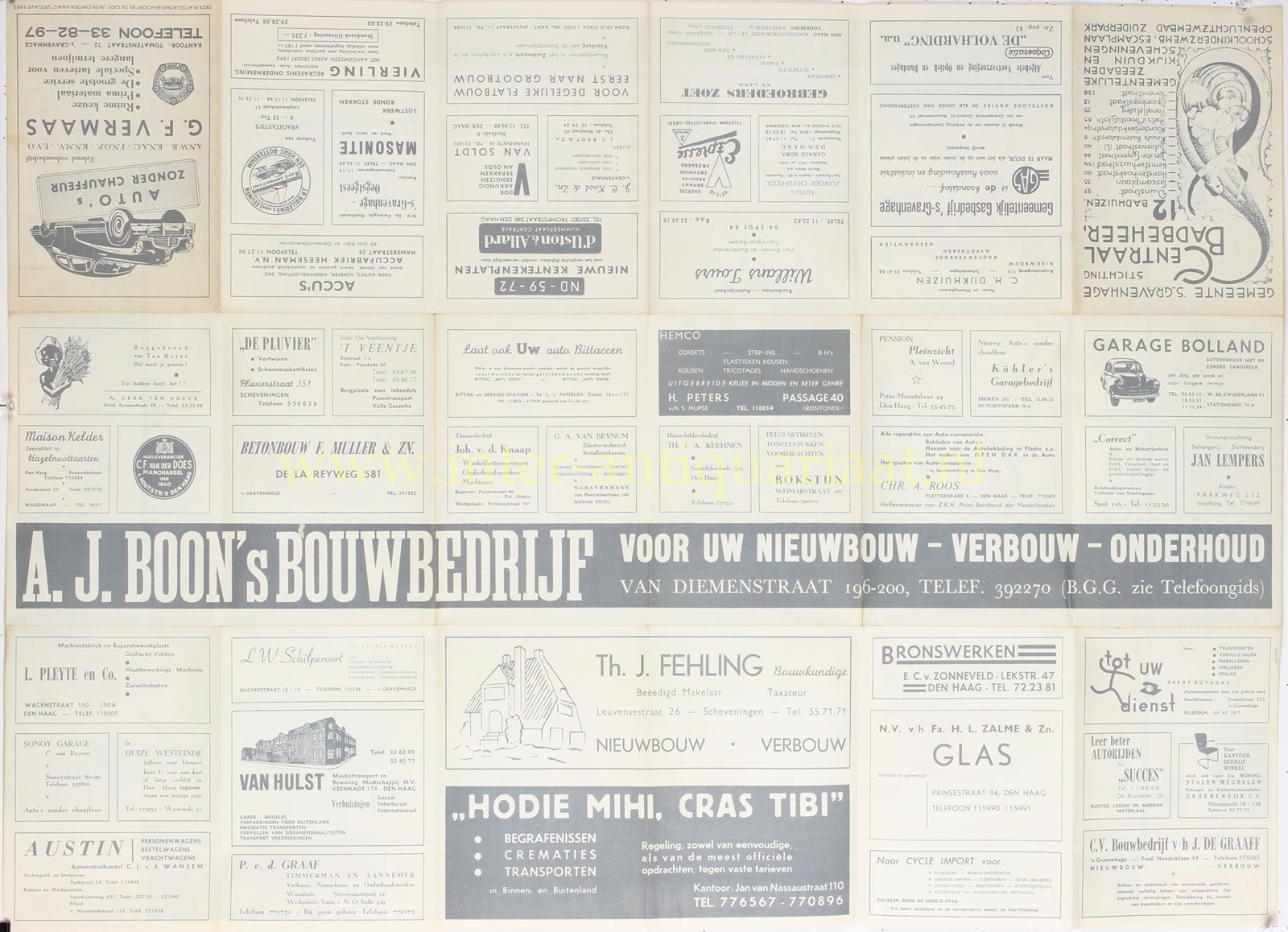
The design makes the sheet especially appealing. Advertisements for Hague-based garages, building firms, contractors, furniture shops, restaurants and service providers surround the map and cover its entire verso. Prominent advertisements for Kodak, Pepsi-Cola, motor businesses and A.J. Boon’s Bouwbedrijf give the sheet the character of a post-war urban document: a practical guide, but also a vivid record of the local economy, building activity and emerging consumer culture of 1952.
Price: Euro 175,-