

The Hague – Joan Blaeu, 1649
€1.850
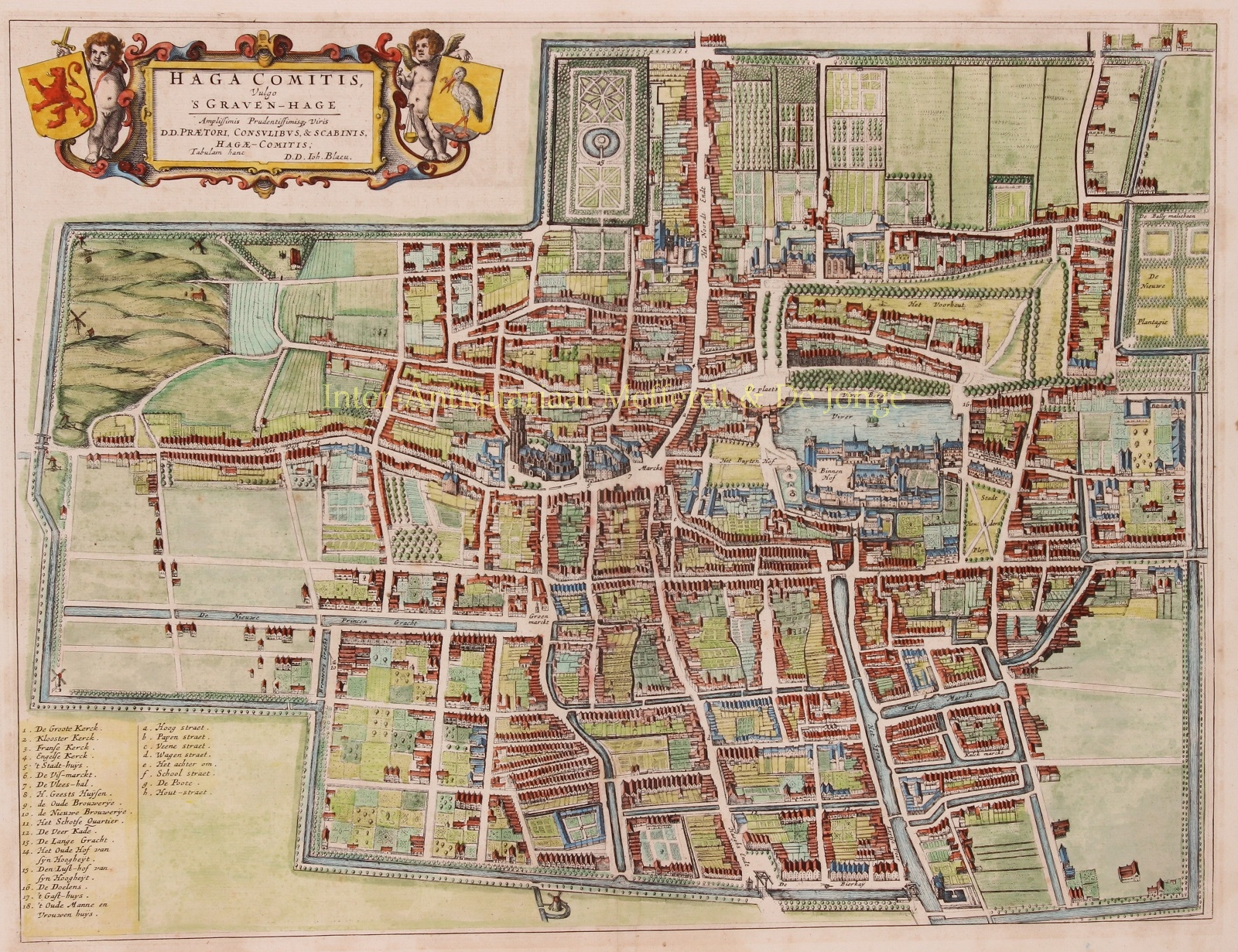


“HAGA COMITIS, COMMONLY CALLED ’S GRAVEN-HAGE”
“Haga Comitis, Vulgo ’s Graven-Hage,” copper engraving published by Joan Blaeu in Amsterdam in 1649 as part of his celebrated “Toonneel der Steden van de Verenighde Nederlanden” [Theatre of the Cities of the United Netherlands] . Original hand colouring. Size (print): 38.5 × 50.5 cm.
It is in fact remarkable that The Hague was included in a town book, for it was not officially a city. Only in 1806 did The Hague receive the honorary title of “city” from Louis Bonaparte. Yet because it was already in the seventeenth century a large and important place (effectively the capital of the Dutch Republic) and possessed several institutions normally found only in cities, Blaeu nevertheless included a plan of The Hague in his atlas.
Prince Maurice had advanced plans to transform The Hague into a fortified city, but the States General regarded this as an infringement on the independence of the administrative centre of the Republic of the Seven Provinces. As a preliminary defensive measure, eleven canals were dug between 1613 and 1619 in a rectangular layout. These canals still exist: Prinsessegracht, Smidswater, Hooigracht, and the waterways along Mauritskade, Hogewal, Prinsessewal, Noordwal, by the Westermolens, Lijnbaan, Buitenom, Zuidwal, Bierkade, Uilebomen, and Zwarteweg. The canal belt was laid out very broadly around the inhabited area, and until about 1850 the town was able to expand modestly within it.
The old comital castle, the Binnenhof, served as the governmental centre of the Republic. The Dutch government still sits there today. And The Hague is still not officially called the capital: according to the constitution of 1815, Amsterdam holds that title, although the government has always remained in The Hague.
Price: Euro 1.850,-