

Amsterdam, Schreierstoren – Willem Hendrik Hoogkamer, c. 1830
€850
THE SCHREIERSTOREN AS A SYMBOL OF GRIEF OVER THE BELGIAN REVOLUTION
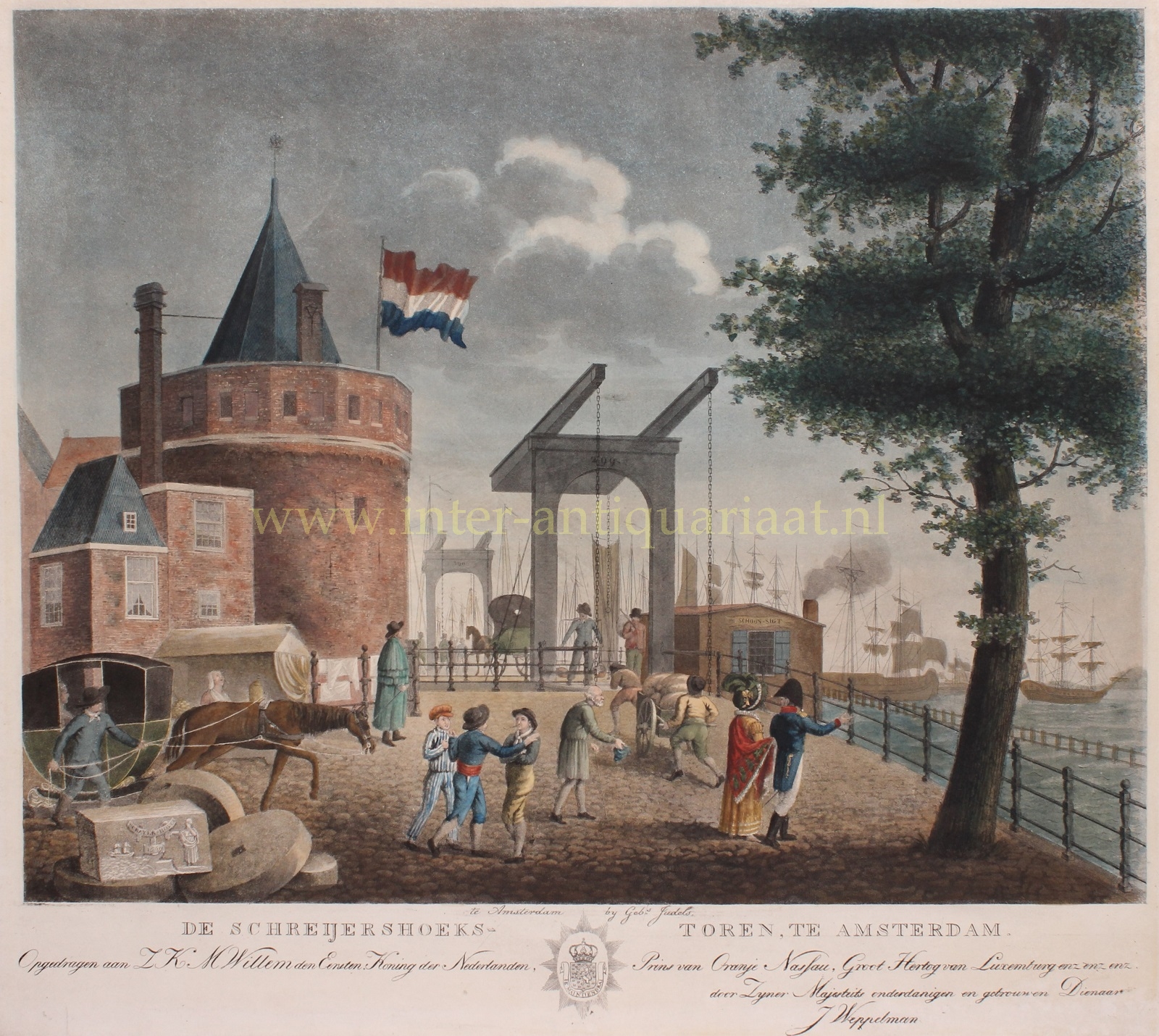
“Schreijershoekstoren, te Amsterdam” [Schreijershoek Tower in Amsterdam]. Aquatint made by Willem Hendrik Hoogkamer after a design by J. Weppelman and published by Gebr. Judels around 1830. Original hand colouring, with later additions. Size (image): 33.7 × 42.5 cm (including text: 39 × 42.5 cm).
At the corner of the Oudezijds Kolk and Geldersekade stands the Schreierstoren. It is the only surviving defensive tower of Amsterdam’s medieval city wall. It was the first defensive tower of the city. From this position there was an excellent view of the harbour and across the IJ, enabling hostile ships to be fired upon if necessary.
The tower was originally called the Schreiershoekstoren. “Schreihoek” probably refers to the sharp angle formed where the Geldersekade and Oudezijds Kolk meet. The Schreierstoren, however, has gone down in history as the place where many women are said to have tearfully (“schreien” means to cry in Dutch) watched their loved ones sail away.
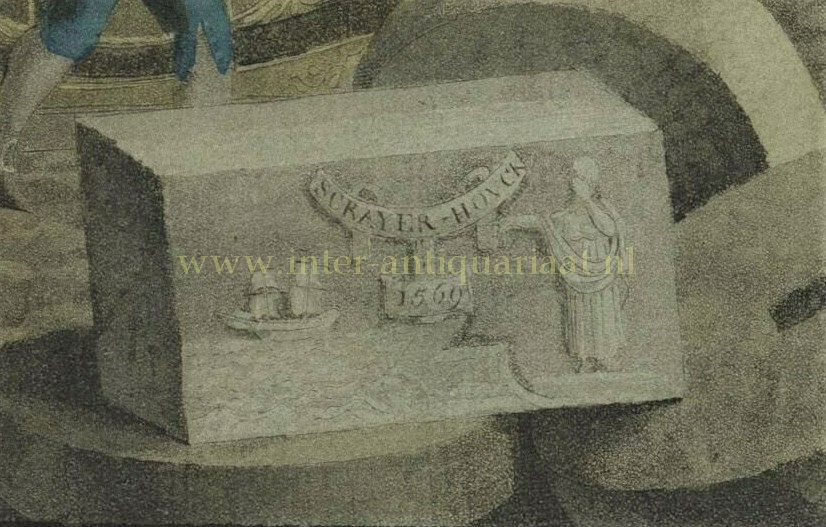
A stone set into the tower in 1569, on the side facing the present-day Prins Hendrikkade, bears witness to this tradition. The relief depicts a weeping woman with the IJ and a departing ship in the background. Its inscription reads: “Scrayer Houck”. In the print, this stone is shown lying in the left foreground.
The year 1569 was a disastrous one for Amsterdam. The Eighty Years’ War (1568–1648) had only just begun, and Amsterdam would not join the Revolt for some years yet. The fleet was captured by the ‘Geuzen‘, while the Duke of Alba threatened to impose the so-called Tenth Penny, a ten per cent tax on the sale of movable goods. It was a drastic measure. The grieving woman on the commemorative stone wears classical dress. She is therefore not an ordinary Amsterdam housewife, but an allegorical figure inspired by classical antiquity. The ship to which she points with tear-filled eyes symbolises merchant shipping, the foundation of Amsterdam’s prosperity. The turbulent waves represent danger and adversity. The Amsterdam city maiden is weeping.
The scene contains numerous references to departure and leave-taking. A horse-drawn sleigh arrives carrying a female passenger — has she come to wave someone goodbye? At a stall strategically positioned for travellers, a woman offers food for sale. A man in an overcoat gazes across the water. An officer points out his ship to a woman. Two men with a handcart carry sacks of goods towards the harbour. In the background, a forest of ships’ masts beckons. Three boys tell one another bold stories about the voyages that await them.
The symbolism of farewell in this image is probably more significant than it first appears. The year 1830 was that of the Belgian Revolution, the armed uprising against King William I of the Netherlands that led to the secession of the southern provinces and the independence of Belgium. For the king it must have been a disastrous year, and it is surely no coincidence that the print is dedicated to him. He refused to accept the Belgian secession. “Je maintiendrai” [I shall maintain] was his motto. The king’s prolonged policy of perseverance caused the national debt to increase enormously. The old beggar, prominently placed at the centre of the composition, alludes to this.
Price: Euro 850,-