

Prague – Elias Baeck + Jeremias Wolff, c. 1720
€3.500


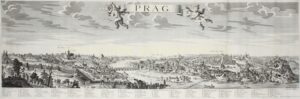

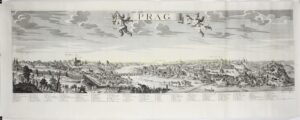
LARGE 18TH-CENTURY PANORAMA OF PRAGUE
“Prag.” Copper engraving on two joined sheets, made by Elias Baeck and published in Augsburg by Jeremias Wolff around 1720. Size: 35 x 107 cm.
Prague is shown from the western or south-western side of the city. The river Vltava (“Muldavia fluvius“) winds through the scene, linking the various parts of the city. On the left lies the Lesser Town (“Die Kleine Seiten“, Malá Strana), above it Prague Castle and St. Vitus Cathedral. In the centre is the Old Town (“Die Alte Statt“, Staré Město), with Charles Bridge as the principal connection across the river. To the right extends the New Town (“Die Neue Statt“, Nové Město), with the elevated fortress of Vyšehrad at the far right.
The scene is richly populated with churches, monasteries, palaces, towers, bridges, gates and fortifications. Beneath the print is an extensive German legend with more than one hundred numbered references to important buildings and institutions. This makes the panorama not only an impressive city view but also a kind of visual guide to Prague: the viewer could locate and identify the individual churches, monasteries, city gates, markets and noble houses.
The city is represented as a series of separate urban units. At the beginning of the 18th century Prague did not exist as a single administrative entity but consisted of several adjoining towns. Only under Emperor Joseph II were these parts administratively united into a single city in 1784.
Above the city view a banderole bearing the title flutters, held by two putti with coats of arms. On the left that of the Holy Roman Empire and on the right that of the Kingdom of Bohemia. It underscores Prague’s special status: as capital of the Kingdom of Bohemia, yet at the same time closely bound to the Habsburg rulers and to the imperial dignity of the Holy Roman Empire.
Elias Baeck (1679–1747) was an Augsburg painter, engraver and printmaker. He worked in Rome and Ljubljana, among other places, but ultimately returned to Augsburg; his work comprised portraits, landscapes and topographical views. Jeremias Wolff (1663–1724) was one of the most important print publishers in Augsburg. Originally a clockmaker, he developed into one of the largest Augsburg publishers of his time.
This print belongs to the flourishing production of large city views by Augsburg publishers in the late 17th and early 18th centuries. Such panoramas were intended for an international public of collectors, travellers, scholars and urban elites. They offered a combination of topographical information, civic pride and decorative representation. In this case Prague appears as a city of exceptional complexity: royal castle-city, Catholic centre, trading place on the Vltava, and capital of Bohemia within the Habsburg Monarchy.
Price: Euro 3.500,-