

Oxford University – William Woollett, 1755
€275
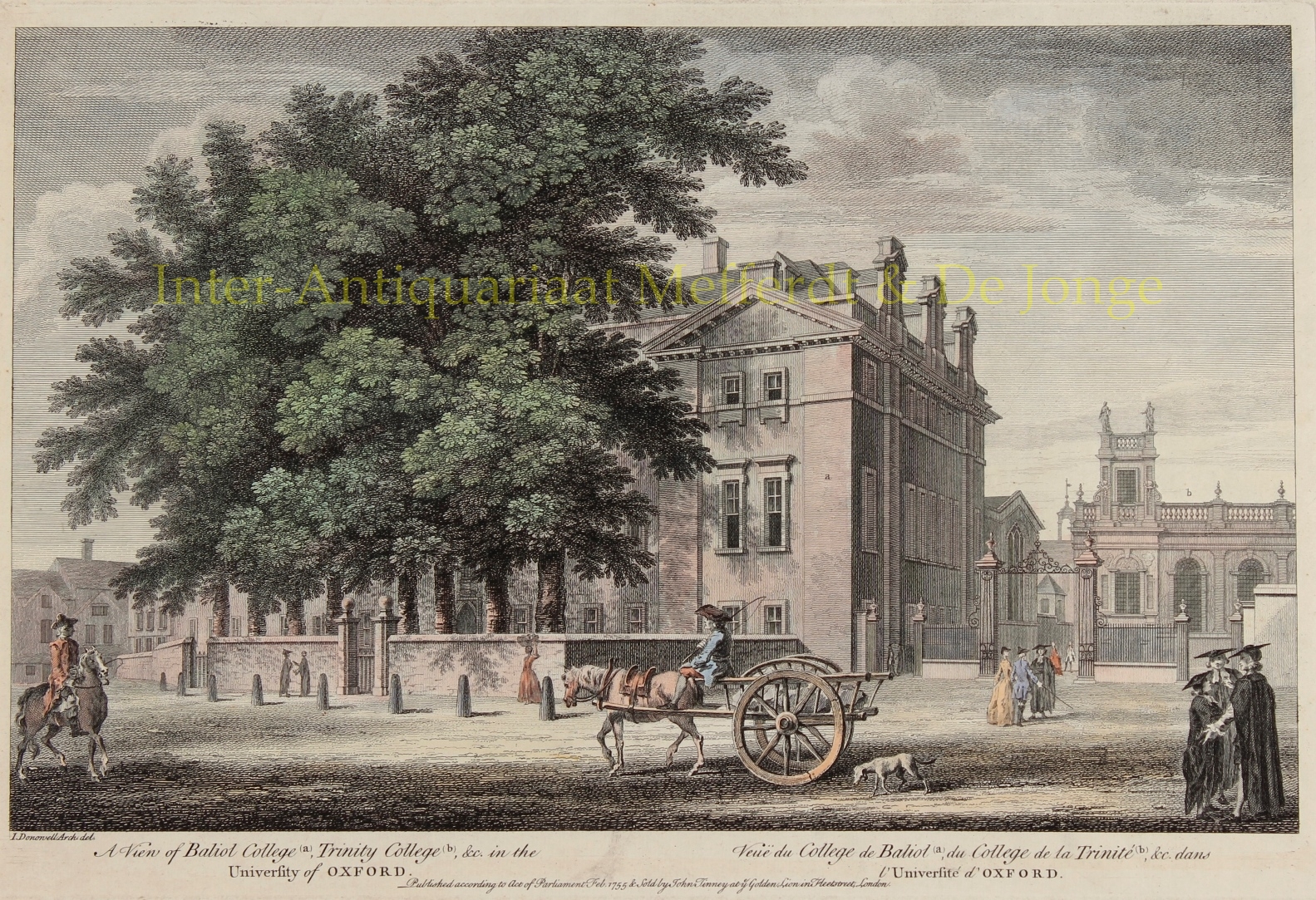
BALLIOL COLLEGE AND TRINITY COLLEGE, OXFORD, 1755
“A View of Baliol College, Trinity College, &c. in the University of Oxford”. Etching and engraving by William Woollett after a drawing by architect and draughtsman John Donowell, published in London by John Tinney in February 1755, as part of the series “Eight Views in the University of Oxford”. Contemporary hand colouring. Size: image 26.3 × 41.8 cm; plate mark 29.2 × 43.4 cm.
A beautiful eighteenth-century view of Broad Street, one of Oxford’s best-known streets, with Balliol College to the left and centre and Trinity College to the right. Donowell not only recorded the architecture of Oxford University with precision, but also provided an appealing glimpse of everyday life in the university city.
Balliol has occupied this site on Broad Street since around 1263 and is therefore one of Oxford’s oldest colleges. In 1755, however, it looked very different from the college we see today. The monumental nineteenth-century façade that now dominates the streetscape had not yet been built. Behind the low wall stood older college buildings, partly concealed by tall trees. The chapel that stood here at the time was also later replaced.
Shortly before this print was made, the future economist Adam Smith had studied here. From 1740 to 1746 he was a Snell Exhibitioner at Balliol, long before The Wealth of Nations made him one of the college’s most famous alumni.
To the right stands Trinity College, behind its monumental entrance gates. Trinity had undergone considerable changes in appearance during the preceding decades. Its imposing Baroque chapel had been completed in 1694; the interior was enriched, among other features, with elaborate woodcarving, while during the eighteenth century the grounds behind the college were transformed into a formal garden.
When William Woollett (1735–1785) made this print in the mid-eighteenth century, Oxford had already been an internationally renowned university for centuries and was closely connected with Britain’s political, ecclesiastical and intellectual elite. Among Trinity’s eighteenth-century students, for example, were the future prime ministers William Pitt the Elder and Lord North.
Price: Euro 275,-