

Cape Town – Isidore Deroy, c. 1850
€1.250
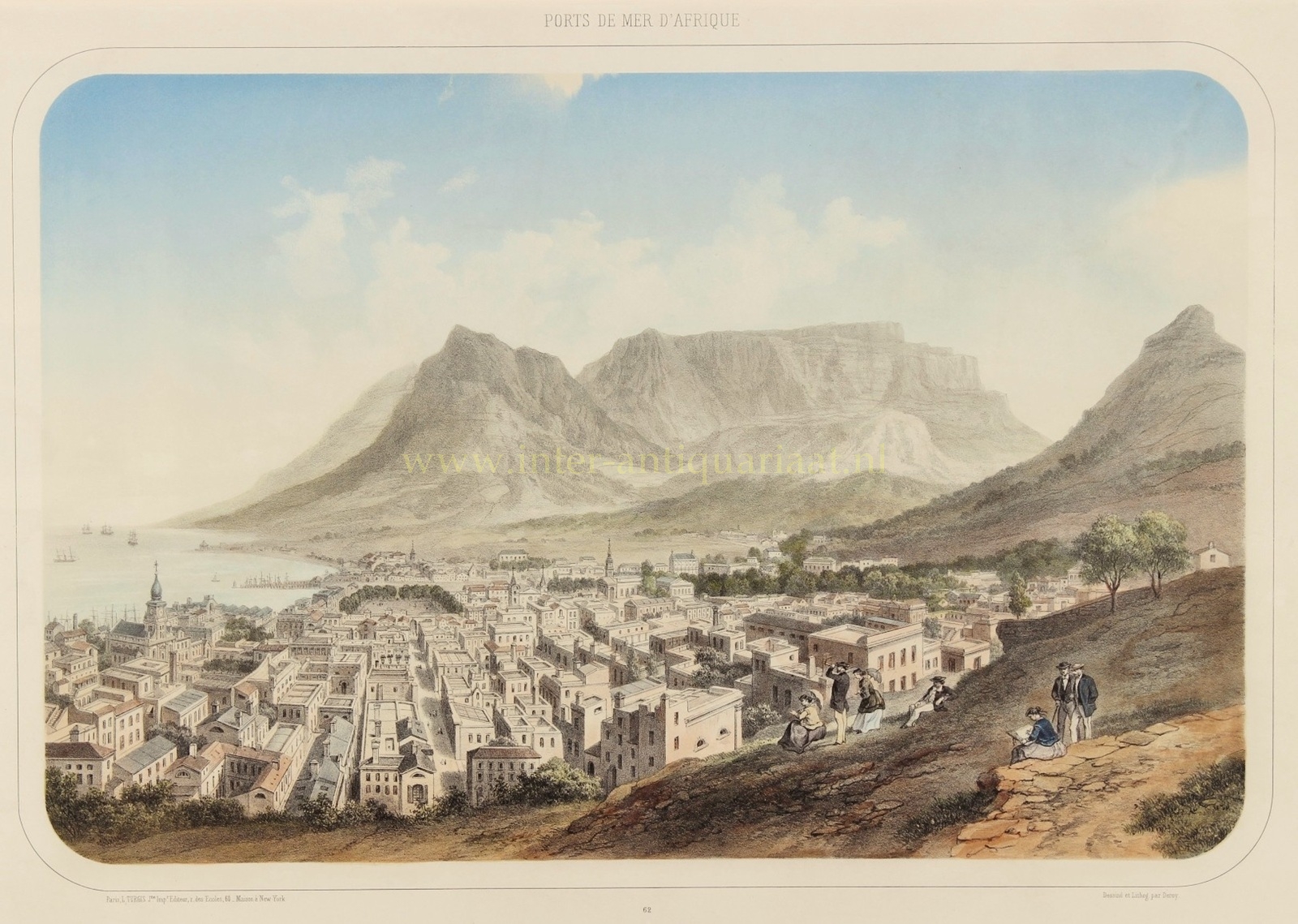
CAPE TOWN AT THE FOOT OF TABLE MOUNTAIN, C. 1850
“Vue de la ville du Cap située au pied des montagnes de la Table et du Lion (Cap-de-Bonne-Espérance) – Vista de la ciudad del Cabo situada al pié de las sierras de la Mesa y del Leon (Cabo-de-Buena-Esperanza)” [View of Cape Town at the foot of Table Mountain and Lion’s Head (Cape of Good Hope)]. Lithograph by Isidore Deroy, published by L. Turgis in Paris, c. 1850. With original hand-colouring. Size: 38 × 49.8 cm.
This rare and beautifully coloured antique view of Cape Town depicts the city from the slopes of Signal Hill, with the imposing massif of Table Mountain and the peak of Lion’s Head rising in the background. The city stretches along the shores of Table Bay, where several sailing ships lie at anchor. In the foreground, elegantly dressed visitors enjoy the magnificent view.
Cape Town is characterised by a dense network of streets, whitewashed houses with flat roofs, church towers and larger public buildings. To the left, near the waterfront, stands the distinctive Groote Kerk, with the harbour and buildings along the bay visible beyond. Deroy paid particular attention to the architecture and the city’s spectacular setting between the sea and the mountains. The soft colours of the sky, the monumental mountain scenery and the lively figures in the foreground lend the lithograph an almost Romantic atmosphere.
Cape Town developed at a strategic location along the maritime trade route between Europe and Asia. From the late sixteenth century onwards, European ships called at Table Bay to take on fresh water and provisions and to trade with the indigenous Khoikhoi population. In 1652, Jan van Riebeeck, acting on behalf of the Dutch East India Company (VOC), established a victualling station at the Cape. Here, VOC ships travelling to and from Asia could replenish their supplies. The settlement gradually developed into an important colonial port. Enslaved people brought from Madagascar and various parts of Asia also played a major role in its growth through forced labour.
Towards the end of the eighteenth century, the Cape became a contested possession in the struggle between the Netherlands and Great Britain for control of international trade routes. In 1795, the British seized the Cape Colony. Following its brief return to the Batavian Republic in 1803, British forces occupied the Cape again in 1806, and British sovereignty was formally recognised in 1814.
When Deroy produced this city view around 1850, Cape Town was the capital of the British Cape Colony and an important port of call for international shipping. The city was developing into a major commercial and administrative centre, where the legacy of Dutch colonial rule remained visible alongside growing British influence. Political circumstances were changing as well: in 1854, the Cape Colony’s first elected parliament convened, an important step towards the introduction of responsible government in 1872.
This lithograph was published in Paris as part of the series Ports de Mer d’Afrique [Seaports of Africa], which depicted important African port cities in picturesque panoramic views. The French artist and lithographer Isidore Deroy (1797–1886) specialised in such panoramic representations.
Price: Euro 1.250,- (incl. frame)