

Nijenrode castle – Daniel Meisner + Paulus Fürst, 1638
€295
NIJENRODE CASTLE WITH A LESSON IN FINANCIAL MANAGEMENT, 1638
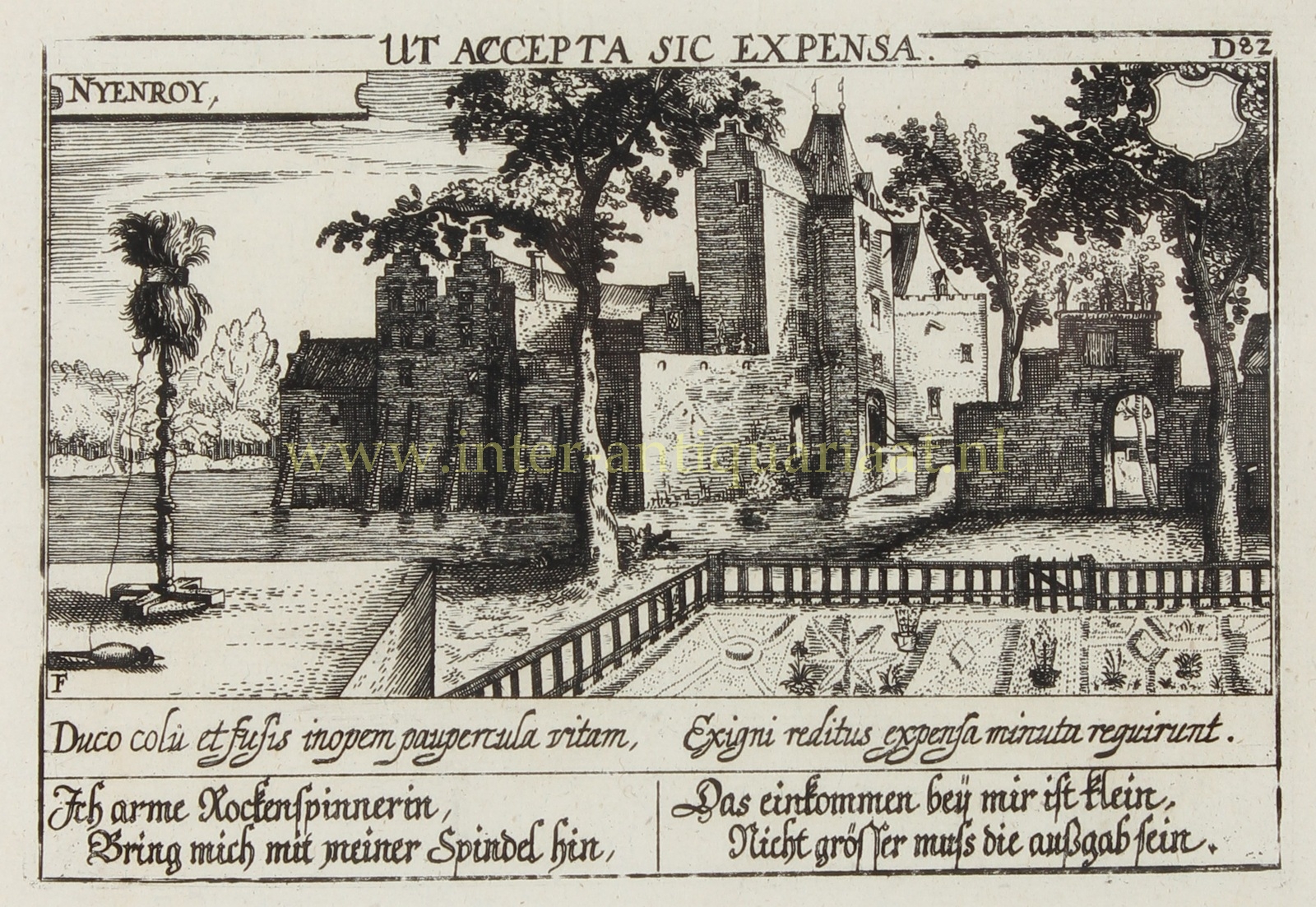
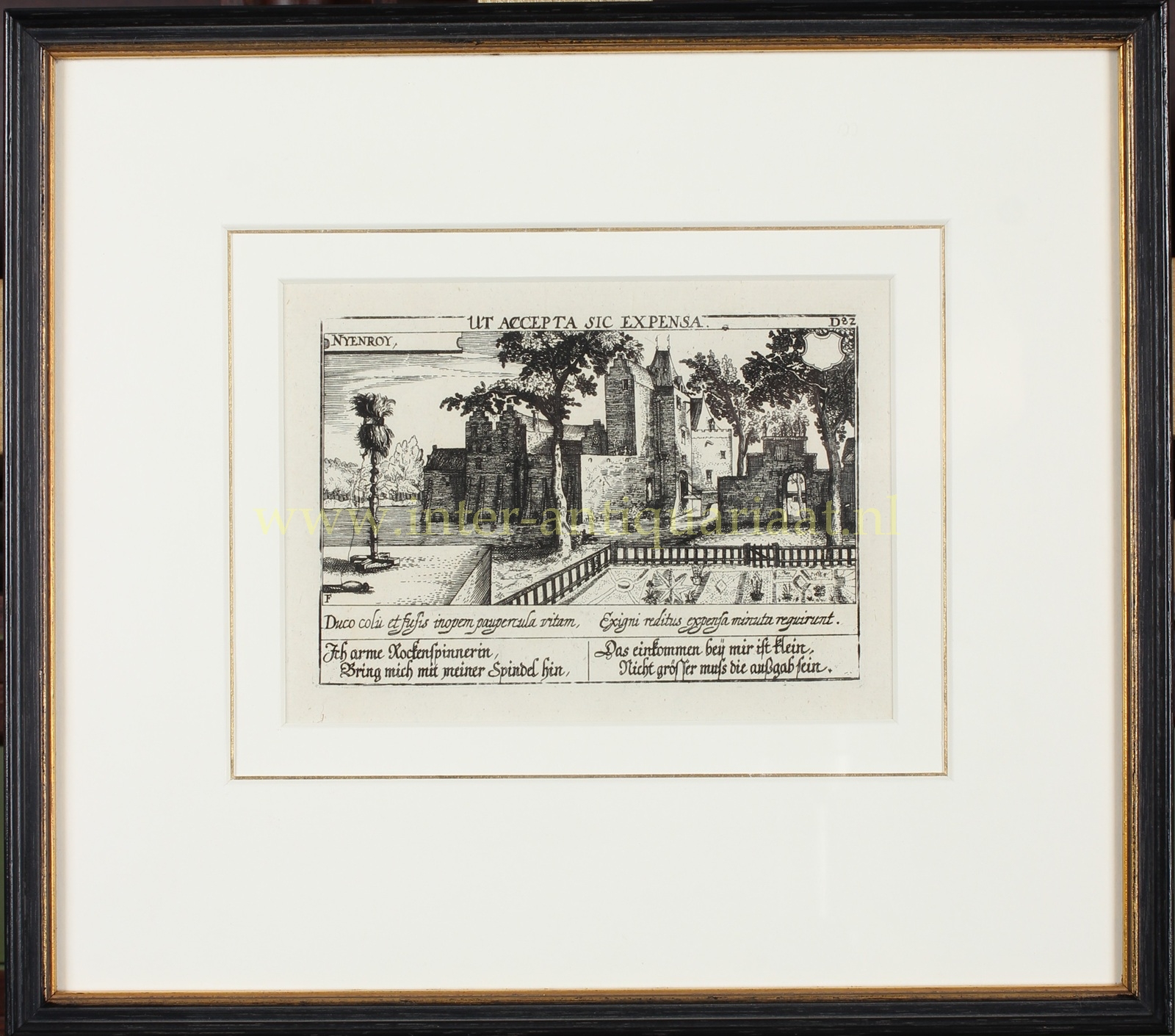
“Nyenroy”, copper engraving from Daniel Meisner’s Thesaurus Philopoliticus, later reissued as the Sciographia Cosmica. Published in Nuremberg by Paulus Fürst in 1638. Size (image) approx. 10 × 14.5 cm.
At the centre rises Nijenrode Castle near Breukelen, seen from the north-east. The moated castle consists of a picturesque succession of walls, stepped gables, towers and gateways, partly concealed behind tall trees. To the right in the foreground is an enclosed formal garden, where several figures are at work. Prominently placed on the left is a distaff, on which wool or flax was wound, the attribute that connects the topographical view with the moralising meaning of the print.
The representation of the castle appears to have been directly derived from a larger etching by Hessel Gerritsz after David Vinckboons, published some ten years earlier, in which Nijenrode is likewise shown from the north-east, with virtually the same buildings, trees and garden. This early seventeenth-century view shows the castle before the extensive modernisation carried out after 1632. (In 1673 Nijenrode was largely destroyed by French troops and subsequently rebuilt.)
The print, however, is more than a topographical view. Above the castle appears the Latin motto:
“Ut accepta sic expensa” [As the income, so the expenditure.] The idea is elaborated in the lines below:
“Duco coli et fusi inopem paupercula vitam, exigui reditus, expensa minuta requirunt.”
Freely translated:
Poor as I am, I lead a modest life with distaff and spindle; small revenues require small expenditure.
The distaff is therefore not merely a picturesque genre detail, but an emblem of moderation and thrift: one should live within one’s means.
Daniel Meisner’s “Thesaurus Philopoliticus — Das ist Politisches Schatzkästlein guter Herren und bestendiger Freund ” was conceived as a collection of practical wisdom and rules of conduct for civic and social life. Begun in Frankfurt in 1623, it eventually grew into a collection of hundreds of views of towns, castles and fortresses. Characteristically, these topographical views were combined with a motto and moralising verses.
There is a certain irony in the fact that a general seventeenth-century lesson in thrift and financial management should have been paired with the topographical setting of a castle that, centuries later, would become home to Nyenrode Business University…
Price: Euro 295,- (incl. frame)