

Zaandam – Hendrik de Leth, ca. 1730
€4.950
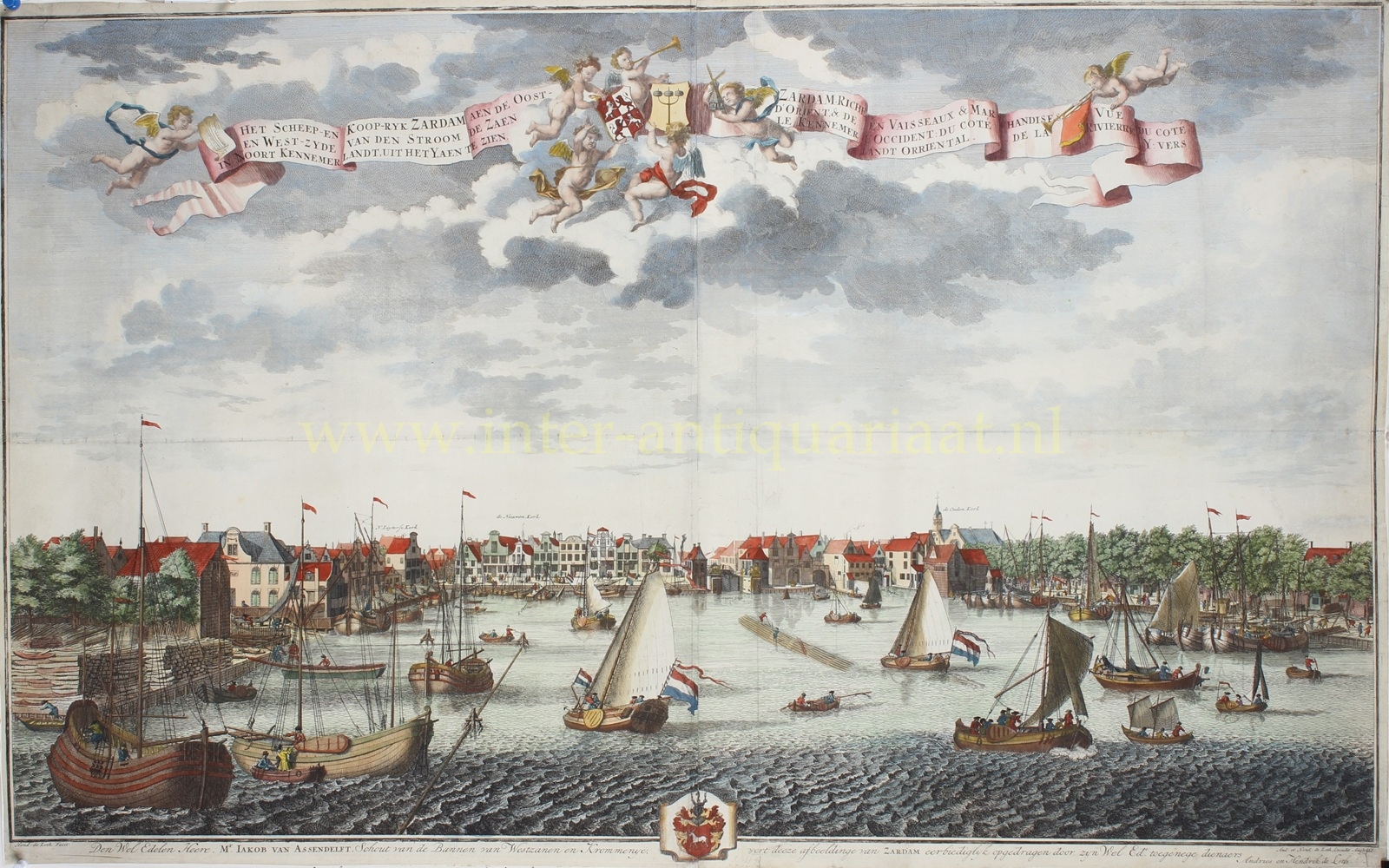


MONUMENTAL VIEW OF ZAANDAM, CENTRE OF SHIPBUILDING AND TRADE, C. 1730
“Het Scheep- en Koop-ryk Zardam aen de Oost- en West-zyde van den Stroom de Zaen in Noort Kennemerlandt, uit het Y, aen te zien” [Zaandam, rich in ships and trade, on the east and west sides of the River Zaan in North Kennemerland, seen from the IJ]. Etching and engraving on two joined sheets, made by Hendrik de Leth (1703–1766) and published in Amsterdam by Andries and Hendrik de Leth, c. 1730. Later hand-coloured. Dimensions approx. 56 × 90 cm.
An imposing view of Zaandam from the IJ, looking northwards across the mouth of the Zaan towards the buildings around the Dam. Westzaandam lies to the left and Oostzaandam to the right. The broad expanse of water in the foreground is bustling with activity. Large and small sailing vessels travel along the Zaan or lie moored along the quays, with rowing boats moving between them. To the left is a shipyard, with large quantities of timber stored along the waterfront. In the middle of the Zaan, a raft of logs is being moved along the river.
Zaandam’s rise as a centre of shipbuilding was closely connected with the 256 sawmills operating there. Mechanically sawn timber could be processed considerably faster and more cheaply than timber sawn by hand. In the cities, the introduction of such mills was long opposed by the sawyers’ guilds; in the Zaan region, where such guilds did not exist, they were able to develop on a large scale. The abundant supply of sawn timber, relatively low production costs and proximity to Amsterdam created ideal conditions for an extensive shipbuilding industry. This industry reached its peak around 1700–1730, when an estimated 100 to 150 seagoing vessels were launched annually from some 26 shipyards in the Zaan region.
Present-day Zaandam did not yet exist administratively as a single town. Westzaandam formed part of the Banne of Westzanen, while Oostzaandam belonged to the Banne of Oostzanen. It was not until 1811 that the two communities were united to form Zaandam. Above the view, we therefore see the coats of arms of both bannen.
The economic importance of shipbuilding in the Zaan region was known far beyond the Dutch Republic. Its most famous foreign visitor was Tsar Peter the Great, who came to Zaandam in 1697 to study Dutch shipbuilding at first hand. His brief stay, more than thirty years before this print was made, illustrates the international reputation the Zaan shipyards had already acquired.
Below the image is the dedication to Jacob van Assendelft, whose family coat of arms appears in the centre beneath the panorama. Van Assendelft was schout (bailiff) of Westzaan and Krommenie and belonged to the administrative elite of his day; he later became an alderman and subsequently mayor of The Hague.
Hendrik de Leth (1703–1766) initially worked together with his father Andries de Leth, who in 1726 had taken over the well-known Amsterdam map, print and art dealership of the Visscher family. Hendrik joined the booksellers’ guild in 1728 and continued the business after his father’s death in 1731. He worked as a draughtsman, etcher, engraver, cartographer and publisher, and became particularly known for his maps, atlases, topographical publications and large engraved city views.
Price: Euro 4.950,- (incl. frame)