

Schenkenschans – Joan Blaeu, 1649
€375
SCHENKENSCHANS: GATEWAY TO THE DUTCH REPUBLIC
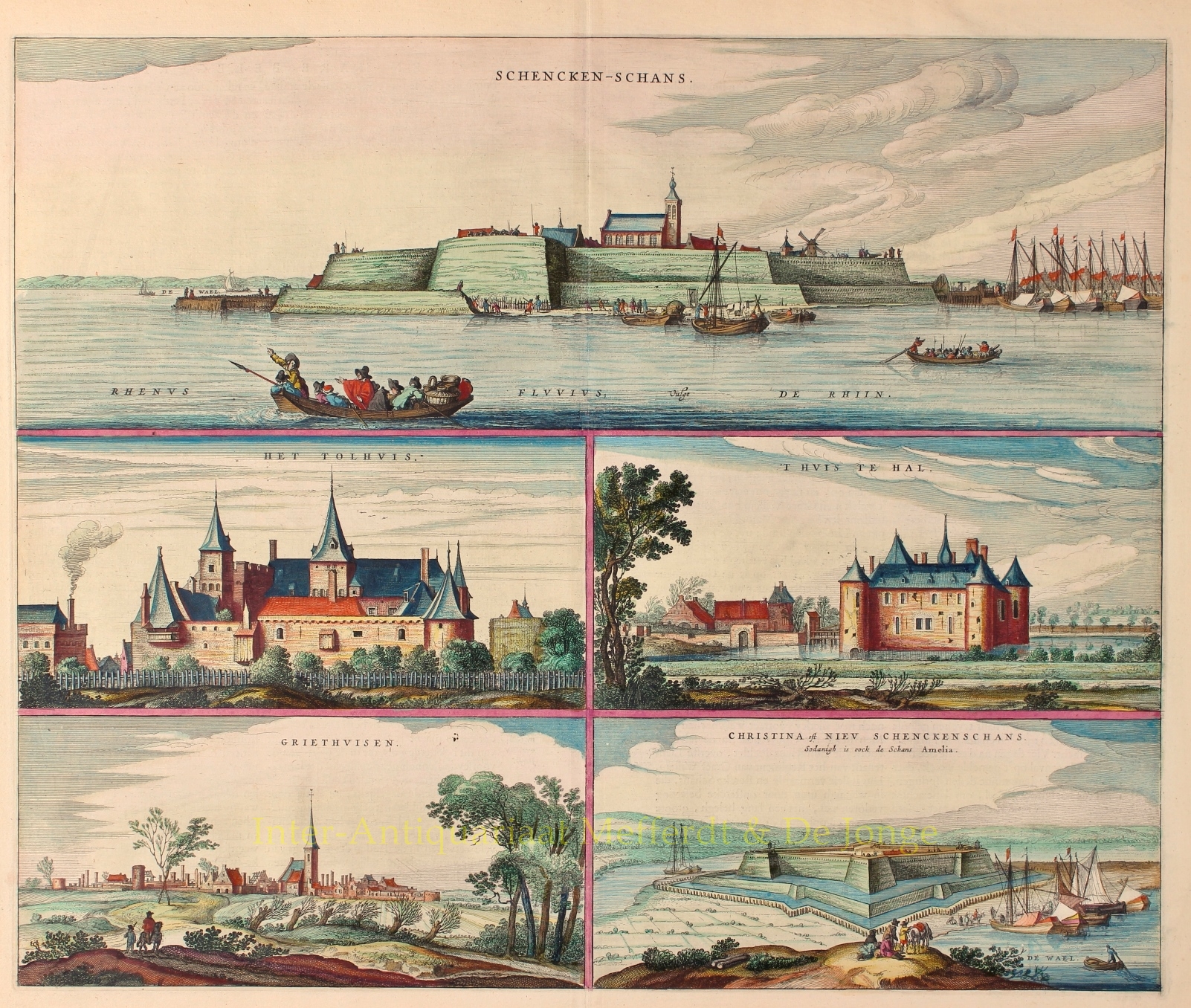
“Schencken-Schans – Het Tolhuis – ‘t Huis te Hal – Griethuisen – Christina oft Nieu Schenckschans“, copper engraving published in Amsterdam by Joan Blaeu for his town book “Novum ac Magnum Theatrum Urbium Belgicae” in 1649. Contemporary hand-colouring. Size: approx. 43 × 52 cm.
This finely hand-coloured seventeenth-century engraving depicts the fortress of Schenkenschans and four nearby locations that played an important role in defending the eastern frontier of the Dutch Republic.
Schenkenschans, now part of the German municipality of Kleve (Cleves), was constructed in 1586 by Maarten Schenk van Nydeggen. At the time, the fortress occupied a strategically vital position near the confluence and division of the Rhine and Waal rivers. From here, both river traffic and the eastern approaches to the Republic could be controlled. Schenkenschans was therefore regarded as one of the Republic’s most important defensive strongholds.
In 1599, Prince Maurice of Orange ordered the fortress to be strengthened. Almost immediately afterwards, it was besieged by Spanish forces under the command of Francisco de Mendoza. The attack was repelled, but during the Eighty Years’ War, Schenkenschans proved not to be impregnable. In 1635, Spanish troops captured the fortress in a surprise attack. Frederick Henry, Prince of Orange, subsequently assembled a large army to recapture it. Following a prolonged siege, the Spanish garrison surrendered on 29 April 1636, restoring the Republic’s control over this strategically important position.
The upper half of the engraving is occupied by a panoramic view of Schenkenschans from the Rhine. The four smaller views below depict the Tolhuis (tollhouse) near Lobith, Huis te Hal, the nearby village of Griethuisen (Griethausen), and the fortress of Christina, also known as New Schenkenschans, situated on the River Waal.
Together, these five views provide a interesting picture of the fortified frontier region that was repeatedly contested during the Eighty Years’ War.
Price: Euro 375,-