

The Hague, vegetable market – Maria Margaretha de la Fargue
€6.500
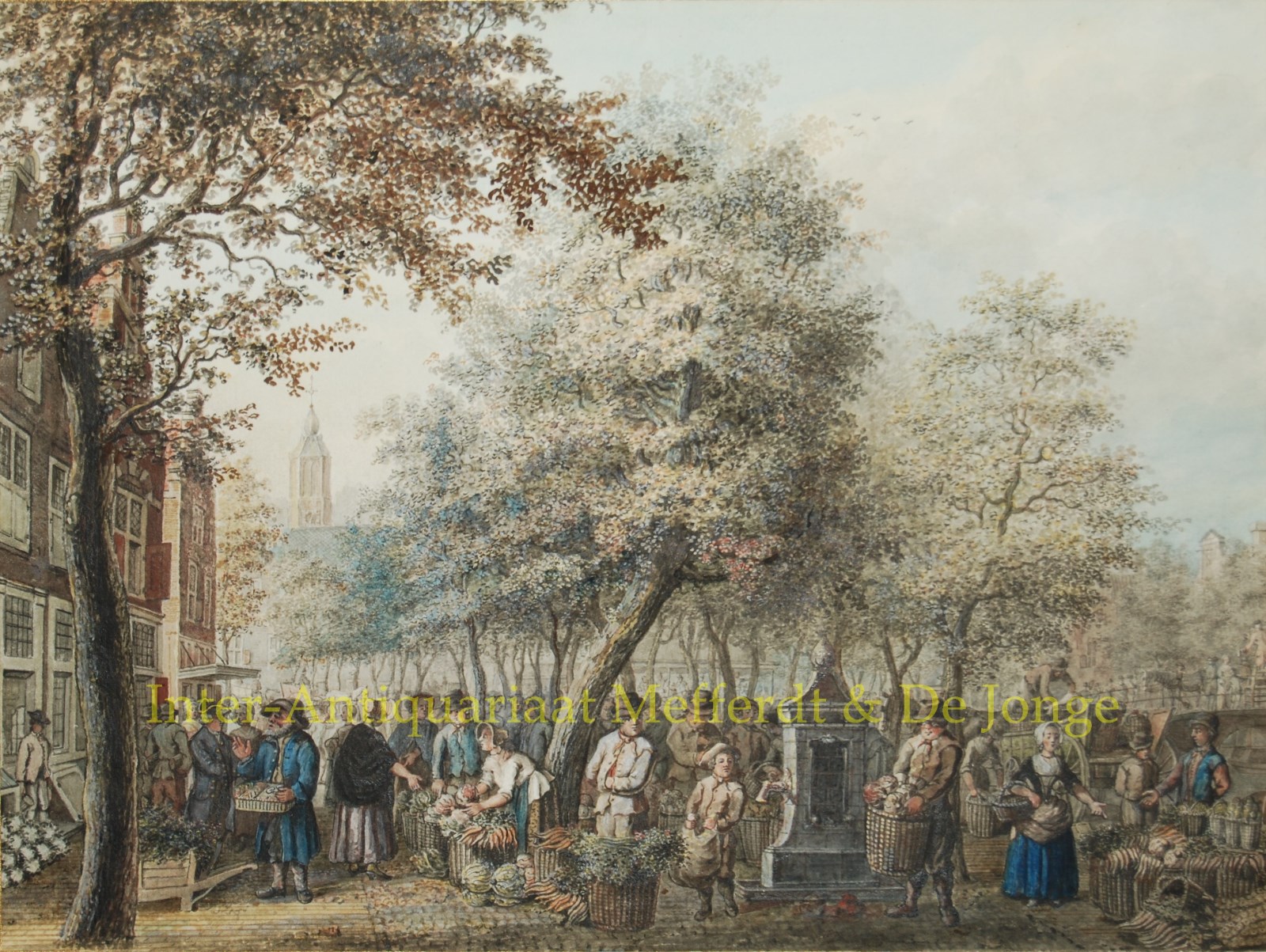
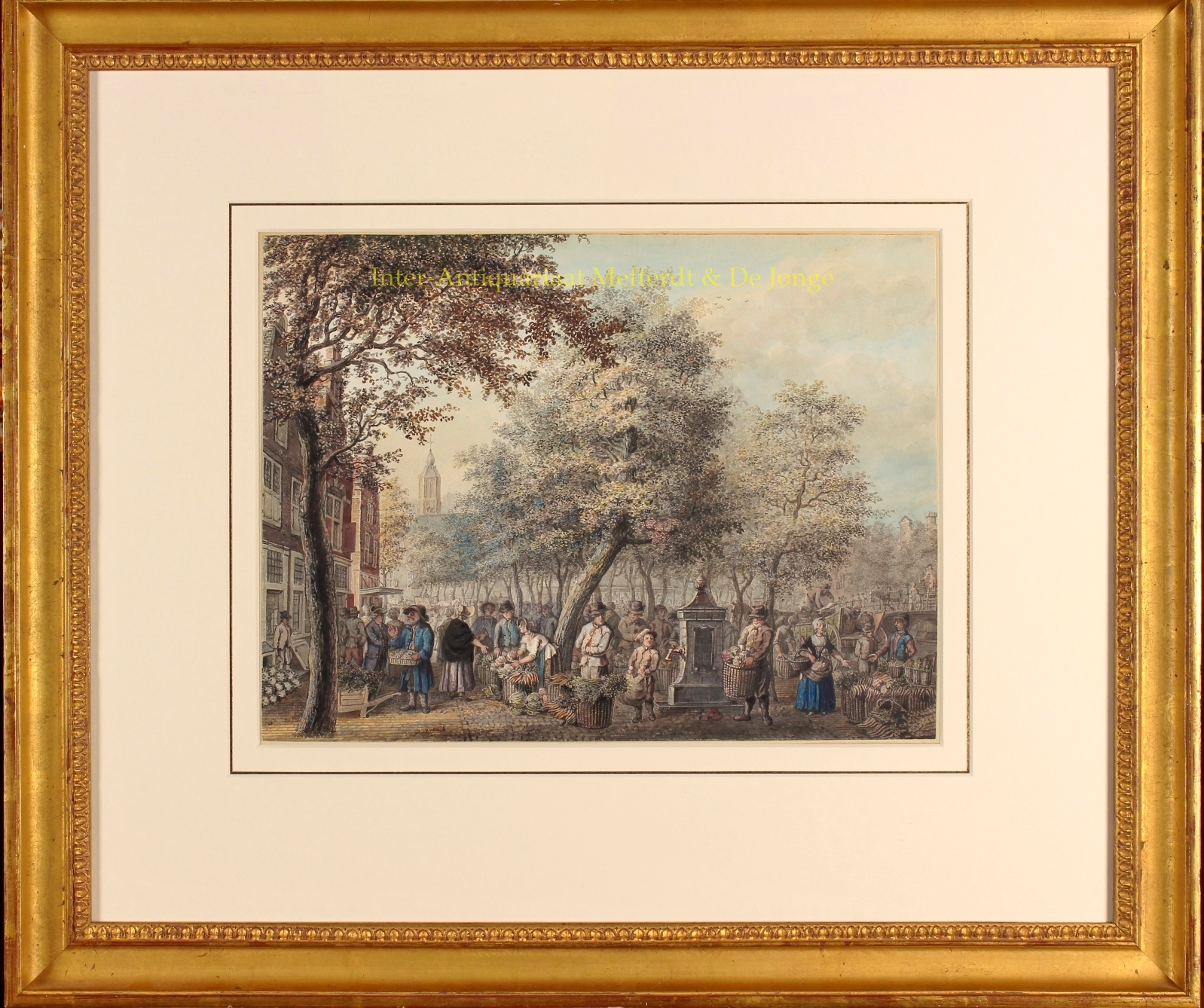
VEGETABLE MARKET IN THE HAGUE, SECOND HALF OF THE 18TH CENTURY
Drawing in pencil, watercolour and gouache, attributed to Maria Margaretha la Fargue. Second half of the 18th century. Size: 26.3 × 35 cm.
In this lively market scene, vendors, customers and passers-by mingle among baskets filled with carrots, melons, turnips, cabbages and other produce. Beneath the tall, leafy trees, trade is bustling. At the centre of the composition stands a stone water pump, around which the daily activities of the market unfold.
The scene probably depicts the Grote Markt (Great Market Square) in The Hague, where a fruit and vegetable market had been held since 1614. Thanks to its connection with the Westland horticultural region via the Prinsegracht canal, the square developed into one of the city’s principal centres of trade. (It continued to serve as a marketplace until 1938, when the market was relocated to Herman Costerstraat.)
The tall trees lining the square, the public water pump and, above all, the tower of the Grote Kerk (Great Church) in the background support this identification. Similar features appear in several views of the Grote Markt by Maria Margaretha la Fargue’s brother Paulus Constantijn, including his painting of 1760 in the National Gallery in London and a drawing dating from after 1760 in the Städel Museum in Frankfurt. Although the surrounding buildings in the present drawing do not correspond exactly to those in these works, the architecture was probably interpreted rather freely in order to emphasise the lively atmosphere of the market.
Maria Margaretha la Fargue (1743–1813) grew up in a family of artists in The Hague. She learned to draw and paint from her elder brothers Paulus Constantijn (1729–1782) and Jacob Elias (1735–c. 1778), who are particularly known for their topographical views of towns and cities. Together with their brother Karel (1738–1793), they ran a family workshop for many years, with Paulus Constantijn as its driving force. The family produced paintings, drawings and prints, as well as illustrations for books and almanacs.
Unlike her brothers, Maria Margaretha specialised primarily in genre scenes depicting everyday life. Her work portrays market traders, street vendors, domestic scenes and encounters between people from different social classes. Her interest lay more in human activity and interaction than in the accurate rendering of architecture. In the present drawing, too, the emphasis is on the colourful bustle of the marketplace. The numerous carefully rendered figures, baskets overflowing with produce and beautifully detailed foliage make this scene a particularly vivid record of eighteenth-century urban life.
Exhibition: Dordrecht, 1983–1984, “Krabbels en Tekeningen”, 19th-century watercolours and drawings from the national collection, including 29 drawings from the collection of Hans van Leeuwen, cat. no. 15 (then attributed to J. A. Langendijk).
Price: Euro 6.500,- (incl. frame)