

Scheveningen – F.B. Lorieux after Adriaen van de Velde, 1803
€450
THE BEACH AT SCHEVENINGEN
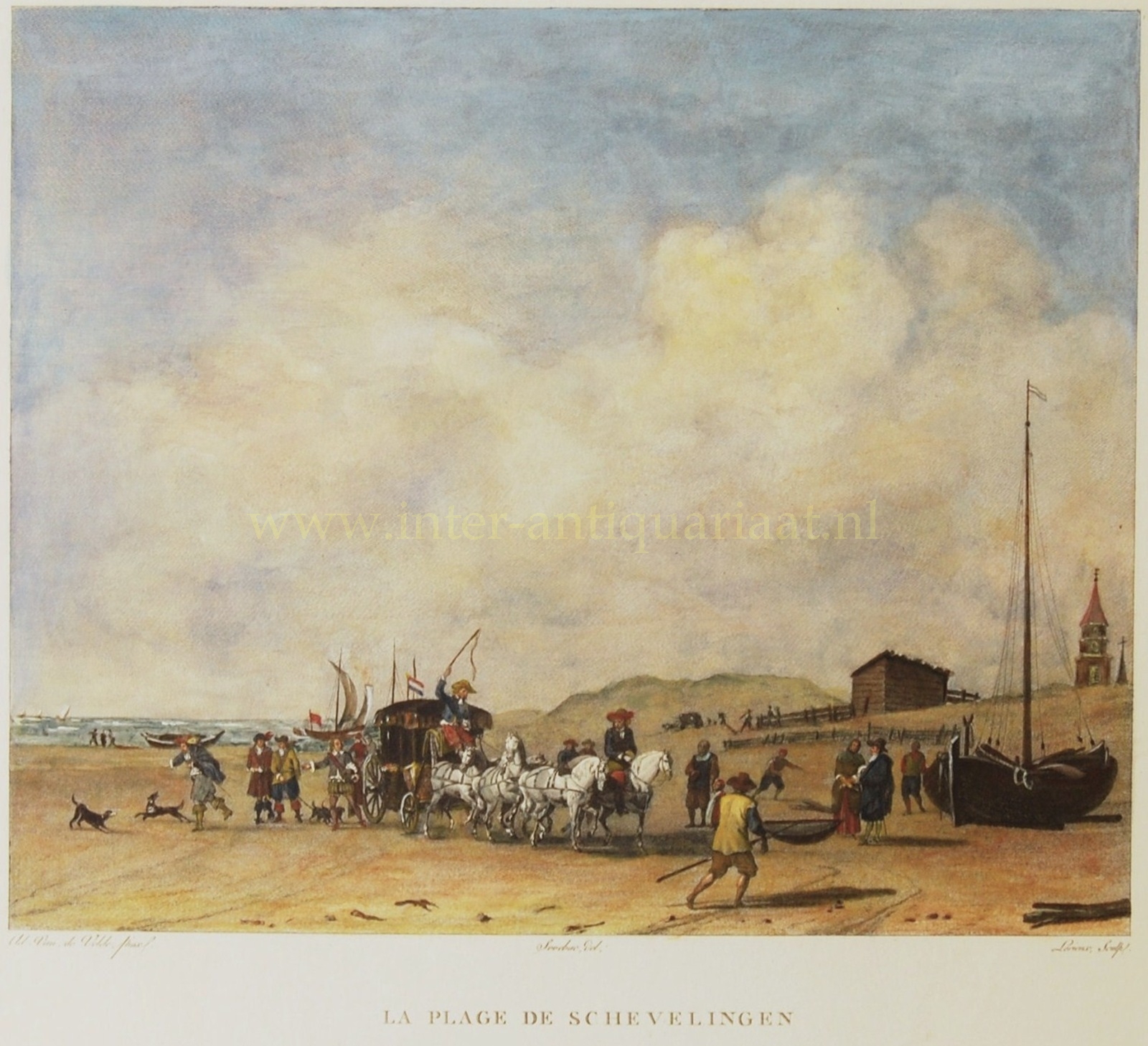
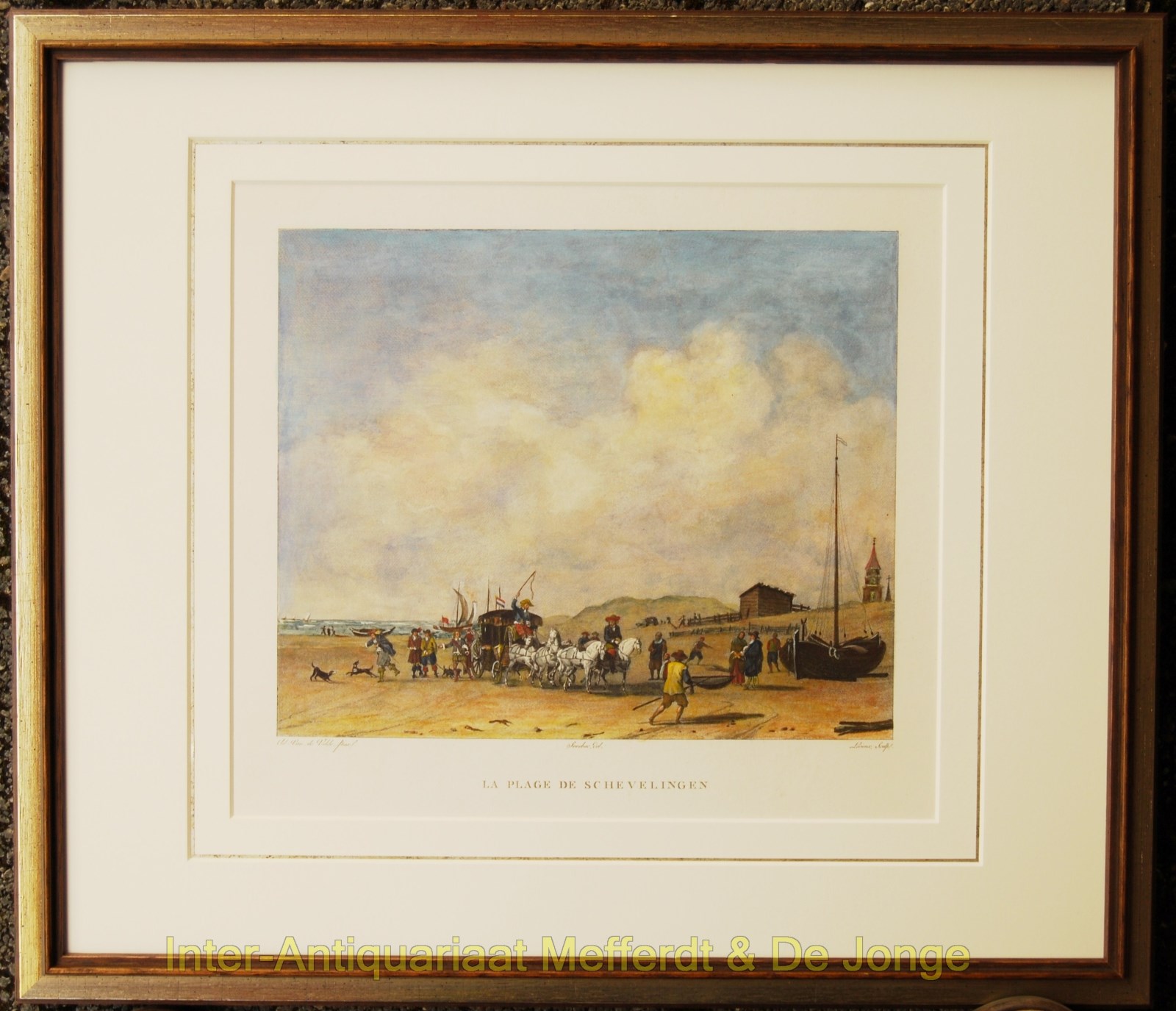
“La Plage de Schevelingen”, copper engraving made in 1803 by F.B. Lorieux after a drawing by Jacques François Swebach-Desfontaines, itself based on the painting Carriage on the Beach at Scheveningen of 1660 by Adriaen van de Velde (1636–1672). The print was published in Paris as part of the monumental print series Le Musée français, issued by Robillard-Péronville and Pierre Laurent. Coloured by a later hand. Size (image) approx. 23.5 × 33 cm; (frame) 47 × 53.5 cm.
An impressive carriage drawn by six white horses makes its way across the broad beach at Scheveningen. A postilion mounted on one of the leading horses guides the team, while the coachman raises his whip. To the left, a servant runs after two dogs playing in the sand. The luxurious carriage provides a striking contrast with the everyday life of the fishermen and villagers around it: people stroll along the beach, children play, and in the foreground a shrimp fisherman returns from his catch carrying a large scoop net. Farther away, fishing boats lie near the shore. On the right, the wooden Kalhuis and the church tower of Scheveningen mark the transition from beach to village.
Since the eighteenth century, the carriage has been associated with the young Prince William III of Orange (1650–1702), who was ten years old when the painting was made and would later become Stadholder of the Dutch Republic and King of England, Scotland and Ireland. The identification is not certain, however. The Louvre, where the original painting is now held, cautiously describes it as the carriage of a nobleman, possibly that of the Prince of Orange. In any event, the prominent depiction of a six-horse carriage clearly emphasises the high status of its occupants.
As in several of Van de Velde’s beach scenes, the horizon is remarkably low. Most of the composition is occupied by a luminous, animated expanse of clouds, while human activity unfolds in a narrow strip below. In the seventeenth century, the beach at Scheveningen was not only the workplace of fishermen but also a popular destination for affluent visitors from The Hague. Van de Velde brings these two worlds together here: fishing and everyday village life on the one hand, and the fashionable seaside recreation of the elite on the other.
The original painting also has an interesting provenance. In 1784, it was purchased at the sale of the collection of the Comte de Vaudreuil for King Louis XVI, and thus entered the French royal collection even before the French Revolution. When the Muséum opened at the Louvre in 1793, the painting was already on display there, at the time under a title that explicitly associated the carriage with the Stadholder. When Le Musée français began reproducing the most important works in the national collection in print from 1803 onwards, Van de Velde’s Scheveningen beach scene was included as well. The painting remains in the Louvre to this day.
Price: Euro 450,- (incl. frame)