

Hengelo, Borne, Oldenzaal – Soviet militairy maps, 1982
€950
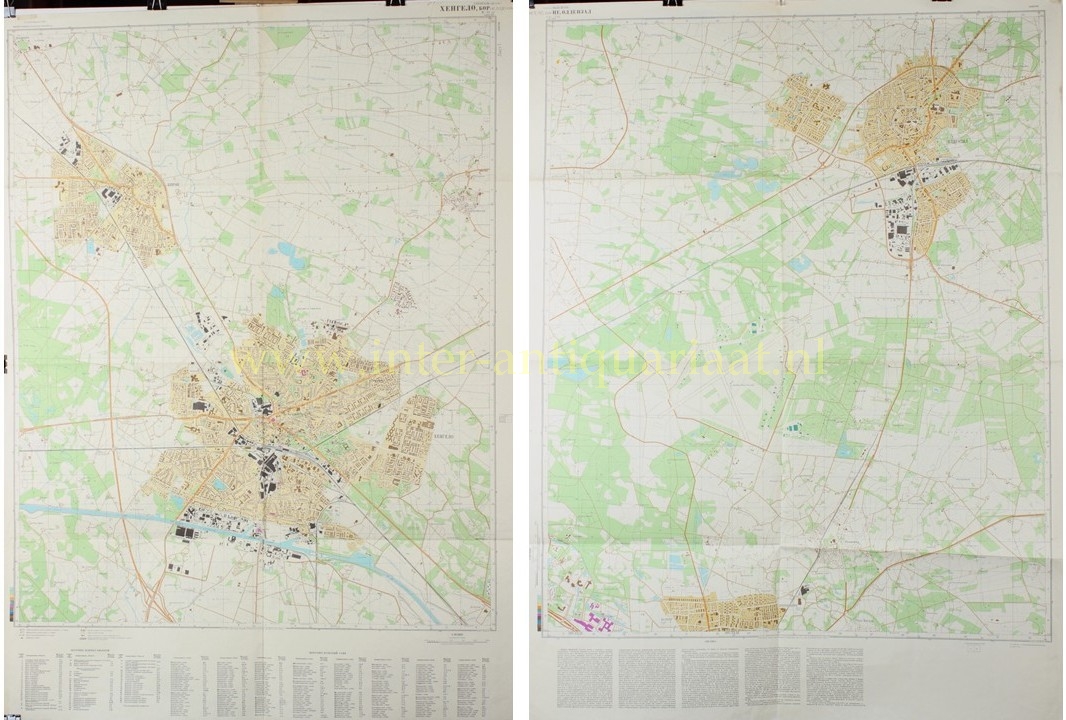






SECRET SOVIET MILITARY MAPS OF HENGELO, BORNE AND OLDENZAAL
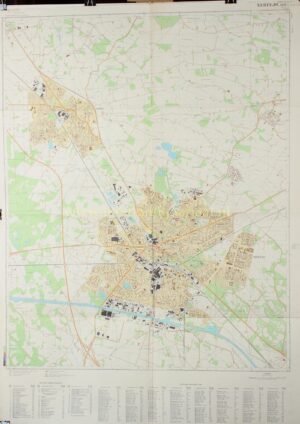
“ХЕНГЕЛО, БОРНЕ, ОЛДЕНЗАЛ”, colour offset print on two sheets, issued in 1982 by the General Staff of the Soviet Army. Size: (each) 89 × 119 cm.
With the collapse of the Soviet Union in 1991, the Cold War came to an end. A period of ideological confrontation and constant threat of war was over. In hindsight, it has become clear that the Soviet Union possessed better maps of the Netherlands (and many other Western countries) than were available domestically. These Russian maps from the early 1980s reveal a striking and at times unsettling level of detail.
From the 1940s onward, the Soviet Union began systematically mapping the world. City plans were produced with unprecedented precision, showing features such as bus stops and government buildings. Several dozen such maps were made of the Netherlands.
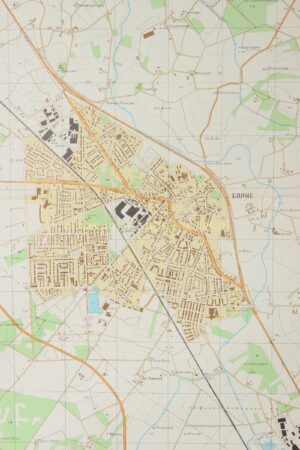
Maps such as this, depicting the Twente industrial region, were intended for operational planning. Government institutions, post offices, factories, barracks, and airfields are all carefully labelled in Cyrillic script. For many bridges, their dimensions and load-bearing capacity are recorded, together with information on the navigability and width of associated rivers and canals. The height of dams and dikes, types of crops, and road surfaces are also indicated. The map is marked “секретно” [secret].
In addition to the fact that many Western countries made topographic maps freely available—something that communist spies undoubtedly exploited—the Soviet Union had access to satellite-derived information from the 1960s onward. Further intelligence was gathered through extensive espionage activities. Soviet agents were almost certainly active via the embassy in the Netherlands, but not exclusively so. In the 1950s, all truck drivers from Eastern Europe were screened by Dutch intelligence services. Although this policy was later relaxed, renewed warnings appeared in the 1980s concerning Ukrainian truck drivers lingering near military installations. Soviet passenger aircraft also occasionally disappeared from Dutch radar; it later emerged that these aircraft had descended to photograph locations of interest.
Yet these maps were probably not produced solely for wartime use. Detailed information was also recorded on crops, roadside vegetation, and the location of facilities such as post offices—seemingly superfluous data if one were planning only a military offensive or even a devastating nuclear strike. This likely reflects the belief within the communist leadership in Moscow, maintained until the end of the Cold War, that the West would ultimately succumb to communism.
These maps enabled a detailed understanding of territories beyond Soviet borders in advance. It was assumed to be only a matter of time before the Soviet Union would extend its influence there; when that moment arrived, such cartographic intelligence would prove invaluable.
The full extent of this global mapping programme only became clear after the collapse of the Soviet superpower in 1991. Despite orders from Moscow to destroy the material, many maps found their way to the West. Through Russian officers, they entered the collections of universities, collectors, companies, and even military institutions.
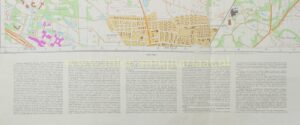
Reading the СПРАВКА [Spravka, explanatory note] at the bottom is particularly striking:
The cities are treated as a coherent urban and industrial complex in Twente, strategically located near the German border and closely linked to Enschede. Hengelo is identified as the principal centre: a major rail and road junction with a port on the Twente Canal, providing access to the Rhine and the North Sea. Borne and Oldenzaal are described as smaller but functionally integrated industrial centres.
Strong emphasis is placed on infrastructure and mobility. The Twente Canal forms the primary transport axis and is described in detail, including precise data on width, depth, locks, and bridges. The dense network of roads and railways allows, according to the Soviet analysis, year-round movement in all directions. Bridge construction, paving, and load capacity are consistently noted, underscoring their direct military relevance.
The landscape is interpreted in functional terms. The flat to gently undulating terrain, with sandy soils, high groundwater levels, and a dense network of waterways, presents a potential obstacle to off-road movement, yet is simultaneously regulated and predictable. Notably, the text explicitly mentions that the destruction of dams and waterworks could lead to large-scale flooding—an unmistakably strategic reading of Dutch water management.
Urban structure is analysed in terms of accessibility and density. Hengelo and Borne exhibit a predominantly radial layout, while Oldenzaal is described as radial-ring in form. Historic centres consist of densely built older quarters, while more modern developments with wider, paved streets occupy the outskirts. Administrative functions, communications infrastructure, and public facilities are carefully located.
Industry forms the core of the analysis. Hengelo is characterised as a major centre of mechanical engineering, metalworking, and chemical production, with output including transport equipment, industrial installations, and advanced electronic and measuring instruments. The text explicitly highlights factories with potential military applications, such as radar and communications systems and equipment for the nuclear sector. Borne is noted as a centre of automobile production, while Oldenzaal has a more diversified industrial base, including textiles, paper, and food processing.
Transport and logistics are treated in detail. The railway network comprises multiple stations, marshalling yards, and workshops with direct links to industrial complexes. The port of Hengelo on the Twente Canal includes several industrial quays. Of particular importance is the nearby Twente–Enschede airfield, with long runways, night-flight capability, and facilities for fuel and ammunition storage, explicitly identified as under NATO control.
Finally, considerable attention is devoted to utilities and communications. Electricity supply, gas networks, water management, and sewage systems are systematically described, as are telecommunications via cable and radio-relay networks. Even medical infrastructure and the presence of the Red Cross are recorded.
Price: Euro 950,- (two maps)