

Katwijk – Daniel Veelwaard, 1803
€395
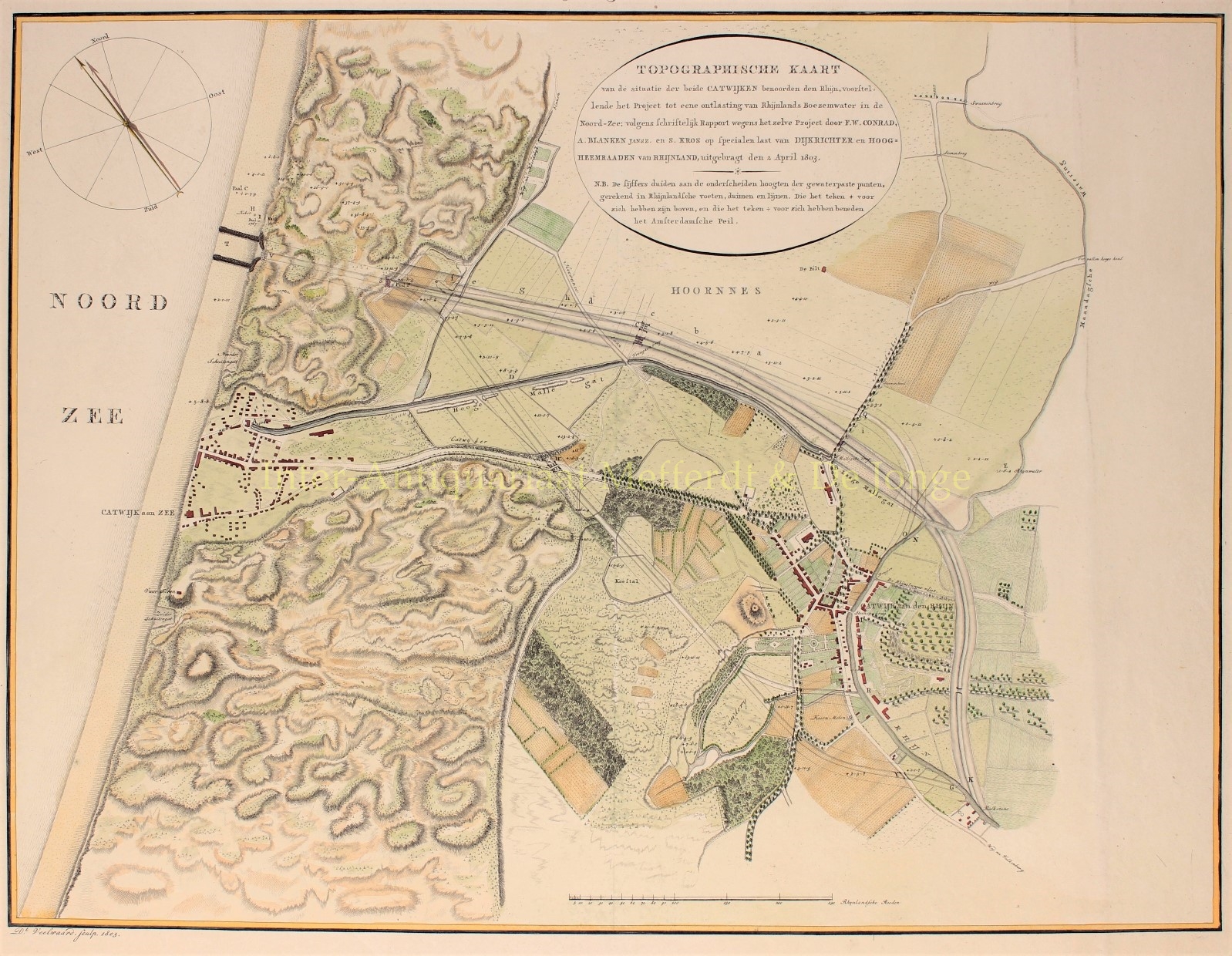
PLAN FOR A DRAINAGE CANAL FROM KATWIJK TO THE NORTH SEA, 1803
“Topographische kaart van de situatie der beide Catwijken benoorden den Rhijn, voorstellende het project tot eene ontlasting van Rhijnlands boezemwater in de Noord-zee” [Topographical map of the two villages of Katwijk north of the Rhine, showing the proposed discharge of Rijnland’s surplus water into the North Sea], copper engraving by Daniel Veelwaard, 1803. Coloured by a later hand. Size: approx. 44 × 56.5 cm.
The mouth of the Oude Rijn (Old Rhine) at Katwijk had already silted up by the 12th century. Since 1255, the Rijnland Water Board had been responsible for managing drainage in the region, but a permanent solution remained elusive for centuries. During the 17th and 18th centuries, the city of Haarlem opposed numerous proposals to create a new outlet to the North Sea. Haarlem wanted to preserve the existing drainage route through the River Spaarne, as the continuous flow of water helped keep the river clean and navigable.
It was not until the establishment of the Batavian Republic in 1795, with its more centralised administration, that broader national interests began to take precedence over local concerns. The authorities sought the advice of Christiaan Brunings, head of the Bureau voor Waterstaat (Bureau of Public Works), established in 1798 and the predecessor of the present-day Rijkswaterstaat. Brunings assembled a team of experts to develop a comprehensive drainage scheme.
Their report was completed in 1803 and immediately received government approval and financial support. Construction began the following year and continued until 1807, attracting considerable public interest. On 21 October 1807, King Louis Napoleon himself attended the inauguration of the new drainage system.
The project finally enabled Rijnland to discharge its surplus water directly into the North Sea. A drainage canal was excavated north of Katwijk, while a second canal was constructed east of Katwijk aan den Rijn. The scheme also included an inland sluice, a sea sluice and three bridges.
This ambitious feat of Dutch hydraulic engineering was accomplished entirely with manual labour, using little more than shovels, wheelbarrows and an enormous workforce. King Louis Napoleon was so impressed by the achievement that he donated 1,000 guilders to be distributed among everyone who had worked on the project.
Price: Euro 395,-