

Marsdiep, Texel – E. Collin after Julius Constantijn Rijk, 1819
€1.650
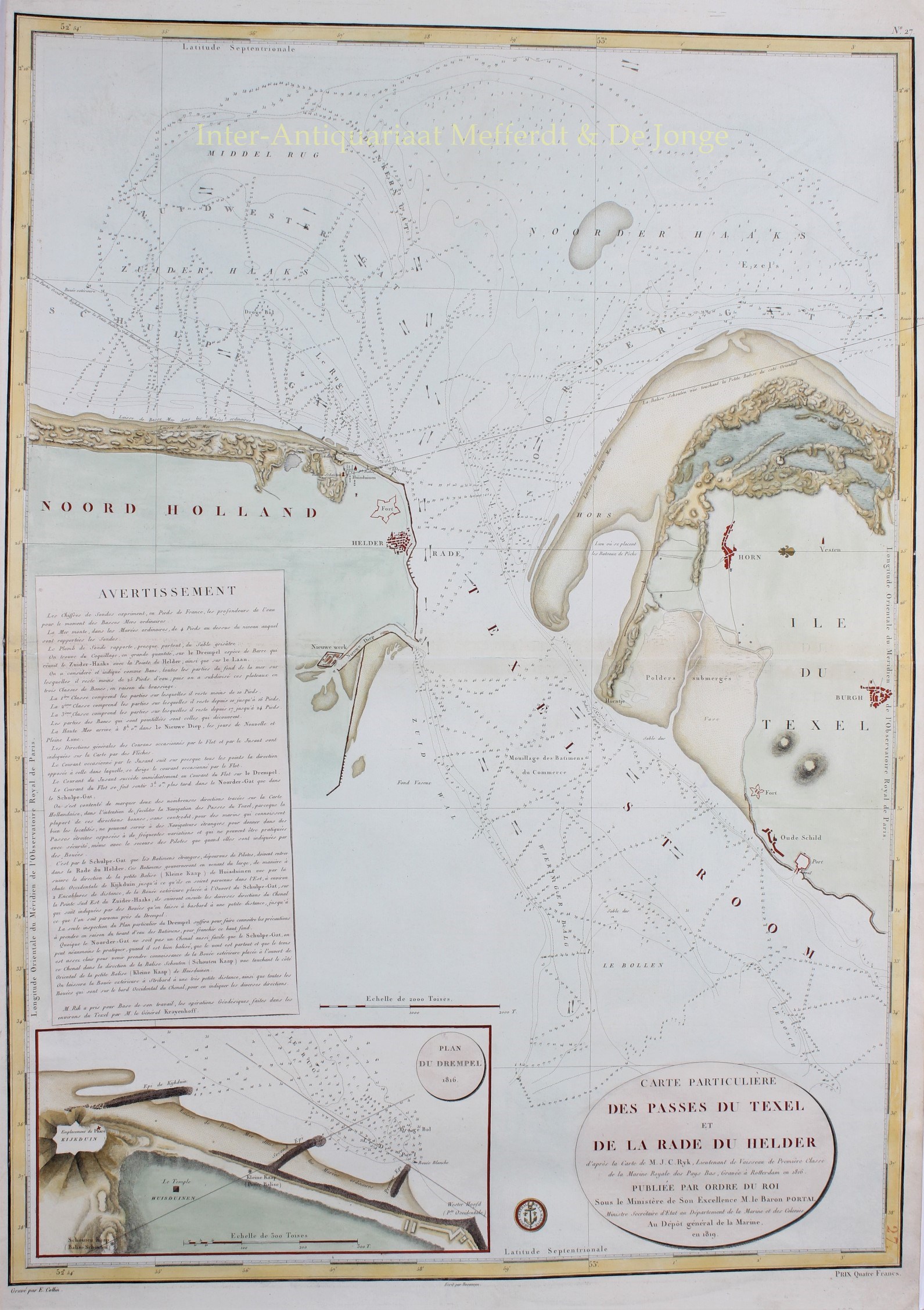



19TH-CENTURY NAUTICAL CHART OF TEXEL AND THE MARSDIEP
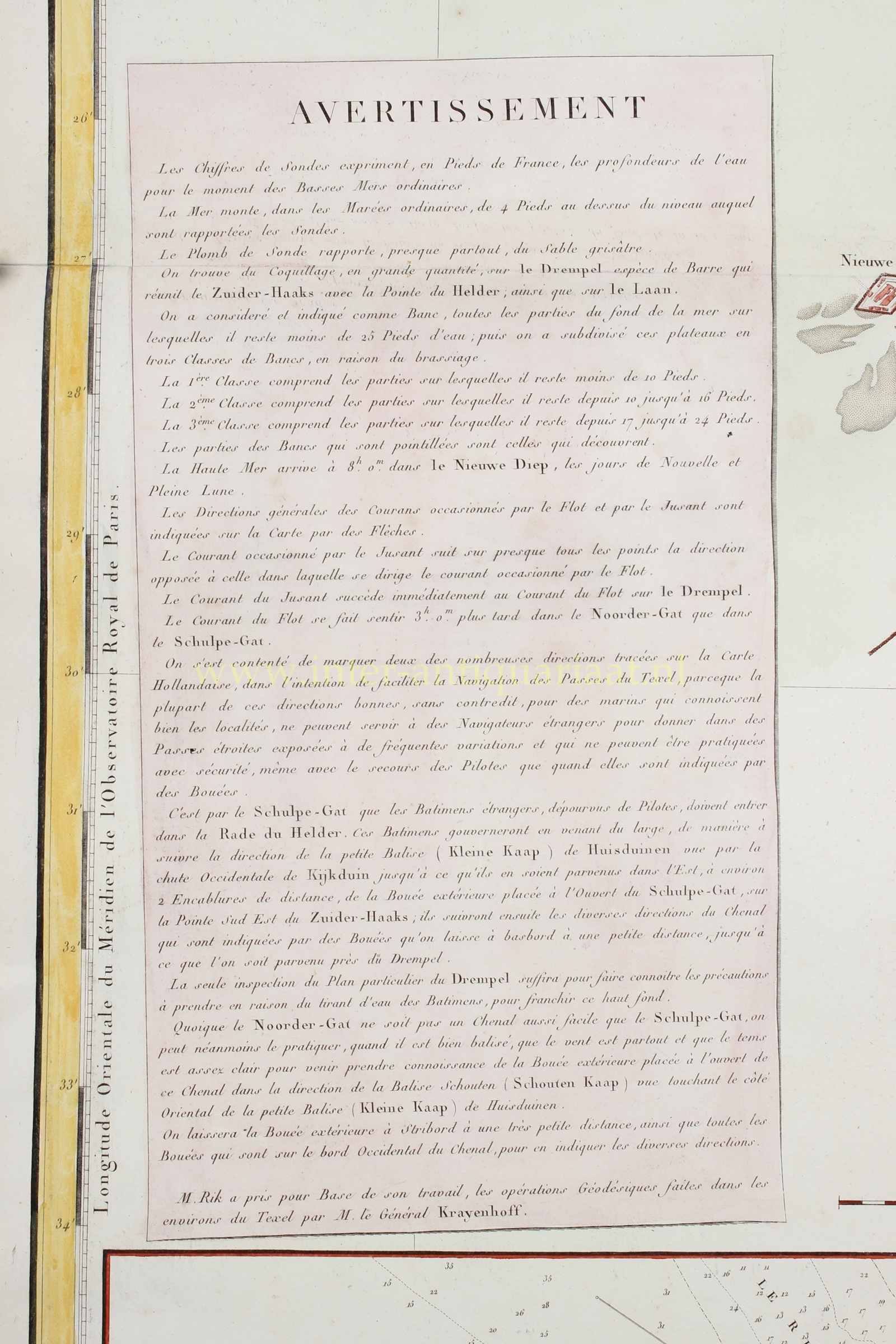
“Carte particulière des passes du Texel et de la Rade du Helder.” Copper engraving on two joined sheets, made by E. Collin after Julius Constantijn Rijk. With an inset map “Plan du Drempel 1816” showing Fort Kijkduin, and an “Avertissement” with instructions on how to read the chart. Published in 1819 by the Dépôt général de la Marine. Coloured by a later hand. Size: 88.8 × 63.7 cm.
Towards the end of the eighteenth century, responsibility for the content of Dutch sea charts shifted from private publishing houses and the VOC to officers of the Admiralties. The Netherlands lagged considerably behind England and France in carrying out state-supervised hydrographic surveys of coastal waters. Dutch surveys were far less reliable and complete than those produced by the French and the English. The first reliable chart of the Dutch sea inlets was due to the French naval officer Charles-François Beautemps Beaupré (1766–1854), who surveyed the waters of Zeeland and South Holland between 1799 and 1811.
In 1812, Joan Cornelis van der Hoop (1742–1825), Advocate-Fiscal of the Admiralty of Amsterdam, commissioned naval lieutenant Julius Constantijn Rijk (1787–1854) and the pilot and hydrographer Pieter Jansen Duinker to survey the roadstead of Texel. This introduced a method of surveying that was new to the Netherlands. The cartographic work was exceptionally accurate owing to the use of an improved method of triangulation on land. The surveys by Rijk and Duinker were published in June 1816 as a printed chart of the Texel channel. Depth contours are shown using the 11-, 19-, and 28-foot lines below low water. These depth lines therefore indicate the depth of the fairway at low tide or ebb. It was the first chart in a series of sheets of the sea inlets, published between 1816 and 1840.
With this chart, the Netherlands more than caught up with France and England. Indeed, the Dépôt général de la Marine in Paris copied the chart and in 1819 issued its own, comparable chart of the Marsdiep.
Price: Euro 1.650,-