

Barbary, Egypt-Libya – Johannes van Keulen, 1681
€375


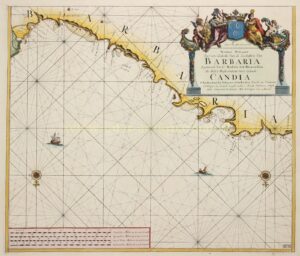

“Nieuwe Paskaart voor een gedeelte van de Zeekusten van Barbaria beginnende van C: Rusato tot Alexandria.” [New sea chart for a portion of the sea coasts of Barbary, beginning at C[ape] Rusato to ALexandria.] Copper engraving by Claes Jansz. Vooght, published by Johannes van Keulen for his sea atlas De Nieuwe Groote Lichtende Zee-Fakkel, issued in Amsterdam after 1681. Coloured by a later hand. Size: 51 × 58.5 cm.
This sea chart depicts the North African littoral along present-day Libya on the Mediterranean, embellished with compass roses and -lines, ships and a distance conversion table. It offers a detailed overview of the principal towns and harbours along the coastline from Alexandria to Cape Rusata (Derna in present-day Libya). At the top of the elegant cartouche appears the arms of Tripoli.
“Barbary” was, from the sixteenth to the nineteenth century, the designation for part of the North African coastal regions. It encompassed the present-day countries of Morocco, Algeria, Tunisia, and Libya. During this period the region served the major European trading nations—the Netherlands, England, France, and Spain—as a gateway to the riches of the Mediterranean: grain from Sicily, wine and oil from Spain, and silk and spices from the East. Dutch merchantmen sailed through Gibraltar toward the Levant and on to the Black Sea, where these and other bulk goods were traded.
Yet these waters were under constant threat: Barbary corsairs preyed on European shipping. Captured crews were sold into slavery or ransomed. This prompted numerous armed expeditions by European powers against the North African cities. Dutch and other European cartographers therefore lavished particular care on these coasts: precise knowledge of harbours, reefs, and currents could literally mean the difference between life and death.
About the Van Keulen publishing house
In the seventeenth and eighteenth centuries the firm of Van Keulen was among Amsterdam’s leading producers of sea charts and nautical instruments. Johannes van Keulen (1654–1715) registered with the Amsterdam booksellers’ guild in 1678. He began at a moment when renowned cartographers such as Blaeu, Hondius, Janssonius, and Doncker had already passed their peak, which enabled him to acquire copperplates, privileges, and stock from predecessors and build his own enterprise.
In 1680 Van Keulen obtained a patent (privilege) from the States of Holland and West Friesland to print sea atlases and pilots. The privilege was intended to protect against illicit copying—especially important for atlases, whose production was costly.
Together with the mathematician, teacher, and cartographer Claes Jansz. Vooght, he produced in 1681 the Nieuwe Groote Lichtende Zee-Fakkel, a five-volume atlas that brought together Vooght’s own charts and those of Johannes van Loon. Johannes’s son Gerard van Keulen (1678–1726) took over the firm in 1714 and continued its expansion. Gerard’s son, Johannes II van Keulen (1704–1755), succeeded him in 1726. In 1743 Johannes van Keulen was appointed “Official Chartmaker to the Dutch East India Company (VOC).” The family had supplied charts to the VOC for many years before this appointment. In 1753 he completed the sixth volume of the Zee-Fakkel, publishing the hitherto secret cartography of the East Indies archipelago.
Price: Euro 375,-