

North and South America – Willem Blaeu + Joan Blaeu, 1634
€3.500


FAMOUS MAP OF AMERICA BY WILLEM BLAEU
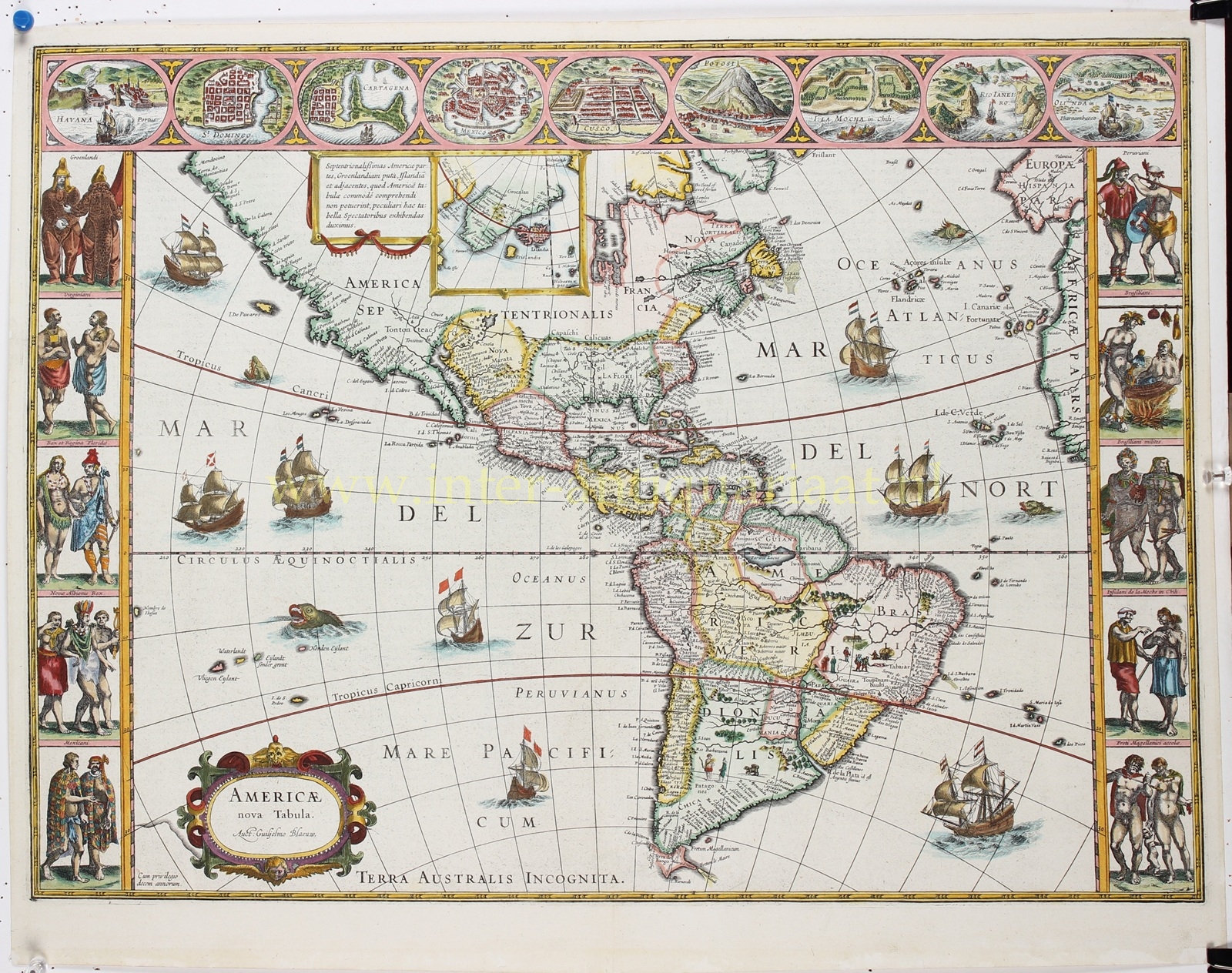
“Americae nova tabula.” Copperplate engraving made by Willem Jansz. Blaeu, first published in 1617; this example from a German-language edition of Joan Blaeu‘s “Novus Atlas“, presumably 1634. Coloured by a later hand. Size approx. 40 x 55 cm.
This famous map of North and South America ranks among the most beloved and influential maps from the Golden Age of Dutch cartography. It is also a fine example of the carte-à-figures type, featuring decorative borders with views of cities and indigenous peoples. In this way the map not only summarises the geographical knowledge of its time, but also the European image of the New World in the early seventeenth century.
Across the top, nine important cities and harbours of the Americas are depicted: Havana, Santo Domingo, Cartagena, Mexico City, Cusco, Potosí, La Mocha in Chile, Rio de Janeiro and Olinda in Dutch Brazil. In the side panels we see inhabitants of various parts of the continent, including Greenlanders, inhabitants of Virginia, the king and queen of Florida, the king of Nova Albion, Mexicans, Peruvians, Brazilians (cannibals!) and Brazilian warriors, islanders of La Mocha (Chile) and inhabitants of Magellanica (Tierra del Fuego). The map is further decorated with sailing ships and sea monsters, while scenes from the life of Native Americans are depicted in South America.
Cartographically, the map represents a fascinating moment in the development of knowledge about the Americas. Blaeu shows all of North and South America on a single sheet — something that within his atlas production occurs only on his world map. As a result, the copper plate remained in use for decades. The map reflects an early seventeenth-century image of the continent: the Great Lakes are absent, the Mississippi is not yet shown, and large parts of the interior remain speculatively filled in. The map does, however, already incorporate new geographical insights arising from the voyage of Jacob Le Maire and Willem Schouten (1615–1617). Tierra del Fuego is shown as an island, separated from the still-unknown “Terra Australis Incognita.”
Notably, California is still depicted as part of the mainland. While from the 1620s onwards the myth of California as an island appeared on many maps, Blaeu never updated his map to reflect that popular but incorrect theory. The west coast therefore retains a relatively classical and restrained form. Along the east coast, Blaeu combines Spanish, French, English and Dutch geographical sources: names from the expeditions of Giovanni da Verrazzano, Henry Hudson, John Davis and Martin Frobisher appear alongside early French place names along the Saint Lawrence River and English names from Virginia.
As on many maps of this period, fact and myth are intertwined. In North America the legendary Norumbega appears — a supposed wealthy city in New England — while in South America the mythical El Dorado (“Manoa al Dorada”) is placed beside a large imaginary lake. Such geographical fantasies reflected the persistent hope of finding hidden riches in the unknown interior of the Americas.
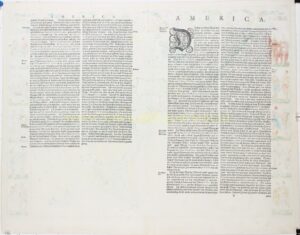
On the reverse of the map…
…there is an extensive German-language geographical and ethnographical description of America as it was imagined in Europe during the first half of the seventeenth century. The text combines factual knowledge from voyages of exploration with classical scholarship, missionary accounts, colonial propaganda and occasionally still clearly legendary elements. It thus offers a remarkable insight into the early modern European worldview.
America is introduced as the “fourth part of the world”, unknown to Antiquity and discovered only at the end of the fifteenth century by Christopher Columbus. According to the author, Columbus was the first to reach the continent in 1492, in the service of the king of Castile. Some scholars would call the region “India”, while others speak of the “New World”, since the continent is said to be almost equal in size to Europe, Asia and Africa combined. The text then explains that the continent takes its name from Amerigo Vespucci, who after Columbus explored and described large parts of the southern continent. Earlier theories that the Romans had already had knowledge of America, or that Seneca had already alluded to its existence in his tragedies, are explicitly rejected.
The author regards America as composed of two great landmasses: America Septentrionalis (North America) and America Meridionalis (South America), connected by a narrow isthmus. The southern boundary is formed by the Strait of Magellan and the Strait of Le Maire. Large parts of the north remain unknown according to the author. Around the continent lie the Atlantic Ocean to the east and the Pacific Ocean to the west; to the south the existence of a Terra Australis Incognita is still suspected.
The text then discusses the various countries and regions of the New World. In North America, Florida, Nicaragua, Yucatán, Nova Francia, Labrador and the semi-legendary Estotiland are mentioned. In South America, Peru, Chile and Brazil are named as the most important territories already conquered by Christian powers.
The text pays particular attention to Cusco and Mexico City, presented as the two great cities of the Americas. Cusco, capital of Peru, is described as a powerful, wealthy and excellently planned city, with straight streets, running water and monumental palaces of marble and stone. The author even claims that few cities in Europe could match its beauty, and that it was inhabited primarily by nobles and princes. Tenochtitlan is likewise presented as a famous and impressive capital of New Spain.
A large part of the text deals with the natural riches of the Americas. Maize is described as the most important food crop: a few kernels are sown in small holes and multiple cobs are harvested per plant. The author also discusses cassava bread, made from a root vegetable closely resembling manioc, as well as sweet potatoes and other root crops. The text further mentions an abundance of sugar, cotton, flax, exotic fruits and precious metals, above all gold.
Notably, the author explicitly states that horses, cattle, donkeys and sheep were originally unknown in the Americas, which is why the indigenous inhabitants were said to have been greatly alarmed when they first saw horses. Rats and mice, too, are said to have arrived with European ships and then spread rapidly.
As with many early modern descriptions, the text also contains numerous wondrous animals and natural phenomena. Mention is made of an animal with a pouch in which it carries its young — unmistakably a marsupial, probably an opossum — and of a strange pig-like creature with a hard skin and cloven hooves. Manatees (sea cows) are described partly as mammals because they suckle their young. “Lions” (probably meaning pumas), “tiger animals” (probably jaguars), wild boar and numerous exotic birds are also mentioned.
The author also describes impressive volcanoes, one of which is said to continuously emit fire and flames. An anecdote recounts how a Dominican friar attempted to investigate whether molten gold truly lay within the volcano, but that his iron chains and kettles melted in the heat.
Finally, the text dwells at length on the monumental roads and infrastructure of the Inca Empire. The great roads between Quito and Cusco are praised as extraordinary works, paved with heavy stones and equipped with walls, watercourses and rest houses (“Tambi“). According to the author, these roads rank among the most impressive constructions in the world, and even kings with their full retinues could lodge in the inns along the way.
The text as a whole reflects the fascination with which seventeenth-century Europeans regarded the Americas: as an immense, wealthy and partly still unknown part of the world, full of powerful cities, exotic peoples, wondrous animals, precious metals and unparalleled natural abundance. At the same time, the text demonstrates how cartography in Blaeu’s day served not merely to record geographical knowledge, but also to convey an intellectual and cultural image of the world.
Literature:
- Philip D. Burden (1996) “The Mapping of North America”, vol. I, map 189.
Price: Euro 3.500,-