

Olinda, Dutch Brazil- Johannes Janssonius, 1651
€475
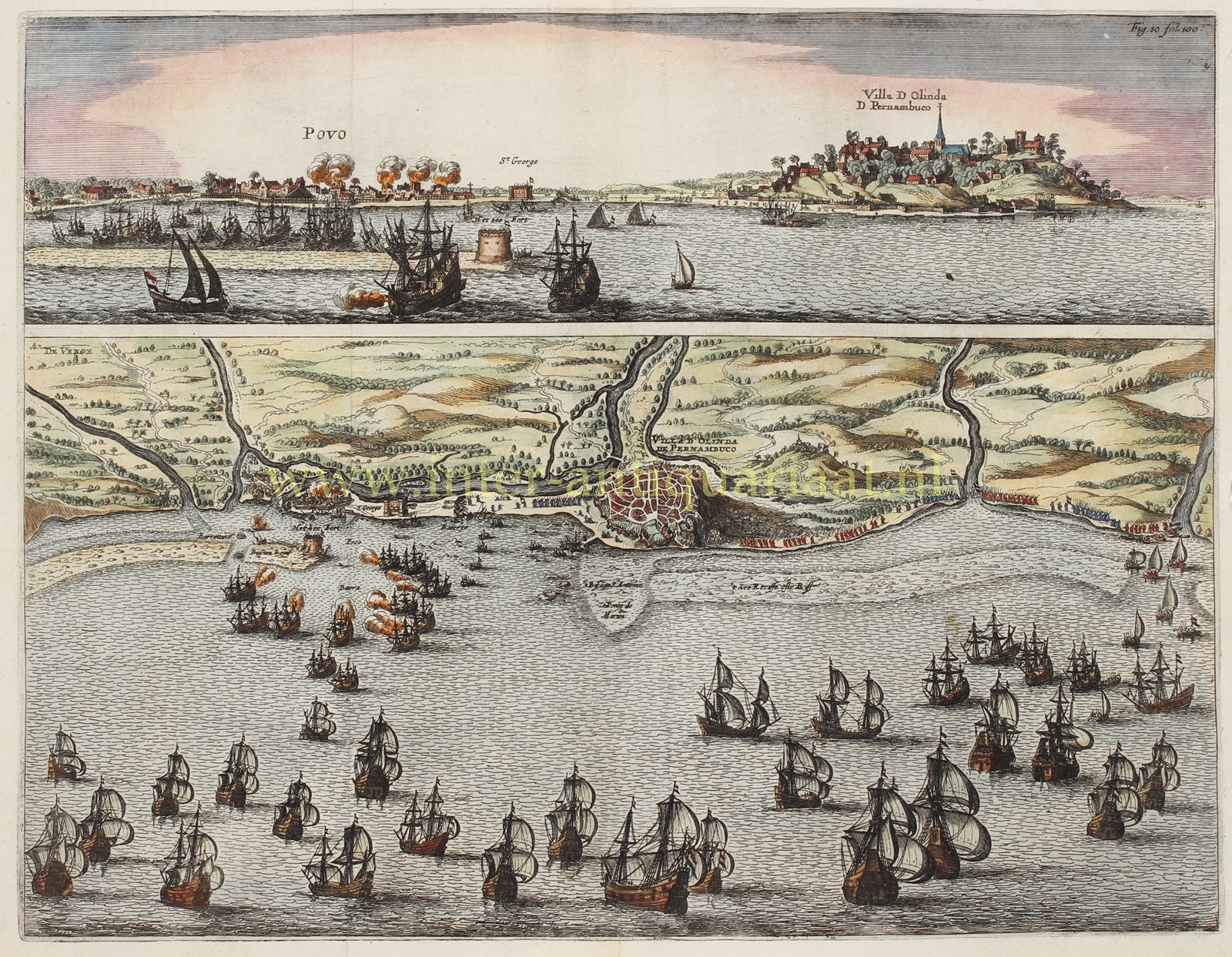
DUTCH CAPTURE OF OLINDA IN BRAZIL UNDER ADMIRAL HENDRICK LONCQ
Etching published by Johannes Janssonius in Amsterdam in 1651 as part of Isaak Commelin’s “Frederick Hendrick van Nassauw Prince van Orangien: zyn leven en bedryf”. Coloured by a later hand. Size (plate mark): 28 × 36.1 cm.
Following the successes of the privateering ships of the Dutch West India Company (WIC) in 1627 and 1628, including the capture of the Spanish silver fleet by Piet Hein in 1628, the WIC had sufficient funds to challenge the colonial power of the dominant Portuguese and Spanish further.
The print depicts the capture of the city of Olinda in Pernambuco, Brazil, by a fleet of the Dutch West India Company under Admiral Hendrick Loncq in February 1630. Above is a view of Olinda from the water, with several buildings in flames. Below, the Dutch fleet is shown lying off Olinda on the Brazilian coast.
Olinda was the capital of the Portuguese colony of Pernambuco. In the seventeenth century, the Kingdom of Portugal was united with Spain during the Iberian Union (1580–1640). Taking advantage of this period of Portuguese weakness, the Dutch occupied the region around Olinda and Recife, thereby gaining access to the Portuguese sugar plantations.
On 16 February 1630, the Dutch captured the city as part of what became Dutch Brazil. Following the conquest, they initially established a provisional government. On 11 March, a High Council and a governor were appointed. The Dutch decided not to establish their capital in Olinda, but in nearby Mauritsstad, in what is now Recife. They subsequently removed valuables from Olinda and set the city on fire on 24 November 1631.
John Maurice, Prince of Nassau-Siegen, was appointed governor of the Dutch possessions in Brazil by the Dutch West India Company in 1637, on the recommendation of Frederick Henry, Prince of Orange. He landed at Recife, the harbour of Pernambuco and the principal Dutch stronghold, in January 1637. Through a series of successful expeditions, he gradually extended the Dutch possessions from Sergipe in the south to São Luís do Maranhão in the north. Following the dissolution of the Iberian Union in 1640, Portugal eventually reasserted its authority over territories lost from the Portuguese Empire, including former Dutch Brazil.
Price: 475,-