

Suriname – Hendrik de Leth after Alexander de Lavaux, c. 1758
€6.250


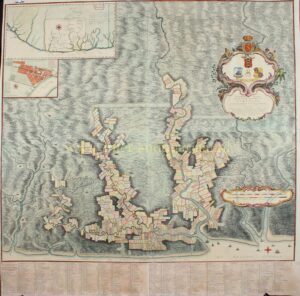


“Algemeene Kaart van de Colonie of Provintie van Suriname met de Rivieren, Districten, Ontdekkingen door Militaire Togten, en de Grootte der gemeeten Plantagien “.[General Map of the Colony or Province of Suriname with the Rivers, Districts, Discoveries by Military Expeditions, and the Size of the Measured Plantations.] Copper engraving in six sheets made around 1758 by Hendrik de Leth after the design by Alexander de Lavaux. Coloured by a later hand. Size approx. 109 × 109 cm.
In 1731 the directors of the Society of Suriname urged the governor to have a map made, in order to obtain a clearer understanding of the location and number of plantations, their extent, and who their owners were. A surveyor was appointed and plantation owners were ordered to map their own properties. However, the plantation holders did not comply and the appointed surveyor proved unsuited to the task, causing the entire plan to threaten to collapse. In 1734, however, Alexander de Lavaux (1703/04–after 1744), a sworn surveyor of the province of Suriname and an ensign in the service of the Society, came forward.
De Lavaux had already collected data for a map for two years and offered his services, which were accepted with great enthusiasm by the directors of the Society. Due to opposition from plantation owners and other setbacks, it took quite some time before De Lavaux could have his map printed, but in 1737 it was finally completed. The map could be provided with an ornamental border depicting Surinamese products, interspersed with the coats of arms of the eleven directors and the secretary of the Society of Suriname, and at the bottom the arms of the Society supported by an Indigenous man and a Black man as shield-bearers.
In 1742 Hendrik de Leth produced a smaller version of the map in two sheets, and around 1758 also an example in four sheets with a larger map image, to which a strip listing plantation owners could be added. That is the version shown here.
It immediately becomes clear how crucial the natural conditions were for the exploitation of the colony: all plantations in the interior were situated along rivers. Overland, through impenetrable rainforest, the plantations were entirely inaccessible. The map focuses particularly on the cultivated area along the Suriname and Commewijne rivers. A total of 436 plantations are indicated, named in the legend and accompanied by information about their size and owners.
In the interior we see burning “runaway slave villages” and other traces of actions against the Maroons in which De Lavaux himself was involved. In order to protect the plantations against these “hostile runaways,” a defensive line was planned around 1750, the so-called “Grooten Oranje Weg” [great orange road), which runs from the Suriname River westward (to the right on the map) towards the Saramacca and eastward towards the Commewijne. Only the western section was constructed in 1750–1751; the eastern section was never realised.
The map contains a large decorative cartouche with the crowned coat of arms of the States General, animals and plants, as well as the arms of Amsterdam, the Dutch West India Company, and Cornelis van Aerssen (governor of Suriname from 1683; his family owned one third of the colony until 1770), and the “SS” monogram of the Society founded by Van Aerssen, all under the motto “Justitia Pietas Fides” [Justice, Piety, Fidelity].
De Lavaux, however, did not receive the recognition for his efforts that had been promised to him, or that he believed he deserved. He wished to seek redress from the directors of the Society in Holland, but encountered difficulties because his return journey to Europe passed, among other places, via the English island of Saint Christopher. His stay there was interpreted as desertion, for which De Lavaux was severely punished, despite all his efforts and his extensive knowledge of Suriname.
Price: Euro 6.250,- (incl. frame)