

Passenger barge Antwerp-Brussels – after Wenceslaus Hollar, 2nd half 17th century
€375
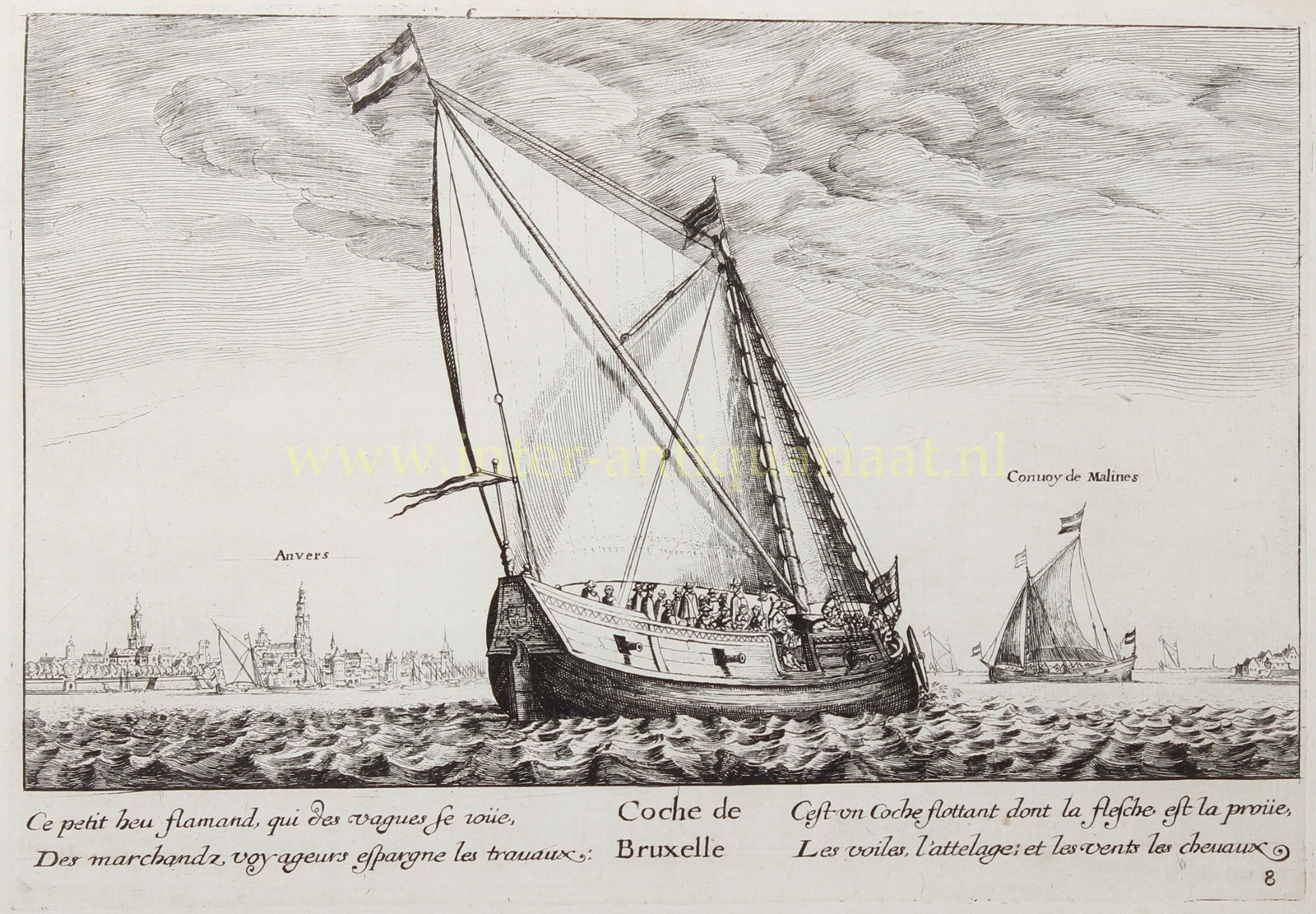
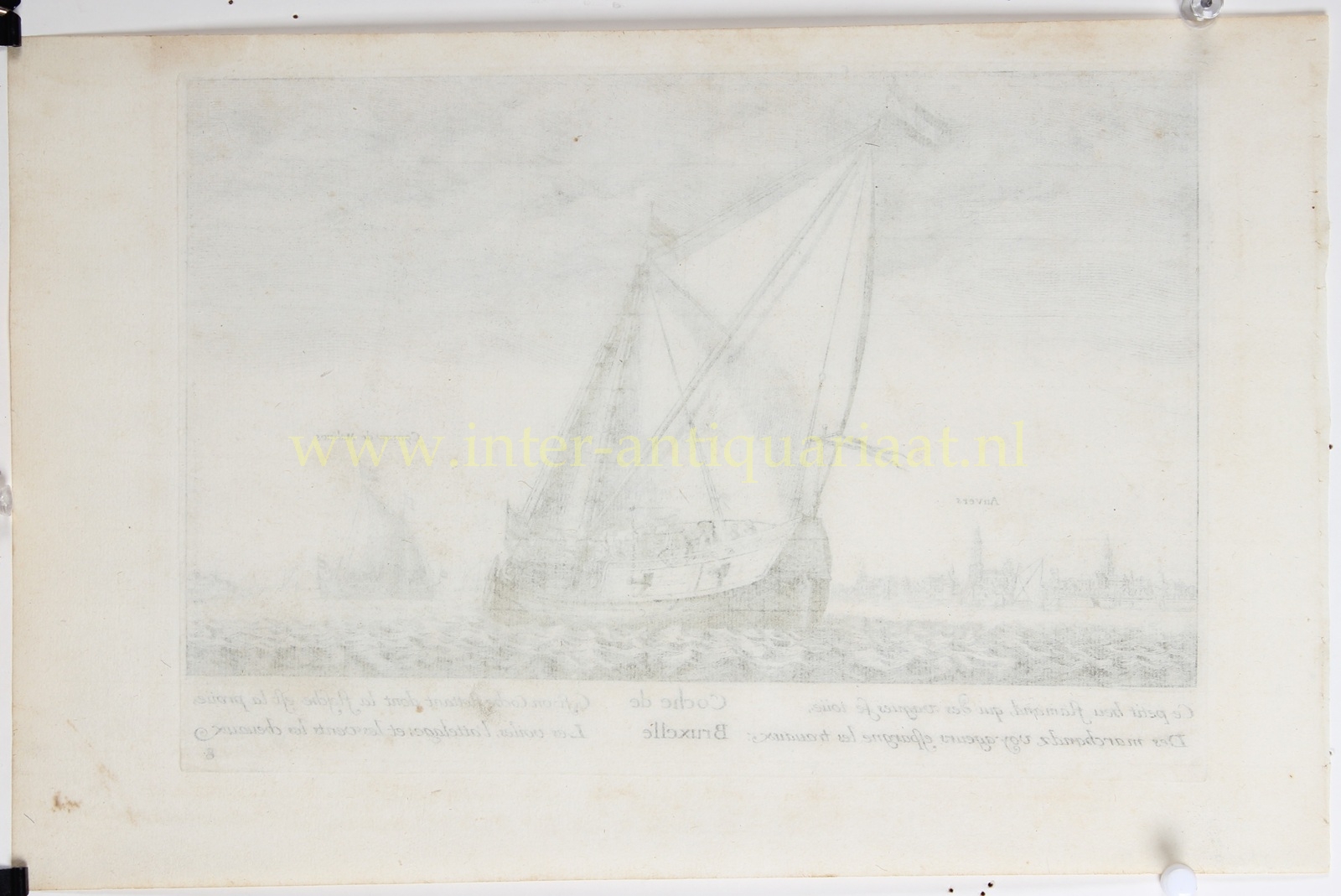

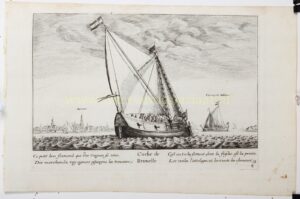
“Coche de Bruxelle”. Etching, published by Louis Boissevin. Seventeenth-century reversed copy after “De Heu van Brussels”, made in 1647 by Wenceslaus Hollar as part of the twelve-part series “Navium Variae Figurae“. Size: plate mark 16.1 × 23.5 cm; paper 19.2 × 30.2 cm.
In comparison with Hollar’s etching, this example has a four-line descriptive text beneath the image:
“Ce petit heu flamand, qui des vagues se joüe,
Des marchandz voyageurs espargne les travaux :
C’est un coche flottant dont la flesche est la proüe,
Les voiles, l’attelage; et les vents les chevaux.”
spares travelling merchants the labours of the journey.
It is a floating coach whose pole is the prow;
the sails are the harness, and the winds the horses.]
At the time this print was made, there was a water connection between Brussels and Antwerp. Travellers who embarked in Brussels on the towboat had to transfer at the Rupel onto the hoy, which carried them onwards to Antwerp.
The vessel carried a square sail, held out by a sprit that was pivoted at the foot of the mast. A hoy was approximately 30 metres long and 4 to 5 metres wide. The ship tapered to a point at the bow, with an upward-sloping bowsprit and foresail; towards the stern the gunwale rose higher, ending in an oval rounded stern and rudder. The vessel was heavily armed and not especially stable. As a result, it capsized on more than one occasion.
In Antwerp, the hoy moored at the Laag Bierhoofd. In the background, the “Convoy de Malines”, the convoy or packet boat of Mechelen, is also shown. Travellers often preferred the slower but more comfortable packet boats to the jolting journey by coach. The French text beneath the image plays wittily on this comparison: the ship is presented as a floating coach, with the prow as the coach pole, the sails as the harness, and the wind supplying the horses.
Wenceslaus Hollar (1607–1677) was a Bohemian artist, trained in Prague, who after several journeys through the German territories and the Netherlands arrived in England in the 1630s. In the following decade, however, he fled the civil wars taking place there and returned to the Low Countries, more specifically to Antwerp.
Hollar’s travels and his stay in the Netherlands left a clear mark on the prints he produced. In 1647, in Antwerp, he published his celebrated Navium Variae Figurae et Formae. This series consisted of twelve prints depicting different Dutch vessel types and is characteristic of Hollar’s great fascination with the sea and shipping. The present image also formed part of that series. Typical of the images in this work is the eye-level viewpoint. As a result, these prints have a low horizon, which in turn allows for a large expanse of sky. As here, town buildings or houses often appear in the background, while Hollar rendered the vessel itself in remarkable detail.
Price: Euro 375,-