

East Indiaman – Johannes van Keulen / Anthonie de Winter, 1680
€2.150
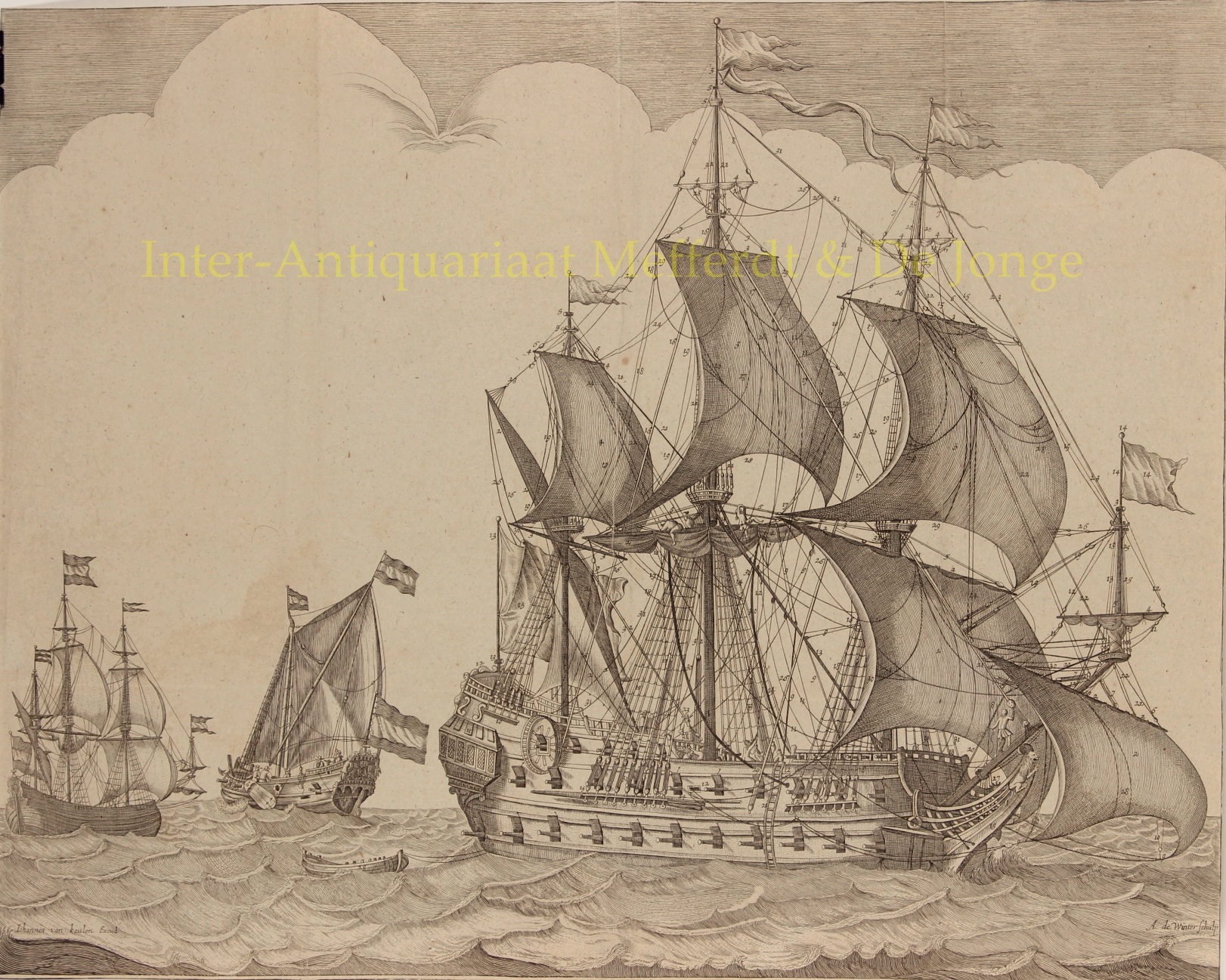
EAST INDIAMAN – A DUTCH RETOURSCHIP UNDER FULL SAIL, C. 1680
East Indiaman. Copper engraving by Anthonie de Winter (1652–1707), published in Amsterdam by Johannes van Keulen I (1654–1715), c. 1680. With the publisher’s address “Johannes van Keulen Excud.” lower left, and signed “A. de Winter sculp.” lower right. Dimensions: 41.5 × 51 cm.
This large and finely engraved ship print shows a Dutch retourschip, or East Indiaman, under full sail. The ship is shown from the port side, with the bow to the right. The transom stern itself is not visible in this side view, but the high stern structure, side gallery, heavy beakhead, closed hull with gunports and extensive three-masted rigging all point to the type of large return ship used in the seventeenth century for long voyages to Asia.
The print is not simply a decorative marine view, but first and foremost a technical and didactic ship print. Small numbers are placed throughout almost the entire rigging. They refer to the different parts of the masts, topmasts, yards, sails, blocks, halyards, sheets, braces, stays, shrouds and other standing and running rigging. The print made visible what an experienced boatswain needed to know: the structure of the ship, the interrelation of the rigging, and the correct position of every rope and fitting.
Two smaller vessels sail in the background: a smaller three-masted ship, probably a fluyt, and an elegant single-masted yacht with a leeboard, possibly a ‘ statenjacht ‘. In the foreground a small rowing boat rides the waves. These smaller vessels reinforce the sense of scale: the great retourschip dominates the image as a technical, maritime and economic object of power.
The print belongs to the nautical world of Johannes van Keulen, the Amsterdam publisher of sea atlases, pilot guides and practical handbooks for navigation and seamanship. It is closely related to Van Keulen’s “De nieuwe Hollandsche scheepsbouw” of 1680, in which the arrangement of “all ships’ ropes and other parts” in a complete ship was explained. Much of this material was later reused in “De Volmaakte Bootsman” [The Perfect Boatswain], an extremely rare practical handbook for boatswains and other seafarers, attributed to Symon van de Moolen. The first edition of De Volmaakte Bootsman probably appeared only around 1698; a later edition was published around 1818 by the widow Hulst van Keulen and again contained a large folding plate with a numbered seventeenth-century three-masted ship and two smaller Dutch vessels. By then, however, the copper plate was already heavily worn, resulting in much weaker later impressions.
The purpose of the book is neatly summarized in the poem addressed to the seaman that precedes the introduction (here in translation)::
“Brave men who shall sail
The waves of Neptune,
If you wish to know, exactly and surely,
What a seaman needs,
How ships must be built,
Keeping proper measure in all things,
Of the parts both great and small
That are needed for this work,
Masts, topmasts, yards and sails,
So as not to err in rigging,
How the standing and running rigging
Must be cut to its proper measure,
Then fitted to the bulwark,
And where all the little ropes must run,
See all these things together
Set out here in proper order.
What a boatswain ought to know,
Nothing of it is forgotten here.
Therefore, men of courage and judgment,
Should you one day seek
To command as captain,
First study these pages well.
Then turn to higher matters,
And you shall attain honour and fame.”
That ambition is expressed in this engraving. It presents the East Indiaman not only as an impressive ship of Dutch seafaring, but also as an ordered system of timber, canvas and rope: a floating machine in which every line, yard and mast had its fixed place and function. The retourschip was the principal transport vessel of the Dutch East India Company; ships of this type connected the Dutch Republic with Asia and brought back spices, porcelain, tea, silk and textiles to Europe.
Price: Euro 2.150,- (incl. frame)